

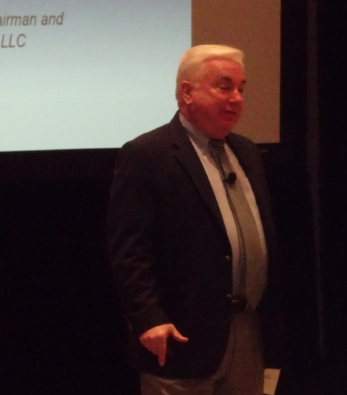
Dennis Dollar
SAN DIEGO–Are NCUA’s field of membership rules necessary or outmoded? Clearly the latter, says the agency’s former chairman—but that doesn’t mean they will be changing any time soon.
Dennis Dollar told the NASCUS Summit here that while the concept of FOM restrictions at credit unions is as antiquated as eye shades, the political reality is they will remain as long as congressmen need some meat to throw to the banking industry’s lobbyists.
“We all know tax exemption is based on structure, not FOM, but too many in Congress equate the two or use it as a trade off with bankers,” said Dollar. “So FOM is a reality we are going to be dealing with for the foreseeable future.”
Dollar, who now leads his own Birmingham, Ala.-based consulting firm, called recent FOM changes proposed by NCUA a good first step. He said his company, which consults on membership changes with credit unions, has done more than 400 FOM projects over the past 12 years.
While Dollar praised the new FOM rules enacted by NCUA, he said they still don’t go as far as the 2003 rules he helped put in place while he was chairman.
Dollar said his firm has averaged 11 charter conversions per year since 2010.
“Everyone, without exception, has been field of membership related, most because they needed to expand, but others because they had to make a merger work,” he said.
States Progressive
Over that same time the average has been that eight of the 11 conversions have been from federal charter to state, as “states have been more progressive with their FOMs. Since the new federal rule has been passed we have been getting calls about going through a conversion to state, and a few federals have said we’re going to wait a few years to see how this works.”
He told the NASCUS meeting, which included state regulators from across the country, that many should pay attention to the new NCUA rules due to parity provisions in their own statutes, and added that some may even choose to go beyond the federal rules in their own states.
Dollar observed that in many ways issues around FOM should never be a “deal killer,” saying that even without formal rules most credit unions would operate with their own voluntary restrictions.
“I would argue that community banks have a de facto FOM in their market area,” he said. “I would maintain that even if FOM were completely removed in credit unions, they would say here is where we are going to focus.’ FOM is always going to matter as long as growth matters. It will no longer matter when growth no longer matters.”
Looking at what Dollar called the “essentiality” of growth in credit unions, he cited year-end 2016 data showing what many know: profitability grows as asset size grows.
“The larger credit unions, if you look at them, as a general rule have more expanded FOMs than do the smaller CUs. As a result, their growth is more dramatic.”
Everything traces back to field of membership, Dollar told the meeting.
Rule Breakdown
In breaking down NCUA’s proposed new FOM rule, Dollar noted:
- Delineation of community charter has been expanded
- Population caps have been retained for community charters
- The concentration of facilities test for underserved area expansion remains
- The definition of “Service Facility” for reasonable proximity purposes for SEG expansion remains
- There is now inclusion of SEG contractors in common bond
- There is now inclusion of office/industrial park in multiple common bond
- There is a streamlined determination of feasibility of groups larger than 3,000
- The rule adds honorably discharged veterans to the other person eligible for membership definition
- The new rule adds employees or contractors with a strong dependency relationship to the definition of a TIP
Dollar pointed to what he called another outdated requirement, the 25-mile radius of a branch as a condition of taking in a SEG.
“Do we really want credit unions to go to that expense when we are in an era where access can be granted using other electronic vehicles?” he asked. “Why should we as a regulator care whether they serve an area with a branch or with electronic means? If you want to look at one area where the states could really advance the definition of member service, it would be in that arena. If you don’t serve your embers well, they are leaving. The member is a much better regulator than you or NCUA. They will vote with their feet.”
For federal community charters, other changes under the new NCUA plan include:
- Single political jurisdiction is a presumed community, and documentation minimized
- A CSA is now categorized as a community
- Congressional district option was not included in the final rule
- MSA or portion thereof is a presumed community, even if the entire MSA or CSA is greater than 2.5 million, and documentation minimized
- The 2.5 million population cap remains
“There is a shift at NCUA, and I think it’s a positive and it’s the way many of you have operated for years,” Dollar said. “We need to go from spending all your time documenting what is the community and instead to answering am I safe and sound, and do I have a business plan to serve that community.”
Dollar said an increasing number of CUs are expanding by using associational common bonds.
Among the dozen association types allowed under NCUA’s new rules: alumni associations, religious organizations, electric cooperatives, homeowners associations, labor unions, scouting groups, PTAs, athletic booster clubs, fraternal organizations/civic groups, and organizations having a mission focused on preserving or further a culture.