

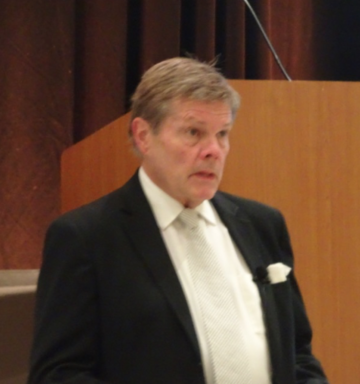
Dwight Johnston
SAN DIEGO–What’s the forecast for the economy and interest rates? It all comes down to the “T-factor,” according to one economist: the T being President Donald Trump.
Stressing that he was not speaking to political issues, Dwight Johnston, chief economist with the California and Nevada leagues, said that when it comes to the economy, many people have called it a “Trump World.”
But the reality, he said, is that:
- Accomplishments to date by the Administration that impact the economy positively or negatively: 0
- Stock market has been surprisingly patient and could remain so
- Bond traders are still betting against Trump
- Congress is where the real power lies
“Nothing has really changed, but Trump World remains full of promise and full of risk,” said Johnston in remarks to NASCUS’ Summit here.
Johnston noted that consumer confidence and retail sales remain at extraordinary levels, reflecting a good consumer mood. That includes strong, ongoing auto sales levels.
“The good news for credit unions going forward is that credit unions have built up a big book of business over the past several years in auto loans,” said Johnston. “What that does over a period of years is, as loans are paid down there are trade-ins and loan balances go up. And I think it’s going to stay that way for a while.”
The reason he expects retail sales and economic numbers to remain solid is the trendline in payroll growth, including July non-farm payrolls adding 209,000 jobs after 231,000 jobs in June. The average monthly gain for 2017 has been 195,000 jobs per month. Wages, he said, have held steady at 2.5% growth, with healthcare and business/professional sectors leading the way.
“And remember we have an all-time record of job openings in the U.S.,” reminded Johnston. “Continuing gains of 200,000-plus is unlikely, but the surprises could keep going.”
A big problem in California, said Johnston, has been an inability to find not just workers, but trainable workers for open positions. Employers have raised wages in many markets but are continuing to confront problems in finding workers in the state.
“Lots of jobs are going unfilled,” he said, adding that a related problem is there are workers available in many markets in the state, but their skills don’t transfer to a new area, where often the cost of living is also higher.
Johnston said the housing starts numbers remain robust, but “especially in California, they aren’t building nearly enough housing units to meet demand.” Average cost to get started to build a home in California, he said, is $150,000 per house, which is why builders build the most expensive homes they can.
What’s been really interesting about this housing market is the consistency of it, said Johnson. There has been high demand, low supply in most states, with homes now on the market for an average 4.2 months vs. the standard 6.5, with bidding wars in many markets not typically considered hot.
“Affordability is a growing issue in some areas, and mortgage rates are the key,” said Johnston.
Johnston, who achieved some fame for predicting the prior housing crash and even putting his money where his mouth was and selling his own home, said he is not seeing warning signs in the current market. “It’s not a bubble, but some bubble-like behavior is getting worrisome,” he said.
Where he finds reassurance is that many of the bad lending practices in the lead up of the financial crisis are no longer in place. Specifically, he pointed to the private securities market and Wall Street, whose practices contributed greatly to the financial crash—companies he said are no longer in the market for the most part.
Overall, said Johnston, housing looks solid in the long term, with a big rental pool remaining in place.
The Direction of Rates
“Every year, there’s a reason” rates don’t increase, despite predictions, said Johnston. “And this year the reason is uncertainty over the direction of Trump Administration. The Fed now saying it’s optimistic on the economy, but less certain on inflation.”
The Fed, said Johnston, is still indicating there will be one more rate increase this year and two to three in 2018; the range would be 1.75% to 2.25%. He added he expects the Fed to begin balance sheet runoff “relatively soon.”
“Remember, the Fed is not tightening in the usual sense, but ‘normalizing,’” said Johnston.
By end of 2018, Johnston sees rates around 2.5%.
What About a Tax Cut?
A tax cut, he said, will provide an economic boost, but if it’s not tax reform or substantive change, longer-term rates may start to taper off and even approach a recession.
Signs of Recession?
“The next recession is not if, but when,” said Johnston.
To that end, looking for early warning signs of a recession:
What NOT to Watch:
- GDP. “It’s backward looking and worst number in the world to watch,” said Johnston
- Consumer confidence
- Stock market
- The absolute or nominal level of yields. “It’s been artificially pressed down by the Fed for so long it’s kind of lost any meaning”
What TO Watch:
- Weekly jobless claims go over 300,000
- Nonfarm payrolls contract below 100,000 for three consecutive months
- Auto sales fall below 15 million
- Existing and new home inventories rise as sales stall
“The earliest and only signal with a perfect record: an inverted yield curve, in which shorter term rates are higher than longer term rates. That typically happens with the Fed stays too tight for too long, but can also be due to bursting of bubbles, said Johnston. He also pointed out that a flattening but rising yield curve can also be an early sign, but not always.
“I don’t see a recession anytime soon. The economy will not turn on a dime, and the stock market is not the economy,” said Johnston.
The Fed, he said, remains a “slave” to the markets, and its decisions will be market-risk based.
“The biggest risks to the economy are the ones we can’t see coming,” said Johnston. “The best approach for 2017-18 is to be optimistic, but cautious.”