

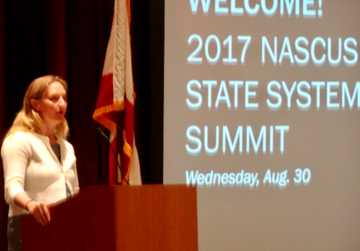
Allyson Baker
SAN DIEGO–What’s going on at the CFPB, and what lies ahead?
The agency has been at the center of countless rumors and even misinformation related to everything from the future of its embattled director, Richard Cordray (see related item in CUToday.info) to the future of the agency itself and whether companies really need to fear it as they once did?
Seeking to offer some answers to those questions, an attorney who was with the CFPB at the time it was founded and who now is in private practice sought to offer credit unions some direction.
Speaking to the NASCUS Summit 2017 here, Allyson Baker, a partner with Venable, LLP in Washington, shared her thoughts with regulators and credit unions on a variety of CFPB-related issues, including:
Future of Director Richard Cordray
Cordray has led the CFPB since July of 2013, with a term to run through July 2018. But there is significant speculation that Cordray will return to Ohio to seek the Democratic nomination for governor. Fueling speculation is that Cordray is scheduled to speak to an AFL-CIO picnic in Ohio on Labor Day. Rep. Jeb Hensarling (R-TX), chair of the Financial Services Committee, has sent a letter demanding to know the director’s intentions, as CUToday.info reports in Fresh Today today.
Saying she doesn’t make political predictions or have insider info on Cordray’s plans, Baker did say, “From a regulatory and law enforcement perspective it probably does matter if Director Cordray stays or goes. If he does leave, there will be a lot of conversation about who would replace him, and lots of names are being thrown around.”
Cordray’s plans also impact the rulemakings the agency pushes forward before he leaves, she noted.
The Short-Term, Small-Dollar Lending Rule
More informally known as the payday lender rule, Baker said she has heard some speculation that the agency’s proposed short-term, small-dollar lending rule “might get slimmed down and might be much more discreet in the types of products and services it is designed to regulate, precisely because Cordray might be leaving and he wants to get this rule out. This received the largest number of comments in the history of the agency and they have really tried to go through them and manage a lot of different equities.”
Arbitration Rule
Finalized in July and scheduled to take effect in March of 2018, the much-debated proposal to ban arbitration clauses in financial contracts is “the most important action the Bureau has taken in six years,” in Baker’s opinion. “It not only affects companies that are obvious providers of financial contracts, but companies that are in that world wittingly or not, such as Google Wallet.”
Baker said the payday rule is seen by many as Cordray’s top priority.
PHH Case
The PHH case is the first in which the constitutionality of the CFPB’s management structure has been significantly challenged. Following a fine assessed by Cordray, the D.C. Circuit court ruled 2-1 that it’s unconstitutional to have an agency with a single director who can’t be removed for any other reason than “for cause.” The court called for that part of the Dodd-Frank law that created the CFPB to be rewritten, but did say it doesn’t negate what the CFPB has done to that point. The ruling is now being appealed.
Relevance of CFPB
Baker said the reality is that an agency can’t catch every actor in a space who is bad or potentially bad. “So, you send a message that is loud and clear enough to be heard by those actors. There is a perception that if the strength of your agency is being challenged, it changes the way parties interact with you. And that is happening with the CFPB, where some see a break in the strength of the agency and they want to leverage that.”
Baker added she sees a “sea change in last 18 months where all of a sudden being sued by the CFPB doesn’t have the same sting. There is a perception that there is a difference in the force of the enforcement office,” said Baker, emphasizing it’s a perception, not a reality in her view.
Future of CFPB
Baker said that after the election of Donald Trump as president, many forecast that the CFPB would disappear. “When was the last time you saw a federal regulatory agency disappear?” asked Baker wryly. “Instead, I think new leadership will put in new guardrails and focus.”
Baker added that the perception of future diminished authority of the CFPB, many state attorneys general have now jumped into the fray of consumer protection.
“The enforcement activity at federal level is still there and states have also come in and it’s created a curious dynamic,” said Baker.
Baker called the CFPB a “pretty predictable agency. You pretty much know it’s priorities: Payday lending rule, arbitration rule, student loan market, cleaning up residual mortgage issues, and going after debt collection. I would say those are the top priorities of the CFPB. When you start talking about states, those priorities can be different, so the ability to predict and anticipate regulatory activity can be a challenge.”
Inside the CFPB
Reminding that she was with the CFPB at the time of its creation, Baker said all the uncertainty has unfortunately had fallout inside the Bureau. “There are a lot of talented people there,” Baker said. “You start to hear about people leaving, checking out, you start to hear about morale issues. I think they are real and they are unfortunate…When you have these morale issues you have uncertainty, and that has changed I think not only the impact from the perspective of the consumer financial services sector, but changed the way people at CFPB think of themselves and the work they do.”