

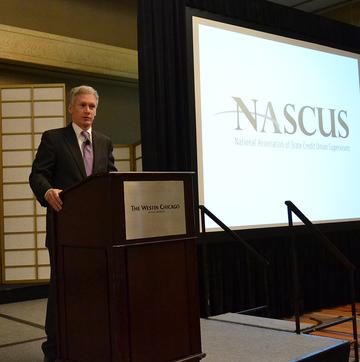
Mark McWatters
CHICAGO—An advance notice of proposed rulemaking (ANPR) on supplemental capital could be coming in January, NCUA Board Member Mark McWatters said Wednesday.
McWatters made the announcement during the 2016 NASCUS State System Summit here during remarks that covered a wide range of topics, including the agency’s budget, the overhead transfer rate (OTR), and the importance of credit unions sharing their input on all key issues.
McWatters told attendees that he has been a proponent of supplemental capital for some time.
“We will have a briefing in October on supplemental capital and go into some detail on the issues facing the agency with this supplemental capital rule,” he said. “Then the goal is to have an ANPR in January in advance of the proposed rulemaking, and then put the rule out for comment. Now the agency is saying we may make (supplemental capital) happen. So if you are interested in this rule, it’s time to sharpen your pencils and respond when the ANPR comes out.”
McWatters also suggested that a final field of membership rule could come up for a board vote by the end of the year. He said the final rule will represent FOM progress for credit unions, and “won’t be perfect” due to Congressional restraints, but will help credit unions grow.
Later this month the NCUA board will hold a briefing on the agency’s budget, and McWatters offered a preview of where his focus might be.
“When we look at the NCUA budget we can look to save a couple bucks here and there by not ordering pencils or hiring six or seven fewer people. But those are not really material savings numbers. The real material savings have to do with the exam process,” said McWatters, who noted that the agency has a team closely examining this aspect of the budget, including how savings are achieved from an extended exam cycle.
OTR will be part of the budget discussion and McWatters emphasized how credit unions need to share their input. McWatters said he has always been a proponent for greater transparency at the agency and credited former Chairman Debbie Matz for placing a great deal of budget and OTR information on NCUA’s website.
“But how many clicks are we getting on this information? Shockingly few,” said McWatters.
McWatters said that after the agency put the OTR rule out for comment that it has received only 40 letters, which he compared to the thousands that flooded in on FOM and MBL. But McWatters said that the comments on OTR are all well thought out, unlike many of the FOM and MBL comments that were simply form letters.
“We are going through these letters now and will come up with an OTR approach that is different, not so tedious, and not so hyper technical,” he said. “The goal is to come up with something maybe outside of the box, more streamlined, easier and more intuitive.”