

WASHINGTON–In response to a proposal first reported by CUToday.info by the Independent Community Bankers of America (ICAB) calling for credit unions that buy banks to pay an “exit fee” for what is said is the lost tax revenue, NAFCU has sent a letter to the Treasury it said seeks to “dispel falsehoods and inaccuracies” it said are being spread by the bank group.
“Bank and credit union mergers are voluntary, market-based transactions that require a community bank’s board of directors to vote to sell to a credit union. To be clear, the bank makes the ultimate decision to sell to, and merge with, a credit union. These transactions are a far cry from ‘hostile takeovers’,” NAFCFU said in a letter to Treasury Secretary Janet Yellen. “ICBA’s complaints about the ‘weaponization’ of the credit union tax exemption are nothing more than a Trojan horse, distracting from their real aim—eliminating competition for community banks. These efforts should be ignored as credit unions continue to provide exceptional products and services for their members and communities, while community banks continue to cut corners and put the interests of consumers and their communities second after shareholder profits. Credit unions always put their members first and have continuously shown the positive impacts they have on their communities.”
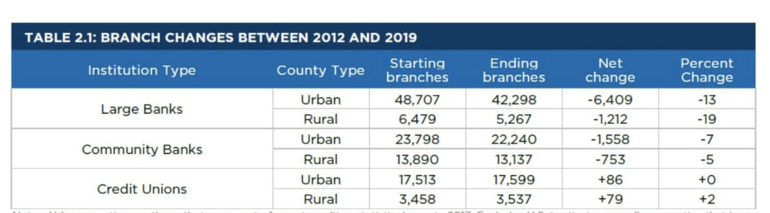
In its letter, NAFCU responded to one allegation made by the ICBA that the CU purchases of banks are reducing branch services in communities by citing a 2019 study from the Federal Reserve detailing the “dramatic decline” in bank branches in rural areas, while credit unions have added branches in both rural and urban areas, “demonstrating credit unions’ commitment to their members and serving underserved communities,” NAFCU wrote.
The letter included the table shown below to show the increase in credit union branches.
“The effect of bank branch closings in rural and urban communities on consumers has been compounded by statutory limitations which prevent credit unions from effectively filling the void. In 1998, as part of the Credit Union Membership Access Act (CUMAA), Congress provided federal credit unions with the ability to add underserved areas to their fields of membership,” NAFCU CEO Dan Berger wrote in the letter. “However, subsequent legal challenges by the banking industry over the reading of the statute led the National Credit Union Administration (NCUA) to limit this authority to only multiple common bond credit unions in 2006. To preserve physical branches and access to affordable financial services, NAFCU has supported legislative amendments to the Federal Credit Union Act (FCU Act) that would permit all federal credit unions to add underserved areas to their field of membership. Specifically, NAFCU supports the discussion draft of the ‘Expanding Financial Access for Underserved Communities Act’.”
Berger wrote that the “biggest difference” between banks and CUs is the latter put their members first, and are also more committed to diversity and inclusion, with the letter stating 51% of CU CEOs are female compared to 5% at banks.

Dan Berger
‘Truth’ About Mergers & Acquisitions
Berger additionally stated any acquisitions of banks by CUs is “transparent” and supervised by both NCUA and the FDIC.
“Credit unions are also subject to other statutory limitations, including a prohibition on holding capital other than as retained earnings, so a merged-bank’s stock must be divested,” said Berger. “In the current phase of financial institution consolidation, there are instances where banks, which answer to shareholders, are unable to remain economically viable. To avoid a bank failure, a merger with a credit union can ensure access to financial services is maintained for an established consumer base. If a merger with a credit union can avoid a banking desert, or continue to serve an underserved market, then consumers benefit and the choice is clear—credit unions are better able to serve their communities because of their statutory mission and commitment to members.”
A ‘Ruse’
Berger dubbed the ICBA’s proposal to establish an excise or “exit” tax on the credit unions that acquire banks a “ruse” to distract from the “fact that countless banks continue to face large fines for their anti-consumer behaviors.” The fines, added Berger, are tax deductible for the banks.
Moreover, wrote Berger, while the ICBA said its proposed exit tax is designed to capture “the future value of the tax revenue that is lost once the business activity of the acquired bank becomes tax exempt.” Berger said the bank group failed to disclose credit unions already pay local property taxes and payroll taxes when a former bank merges with a credit union.
“The proposed additional legislative actions outlined in ICBA’s letter would only serve to dilute the economic benefits of the credit union tax exemption and harm consumers as a result,” Berger stated. “As not-for-profit, member-owned financial institutions, each dollar that credit unions earn is returned to their members in the form of lower rates, higher dividends, and other benefits. As credit unions already operate on tight margins, any additional expenses would only reduce the types of products and services credit unions can offer their members to help them achieve financial security and prosperity.
“In fact, although ICBA refuses to acknowledge the benefits of the credit union tax exemption, the numbers speak for themselves,” the letter continued. “According to NAFCU’s own independent study, the estimated benefit credit unions provide the economy totals roughly $16 billion a year, or $159 billion over 10 years. The study shows that altering the tax status of credit unions would have a devastating impact not only on credit union members across the country, but also on consumers and small businesses in general. More specifically, removing the credit union tax exemption would cost the federal government $38 billion in lost income tax revenue over the next 10 years. Simply put, the credit union tax exemption helps grow the greater economy, create jobs, and deliver a net surplus in federal tax revenues.”