

SEATTLE–Tackling the thorny questions around generating more loans and especially more yield, a panel here offered their insights and thoughts on what credit unions can do.
Speaking to the topic “State of Member Lending: How to Step Away from Traditional Lending,” the four panelists at NAFCU’s annual meeting here responded to audience queries around getting into new markets, and also spoke to some potentially increased risks being seen in the used car market.
Acting as moderator was Brian Timson, National VP with Allied Solutions. Participating as panelists were Tim Kelly, president of AFG; Jerry Kroshus, president of Auto Approve, and Kent Staudmyer, VP-sales with NFP.
Here’s a look at some of what was discussed:
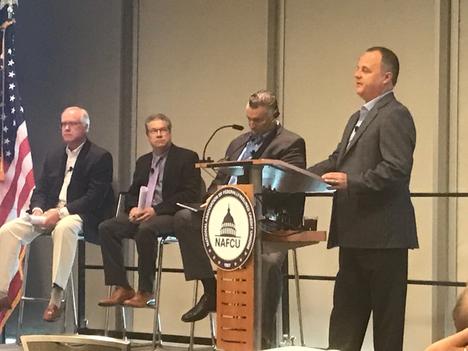
Panel at NAFCU annual meeting.
Timson: I spend a great deal of time in my role at Allied in how to overcome the negative equity challenge that seems to be increasing by the day, how to reach more membership, underwriting–which is a challenge when many focus on the prime and superprime space and that is an issue in getting yield–Millennials, and finding good, cost-effective ways to identify new loans.
Over the past few years we’ve seen tremendous growth in lending at credit unions. With all the other players entering the space, what should CUs be looking at to retain the growth trends and keep growing?
Kroshus: We do auto refi’s, and on average save people about $100 a month.
Kelly: We offer fully insured balloon program and leasing. We take 100% of the residual value risk. We would encourage you not to be afraid of new lending ideas. Residual-based financing is now used in about 30% of all new cars, including a walkaway balloon loan program, which is lease-like.
Timson: With consumers getting younger, how do your products help institutions adapt to that market?
Kelly: With our program, the data we see shows about one-third of Millennials use residual-based financing for their purchases, and that makes sense. Millennials don’t own things; they rent them. The other demographic is the over-70 folks who are in the same boat. They have fixed incomes and need lower payments.
Staudmyer: At NFP, we offer a purchase loan at up to 100% LTV, with no other obstacles to getting into home ownership.
Kroshus: Oddly enough, we sometimes see Millennials wanting to jump term. They will go with the higher rate to get the lower payment.
Timson: What we’re seeing is this movement toward extending term, and unfortunately all we’re doing is creating this huge negative equity situation.
Kelly: Negative (vehicle) equity is at an all-time high at an average $5,000. These are your members. They may be at 120%, 130% LTV and outside your underwriting guidelines. We can help get people out of that negative equity cycle.
Even a three-year-old vehicle doesn’t have the technology many younger consumers want. Cars aren’t going to do anything but get more and more sophisticated. You have to shorten the cycle somehow, or these guys are just going to keep trading out and trading out. A new Suburban today is $75,000. The average car is $35,000.
Timson: How can your lending space help us ID members and find higher-yielding loans?
Kroshus: We spend a lot of money on lead generation. We have referral programs. If credit unions want to go into a new untapped market, often we are a source for that.
Staudmyer: From a home equity perspective, many CUs stop lending at 80% LTV. With our program we will go to 100% LTV, and that brings in organic new members. Not all people are going to use that, but once you advertise it, it draws in folks to your programs.
Kelly: With yield, traditionally you are all A/B lenders, and a few may go to high C’s. The only thing that stinks about that FICO band is these guys are rate-shoppers and it’s a race to the bottom. With residual-based financing, the yield is higher, because the average balance is higher every period. Almost 75% of those in residual-based financing are A/B borrowers, so you can get more yield out of them.
Kroshus: We’ve seen a shift in our credit union network where they want us to go to 580-700 because they recognize that yield is higher.
Timson: That raises issue of risk-management capabilities. It’s so important. You are going to have a lot more delinquency and loss and you have to be prepared. The largest indirect lenders I’ve met in the country lately have been pulling way back. If you’re competing with Chase it can be a volume game, and it seems there are a lot better ROIs through other models.
Audience member: What is the difference between a traditional lease and your residual-based balloon?
Kelly: The primary difference is the title. In a one-way balloon loan, the title is in the member’s name. In a lease, the program manager owns the asset. There are other subtle differences, such as around sales taxes and around fees for being over mileage limits or early termination.
Timson: Why don’t more credit unions offer leasing?
Audience member: Our concern is about risk.
Kelly: There is a higher charge-off value in case of a default. But at the same time, the yield is higher. We don’t see delinquencies any higher than your normal delinquencies.
Timson: There is still a lot of hesitation in adoption of these new avenues of diversification. Why? How do you convey the risk vs. reward?
Kelly: Often, it’s not hesitation, it’s non-adoption. Credit unions are conservative in nature and there’s no other way to describe. A lot of your credit unions have capital over 10%. Some of these loan products are different and represent risk.
Staudmyer: From a home equity perspective, back in 2008-09 a lot of companies didn’t honor their commitments, and it left a lot of shock. So, you have to do your due-diligence. How long has the company been doing this? Have they been through a cycle of recession and are they still around?