

WASHINGTON–With credit unions and retailers simultaneously hiking the Hill this week in Washington to stake out opposite sides on the interchange bill before Congress, a panel here discussed what the proposed changes in the bill would mean and what CUs should be telling their representatives.
At issue is the interchange bill introduced by Sens. Dick Durbin (D-IL) and Roger Marshall (R-KS). The bill would allow merchants to route payments through an unaffiliated network.
Participating on the panel were Jeff Tassey, chairman of the Electronic Payments Coalition; Meredith Ritchie, SVP/general counsel and chief ethics and government affairs officer with Alliant Credit Union, and Amanda Slater, SVP and head of U.S. federal affairs with Mastercard.
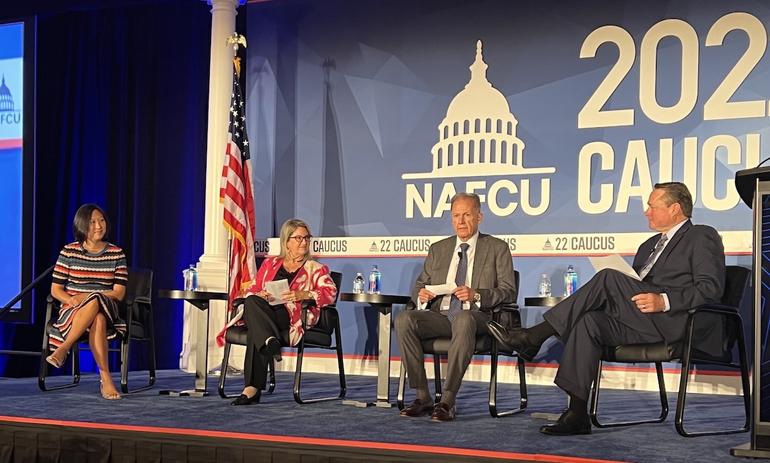
NAFCU President and CEO Dan Berger moderated the discussion. Here’s a look at some of what was discussed:
Berger: What is Mastercard hearing from financial institutions on the interchange bill?
Slater: We are hearing a united front from financial institutions, which are really helping to educate on what the impact will be. From an advocacy standpoint, we’ve seen a quick deployment of resources, which has prevented any co-sponsors from signing on so far. But we’re not taking anything for granted. Sixty-seven senators were not here the last time the Durbin Amendment was passed, so we are educating them. We are educating financial institutions on how the routing would work. We’ve seen this narrative before on how it will help consumers and hold down prices. But we have data now (after the first Durbin bill). We saw costs go up on access to free checking and on minimum balances. The data show the exemption (for smaller institutions) is no working. That resonates with representatives.
Ritchie: We know the original (Durbin interchange bill) didn’t work well and we are fearful of the extension of it. I think each time we see a piece of legislation like this it is a possible erosion of revenue. At Alliant we don’t talk too much about revenue as we do about give-back to members. And I think that’s at the core. In order for us to continue to give our members great rates, this piece is going to be an erosion of that. I think that is at the crux of what we are seeing and fearful of. The other main point I would make is confusion to consumers. We are always looking to clarify communications to consumers.
Berger: This bill has an exemption for FIs under $100 billion. Why won’t that work?
Massey: There are a lot of reasons. This hasn’t worked in the past. This is just a fairly blatant attempt to try to split our coalition. Exemptions don’t work because you can’t take large chunks of profit out of 70% 80% of the market and not expect those costs to go somewhere. Whether you like big banks or not, they enable the construction of the global system, which is very expensive. This is one time when it works in favor of all institutions to have these large institutions covering so much. …You cannot exempt one side of a two-sided market without having secondary effect.
Berger: What would be impact of losing that interchange?
Ritchie: We have done and many credit unions have done many things in the past to diminish revenue or income, such as getting rid of overdraft fees. This is just one more. What that number would be is unknown right now. But whether it’s $100,000 or $1 million, it’s going to affect the balance sheet and lead to something we can’t do anymore. Typically, that would translate into loan rates or savings rates.
Berger: What have you seen with fraud after the Durbin Amendment passed?
Slater: We saw fraud losses rise to 12.4 (basis points) in 2019 from 7.8 when the Durbin amendment passed. Just last week the retailers said if you enable multiple networks your transactions will be more secure. Instead, what the legislation does is create a race to the bottom where retailers are only looking at costs, versus any payments security or cybersecurity value. I think that gets lost in the debate around the Durbin/Marshall bill.
Berger: What are the retailers saying? What are their lobbying points, and what can people in this room do to counter that message?
Massey: They have good grassroots. They are numerous. What the retailers do is they hijack whatever headline is out there. Most recently inflation was one area they used. They sent a note to the Hill that the U.S. has the highest rates of credit card fraud in the world, and they associated the networks with China’s Union Pay. All of these are non sequiturs, but they are hot buttons. You want to get out of these as quickly as possible. There are a lot of reasons we have the highest fraud--we have the largest developed market. The retailers have to do their part to secure the system. And consumers aren’t liable for fraud. I would get as quickly as possible to what fraud means to you.
The Very Best in CU Reporting. For You. For Free. Or Your Money Back.
Don’t forget to check your Spam/Junk email folder if you haven’t been receiving your free, popular and daily CUToday.info news headlines.
And if you haven’t yet signed up for the new email solution on which CUToday.info has partnered with ResponseGenius, you can do so here. Signing up requires less than one minute of your time.
CUToday.info has received very positive response from readers following the move to an improved provider of the daily headlines, but many also noted they did need to go to their Spam/Junk folder and mark it as safe.
The new email solution has not only improved every reader’s delivery experience, but it also features a fresh, new format that is easy to read, especially on mobile devices.
Please note and/or make your IT department or email administrator aware the emails will be coming from the domains CUTodayinfo.com and CUTodayinfoReply.com.