

WASHINGTON–NCUA Chairman Todd Harper told NAFCU’s Congressional Caucus credit unions must play a role in helping Americans suffering as a result of the COVID-19 pandemic, while again calling for third-party oversight authority and requesting input on how the agency can best oversee emerging technologies.
Before beginning his remarks, Harper wryly observed, “Let me start by noting that 2020 was one of the most challenging years for the U.S. economy in its history. We used to say that hindsight is 20/20. After the year we just had, I don’t want to use that phrase ever again, because in hindsight 2020 was a very bad year.”
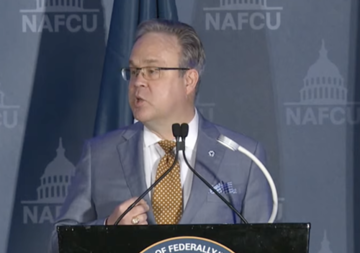
Todd Harper speaks during NAFCU Caucus
Noting that while the economic outlook is positive, Harper said the pandemic-induced recession has hit the poorest households the hardest, and for these households, many of whom are credit union members, the recovery could take longer, especially as forbearance programs, moratoriums on evictions and foreclosures, and supplemental unemployment insurance payments come to an end.
“The share of subprime borrowers in forbearance jumped from 26% in June 2020 to 39% in June 2021. And, mortgages held by borrowers living in the lowest income neighborhoods accounted for 21% of mortgages in forbearance at the end of June, but only 16% of all outstanding mortgages,” said Harper.
‘Considerable Stress’
“With lower-income households likely to come under considerable financial stress in the months ahead, I urge all credit unions to continue to work with their members who have financial difficulties,” Harper said. “To support your efforts, NCUA has instructed its examiners to refrain from criticizing a credit union’s efforts to provide prudent relief for members, when conducted in a reasonable manner with proper controls and management oversight.”
Harper told the meeting NCUA has also offered other targeted relief measures, such as its recently finalized capitalization of interest rule, which is designed to help borrowers resume affordable and sustainable payments.
“For borrowers experiencing financial hardship, a prudently underwritten and appropriately managed loan modification, consistent with consumer financial protection laws and safe-and-sound lending practices, is often a win-win-win for the borrower and the credit union as well as for communities and our economy,” he said.
Chairing the FFIEC
Harper, who currently chairs the Federal Financial Institutions Examination Council (FFIEC), outlined that organization’s priorities and said it is renewing its focus on the appraisal system’s governance and infrastructure, as well as appraisal equity and quality.
Appraisal Bias
Meanwhile, Harper said systemic and institutionalized discrimination in the appraisal industry demands reforms that would provide for appraisal independence and appraisal inflation. If that bias is addressed, it would go a long way toward helping many minority communities to obtain housing, he said.
“At the NCUA, we are studying the causes of disparities in appraisal and valuation services to inform our future policymaking,” said Harper. “And, as FFIEC Chairman, I will continue this conversation and take action on appraisal bias with my fellow regulators, including working to finalize a joint-agency rule to establish quality control standards for appraisal valuation models.”
Emerging Technologies
Harper noted the financial services marketplace continues to evolve, and he said NCUA needs to “lay the foundation for credit unions to operate in the growing digital asset arena,” including cryptocurrencies, digital assets, blockchain, and decentralized finance.
“While we should recognize and harness the potential opportunities these products and technologies offer, we must also recognize the potential risks they pose and develop appropriate guardrails,” Harper told the NAFCU meeting.
He reminded Caucus-attendees NCUA is currently seeking input from credit unions and others related to overseeing those technologies without stifling innovation.
“We especially need to understand what limitations could affect your ability to adopt these technologies and what risks they could pose, so that we can adopt appropriate guardrails to protect the financial well-being of members and the safety and soundness of the system,” he said.
Vendor Authority & Other Legislative Priorities
As he has in prior remarks, Harper said he is “deeply concerned about the increased reliance of credit unions on CUSOs and other third parties,” and he again called for NCUA to have authority over third-party vendors, an authority other regulators already have, he stated.
Harper repeated his request that Congress act to provide the agency with the third-party oversight authority.
“Without this authority, thousands of credit unions, millions of credit union members, and billions of dollars in assets are potentially exposed to unnecessary risks,” said Harper.
Harper also called on Congress to give the NCUA board greater flexibility to manage the Share Insurance Fund, so that it can “build reserves during sunny days and avoid potential premiums during rainy days. During the financial crisis of 2008–2010, the failure of five large corporate credit unions threatened the stability of the credit union system and the viability of the Share Insurance Fund.
“This episode demonstrated that significant failures or other large shocks to the system could quickly deplete the Share Insurance Fund’s equity levels,” Harper said. “Therefore, it is essential that the NCUA board have the ability to build up the fund’s reserves during periods of economic prosperity and financial stability, so that it is more resilient during periods of economic and financial stress.”