

WASHINGTON–Rep. Ted Budd (R-NC) told credit unions he continues to advocate for repeal of the Durbin Amendment and is co-sponsoring a number of pieces of legislation aimed at providing assistance to CUs.
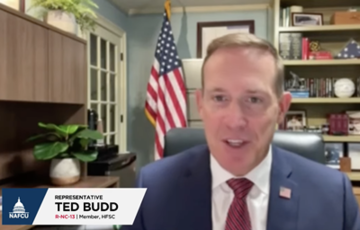
Speaking to NAFCU’s Congressional Caucus, Budd, a member of the House Financial Services Committee, offered a credit union-friendly message, saying he favors rules making it easier for credit unions to operate, to serve consumers, and to help ease credit unions’ regulatory burdens.
Budd was most outspoken about the Durbin Amendment, which he said he has long opposed and which he said has created “divisiveness and confusion, which was inevitable given how hastily it was considered and passed.”
Budd further called for repeal of the Durbin Amendment.
He said he also opposes a Federal Reserve proposal he said would force card-issuing institutions to “essentially transfer their technology to vendors and retailers” as part of providing routing choice.
“This is just another plan to expand already destructive government mandates and regulations on debit cards,” said Budd, adding he plans to send a letter to the Fed detailing the problems with the proposals and ask it be reconsidered.
Other Priorities
Budd also told the NAFCU meeting:
- He will “staunchly fight” proposals that seek to expand the Military Lending Act to establish a 36% rate cap on all loans.
- He is again co-sponsoring the Consumer Financial Protection Commission Act, which he said would “reign in” the CFPB to make it more accountable by reconfiguring its structure to put in place a bipartisan Commission in place rather than a single director.
- He supports the Secure Act, which would give businesses and consumers the ability to execute critical documents using secure two-way audio visual communication. “New technology has emerged to modernize and streamline services for consumers at every level. Remote transactions were frequently used to stop the spread of the disease and create flexibility during the notarization process,” he said.
- He supports the Online Accessibility Act, which he said provides guidance to help businesses make their websites compliant with the ADA while also increasing website accessibility for the disabled and “reduces the amount of predatory lawsuits filed against businesses every day.”