

FORT LAUDERDALE, Fla.–Credit union CFOs here were given an update on where NCUA stands with new exam solutions and timing, including a plan under which state chartered CUs would be examined every other year by their state regulator only.
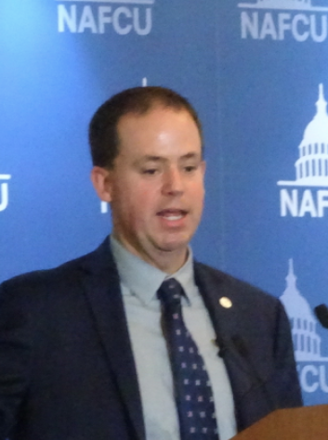
Robert Parrish
Robert Parrish, financial administrator and programmer with the agency, told the NAFCU CFO Conference “big changes” are coming to the examination process as NCUA works in partnership with Deloitte on its new Metric Stream platform. It is also in the process of now wrapping up its pilot of the Flex exam procedures that have been tested by the Region IV office in Austin, Texas. As a result, NCUA expects to roll out the remote/virtual exams to more credit unions in 2019 and beyond, said Parrish.
In addition, the agency is starting to pilot alternating exams of state-chartered CUs with state supervisory agencies in seven states in 2019. NCUA will then accept the report from the state regulator, Parrish said.
The extended exam schedule, which is open to CUs below $1 billion in assets that are well-capitalized and CAMEL Code 1 or 2 in both the composite rating and management component, is a “selective process,” said Parrish. Credit unions that are selected to participate are given four weeks’ notice they have been selected, and in terms of exam procedures, there will be improved alignment of information/document requests, and a separate pre-exam planning, according to Parrish.
A Few Notes on Supervision
Even if a CU qualifies for the extended exam schedule, that can change if there is the presence of potential risk, financial or operations. “There are no absolutes—specific issues or a combination of trends and issues may drive alternate supervision plan,” said Parrish.
For offsite supervision, Parrish said the process is evolving and will grow in importance. He said examiners will be tasked with obtaining the audit report during cyclical risk reviews when the audit is complete, and further noted the agency is currently pilot-testing the AICPA’s RIVIO secure portal.
In terms of examiners and their communications with credit unions during the exam process, Parrish said CUs and examiners are to establish expectations and details ahead of time (including where the examiner will work and how access the building, and in turn being open with the CU and working to resolve problems when identified). Both parties should expect to deliver logical and professional rationale for decisions.
CECL Compliance Reminders
Like several speakers at the NAFCU CFO event, Parrish addressed CECL compliance, and offered these reminders:
- Credit unions have an implementation effective date of Jan. 1, 2022, which means CUs will first be required to file CECL-compliant Call Reports on March 31, 2022
- Credit unions can choose to “early adopt” the CECL standard
- CUs should become familiar with the new accounting standard
- CUs should determine steps and timing needed to implement
- CUs should discuss the new accounting standard with the board, audit committee, supervisory committee, external auditor and peers
- CUs should identify existing processes that can be leverage in applying new standard
- CUs should consider whether additional data may be needed to be collected or maintained
- CUs should evaluate and plan for potential impact on regulatory net worth
Exam Concerns and Trends in 2019
Parrish touched on some of these bullet points in looking ahead to next year:
- Internal control and fraud. (Parrish said 90% of the losses to the NCUSIF over last five years have been due to fraud being a key contributor). Small credit unions are particularly vulnerable, said Parrish, and it will be seeing increased focus from the agency.
- Interest rate risk and liquidity. NCUA is concerned over the increased market volatility in the economy, including the collapse of the refi market. “The temptation to take on more risk will continue to lure credit unions toward IRR mismatches. There are credit unions reaching far to address interest rate mismatches without much planning.” Parrish said IRR assessments and balance sheet strength will become a more prominent concern, especially in long-term asset-laden FICUs.
- Examiners will be more focused on credit risk
- Examiners will be more focused on the Bank Secrecy Act
Credit Risk
With credit risk, Parrish said NCUA is concerned with:
- Auto lending exposures, including term limits, credit quality, and POS-sourced (indirect) loans. “All the indicators are of increased risk appetite,” he said.
- Commercial lending. A growing segment for credit unions, he said new regulations have removed regulatory restraints, meaning new emphasis on sound judgment and sound risk management. “There will be continued close attention to your internal controls.”
Other points raised by Parrish:
- With growing portfolios of commercial real estate, Parrish said the agency is concerned the board lacks the expertise needed to oversee the channel
- Similarly, with commercial loans, NCUA is concerned with small and mid-size CUs using CUSOs to underwrite and structure loans, and then not following CUSO approval conditions and not mitigating the risk