

FT. LAUDERDALE, Fla.–The promise, the payoff, the fears and even the futuristic—artificial intelligence-based CEOs, anyone?—aspects of AI were discussed by two credit union leaders here.
Offering their experiences and perspectives as part of a Q&A discussion during the NAFCU CFO Conference were Amanda Garabedian, COO with the $439-million Adventure Credit Union in Grand Rapids, Mich., and David Tuyo, president and CEO of the $955-million University Credit Union in Los Angeles. The session was moderated by Karan Maini, VP-banking, financial services and insurance with Persistent Systems.
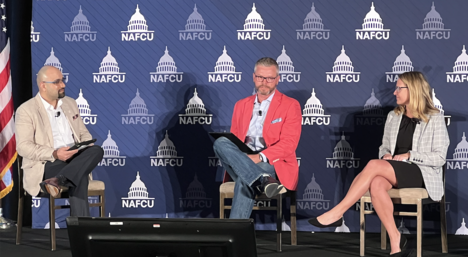
Caption: From left, Karan Maini, David Tuyo and Amanda Garabedian during NAFCU CFO Conference.
Here’s a look at the questions posed and the responses provided:
Maini: What does AI mean to you?
Garabedian: It’s a bunch of data you bring together and eventually start to use in your business to ensure you are creating automation and personalization in the member experience and in the employee experience. The term that has been thrown around quite a bit is ‘cognitive collaboration’ and how that technology is going to be incorporated into the business. For example, now GPS will even pull up something that’s in your calendar and tell you the fastest way to get to where you’re going. It continues to learn and evolve with the process, and that’s what we’re going to continue to try to do within the credit union.
Tuyo: When we talk about cognitive collaboration, in today’s world people think of AI as a chatbot, but it’s so much more. It’s any process that requires human intelligence and replacing it with AI. For us, we have a pretty robust strategy and have used it to leverage it in many ways.
Maini: Do you see a snowball effect in financial services?
Amanda: Certainly. We’ve talked about the staffing shortages and what that means as well as inefficient operations, which are really expensive to run. To combat the shortages and just to keep pace with the other industries that just keep creeping into financial institutions, we have to keep pace. There is no choice not to. As we continue to develop on our side things going to increase at a much more rapid pace than we have seen in the past
Tuyo: In my 25 years in financial services I don’t think there’s been anything that has moved this fast. AI is the future. Conversations have gone from how to set up bots to how to setup leadership. An AI CEO may make us uncomfortable, but it is a possibility and something we have to think about.
Maini: In your operations, what have you implemented and what do you see being leveraged?
Garabedian: We’ve done a lot of things to set up the foundational component for AI. We have chat with a human on the other side of that. We have a data warehouse initiative so that as we move forward and from the end-user perspective, it’s in our plans to continue to incorporate it as we grow. No one will ever have the perfect solution—we get into that situation where if we just know one more piece, then we can start—really you just have to start. We have also trend it around internally to how it can create more process improvements inside the credit union and with the team experience.
Tuyo: We have kind of a two-sided strategy, one member-facing and one employee-facing. Our member-facing AI is named Royce, after the name of the building at UCLA where we were founded. We started with an intelligent virtual assistant and it was really immediately impactful for us. Right now, the (record) for us is 81 interactions back and forth (with a member and AI). From there we integrated Royce into other applications, such as lending, where we’ve seen great lift. When you call into University CU today you are talking to AI. Royce is learning and growing every day and handled more than 30,000 calls last month. From that Royce has an app with conversational banking, so you can request funds to be moved or make a payment. We will continue to build out those transaction sets.
One of the biggest challenges isn’t not adapting AI, it’s our legacy systems that won’t integrate. (Vendors) want us to integrate their AI systems. That creates a fractured experience and could force us to choose new partners. We are now looking to implement AI in online banking and in automating fulfillment.
On the team member-side the name of our AI is Coach. We replaced our entire intranet. Training is great, but when people are on the floor and in production maybe in the stress of the moment it’s not working like you want. So, they would search the intranet or do a Google search. Coach now automates the entire process with a 97% satisfaction rate. Coach and Royce also never get sick.
(Tuyo also noted that a prior to the pandemic its workforce was 100% in the Los Angeles area and now is spread across nine states, which he said the CU supports.)
Maini: Have you seen extraordinary member experience as a result of AI?
Tuyo: During the pandemic we saw a decrease in membership growth. We had had been pretty consistent growth above peer average. When campuses closed and there were no people there, we saw it drop below 1% for first time in five years, so we had to make a pivot and change. This year we are going to surpass 19% membership growth and will have 30% loan growth. It’s worked out very well. The team is doing very well. It’s more about the people than technology and we can’t forget that.
Garabedian: We have very much increased the digital traffic and transactions. The pandemic caused us to shift a little bit, but we kept on the path. We did not lose sight of the long-term goal, we just kind of adjusted the roadmap. We saw about a 500% lift in our chat volume, even though there is a staff member on the other side. We are seeing how those different approaches are conditioning our members for the personalized experience where AI is introduced.
Maini: Have there been any unintended consequences from AI?
Tuyo: We did not anticipate the amount of fear our staff had that the bots are coming for their jobs. We got lucky, as we also happened to have two initiatives launching, a career path and job laddering program, to taking a more active coaching role. Employees can receive certification to becoming financial counselor, and then a personal financial planner. They can then move into a coaching position that comes with raises and opportunities to choose how they are going to pursue their career. It’s not providing certainty, but it does provide clarity.
Garabedian: The staff buy in and consensus from the team is the number-one hurdle in the process. Second is having the right vendor partner. You can get distracted by the shiny parts of things.