

FT. LAUDERDALE, Calif.–There is new pressure on credit unions to provide benefits plans to senior executives as the Great Resignation remains the new reality in the employment landscape, according to a trio of experts.
Speaking to NAFCU’s CFO Conference, the three experts, all of whom are with executive benefits consulting firm Gallagher, outlined what they are seeing and why when it comes to recruiting and retaining leadership.
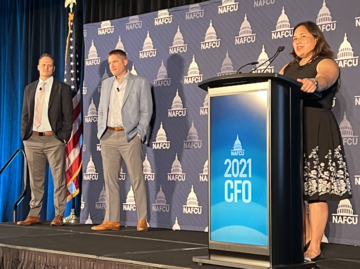
Addressing the meeting were Liz Santos, chief of staff in the executive benefits practice, VP Tyler Talbot and Relationship Manager B.J. Burt.
According to the trio, executive benefits plans are not just about retaining C-suite leaders but also can and should be used to drive performance.
Nonqualified benefit plans are a specialized tool for highly compensated execs and staff that bridges the gap between 401(k) and other retirement options, the audience was told. They can be tailored to any credit union’s needs, they added.
“When properly designed they can mitigate the benefit expense and any excise tax liability,” said Santos.
The Case for Retention
The three pillars of the case for retention include, according to Santos:
- The Great Resignation
- Urgency in the C-Suite
- Turnover is costly. “To recruit a new executive can cost from five to seven times the hiring amount,” Santos said. “That includes the recruiter’s fee and replacement, and relocation fees, and signing bonuses, which are becoming even more common,” said Santos. “A lot of credit unions are doing signing bonuses. They go through all the effort of getting a commitment, and that person then goes somewhere else.”
There is a lot of movement, especially this year, that will drive the case for retention, Santos added.
Questions from the Board
Talbot said board members often ask why the credit union should pay an executive extra for a doing a job they are paid to do.
“It’s a good point,” said Talbot. “But if you are trying to drive some sort of performance goal it helps to have some sort of incentive or bonus.”
According to the Gallagher representatives, the bonus compensation plans offer:
- Alignment of performance with goals
- Better communication
- Better results
- Better value
- Accountability
What Comp Survey Shows
During the presentation results from a NAFCU Survey on compensation showed executives averaged 12% raises during 2021 across all asset sizes and that over the past five years CEOs have seen a total compensation increase of just over 35%. The survey further found 34% of CU CEOs are at retirement age.
“There is going to be a lot of movement in the C-Suite. Hopefully there is a succession plan in place,” said Santos. “When someone on the team fills that void it creates a domino effect in the credit union and at other places.”
Santos cited data from DDJ Myers showing that for external placements salaries are in the 50%-60% percentile, while for internal placements salaries are in the 40% to 50% percentile. Not surprisingly, that has led to a scenario in which people who want a bigger bump in salary leave to join other organizations, which adds to the importance of identifying strategies for keeping people, she said.
Burt reminded that it is a good practice to revisit every few years the existing benefit plans to make sure they are tracking the future benefit that was promised.
The Opportunity
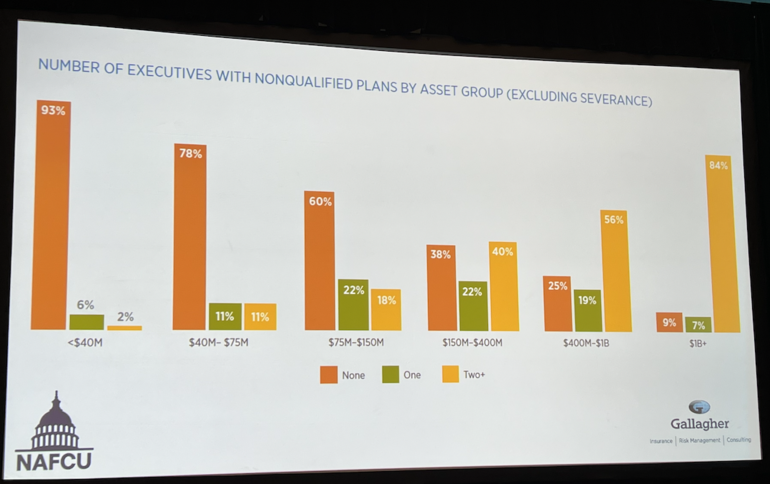
The “plan with no formal structure” is where the opportunity is, according to Santos. “There is a real opportunity here to add some structure where you add your performance metrics,” said Santos.
Tyler added that often the credit union’s board and CEOs expand the benefits options and go deeper on the bench to retain more employees in order to retain the culture.
There are generally two types of benefits plans offered to C-Suite executives in credit unions: 457(f) plans and split dollar plans.
The 457(f) is a “promise to pay,” a benefit accrued by the credit union over the vesting period and paid out (typically in a lump sum) at vesting. The executive pays taxes upon vesting in the promised benefit. The remaining after-tax balance can be invested by the executive in order to provide an annual income stream during retirement.
“For years and years and years this what we did at our firm, only 457(f) plans, because split dollar is really hard,” Tyler observed. “Split dollar is tied to interest rates and they are loans.”
Split-dollar plans are considered loans. The CU loans money to the executive who buys a life insurance policy. That policy pays back the credit union for the cost of its loan plus interest out of the payout from the executive’s death.
For the executive there is tax-free income for 20 years, plus predetermined percentage of excess death proceeds, Tyler explained.
“Now, interest rates make sense to do split-dollar, although we’re not sure how long that’s going to be around,” he said.
Split-dollar plans also allow for a custom drawing schedule, including prior to retirement.
Which is Better?
While the question is often asked, Burt said one plan is not better than the other and depends on the particulars of the scenario.
“If you have time on your side, split-dollar may be the better solution. It sits as an asset for the credit union and earns interest. From the executive standpoint, it’s tax-free money,” said Burt. “One other difference is with a split-dollar plan it is not guaranteed income, so you need to make conservative assumptions. With the 457(f) as long as the four walls of the credit union are still standing, that benefit will pay off.”
Burt told the audience of CFOs that in eight-out-of-10 credit unions Gallagher works with it is the CFO who is managing the plans.
“So, it’s important to understand how these work,” he said, before adding, “Anyone who specializes in these plans can put one in place. What really sets it apart is the plan administration.”
Seriously, Which is Best?
“We get this question all the time,” Tyler reiterated. “The best plan is the one that works or retains or attracts or rewards the individual you are looking to retain, retract or reward. It’s not one shoe fits all. Maybe you do both. Maybe you do some 457(f) and some split-dollar plans.”