

FORT LAUDERALE, Fla.–There are any number of challenges to credit unions when it comes to complying with the new CECL standard, but one person said there are four key areas a CU should watch.
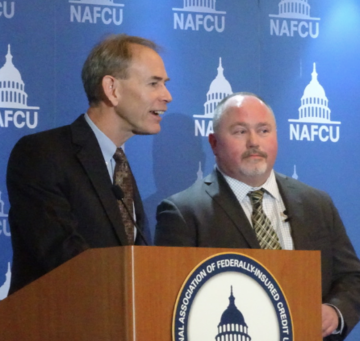
(R) Bryan Morgensen
Speaking to the NAFCU CFO Conference here, Bryan W. Mogensen of Clifton LarsonAllen, LLP dedicated his remarks to the Current Expected Credit Losses (CECL) standard to these four areas:
- Credit cards
- Loans formerly known as TDRs
- PCI loans
- Debt securities
Here’s a look at what Mogensen had to say about each, as well as a number of other points related to CECL:
Credit Cards
As unfunded credit lines, no allowance is required if the cards are unconditionally cancellable by issuer. A credit union should divide its portfolio into Transactors (those who pay off monthly, earn rewards and lower charge-offs), and Revolvers (those who retain monthly balance, who generate the most net income, and who have higher charge-offs).
A credit union will need to evaluate weighted average life based on payment activity (FIFO) or according to payments applied based on CARD Act (higher APRs paid first), but either method is acceptable, said Mogensen.
A credit union must also determine its loss-emergence period, the period from loss-triggering event to charge-off.
“You need to capture this data to determine what that life is and then determine your reserves,” said Mogensen.
Troubled Debt Restructures
While the individually impaired concept was removed from ASU 2016-13, the TDR concept was retained, explained Mogensen. The initial indications are TDR credit losses can be measured using various CECL models, but FASB has indicated that allowance must still consider full “economic loss.”
Discounted cash flows must also be factored in.
Purchase Credit Impaired/Purchase Credit Deteriorated Loans
PCI/PCD refers to loans that have incurred “more than insignificant” deterioration since origination. Mogensen said more loans qualify as PCD than PCI. Discounts associated with credit loss are added to reserves upon acquisition.
PCD adjustment applies prospectively, Mogensen explained. A CU must adjust the amortized cost basis of the loan to reflect addition of the ALLL.
A CU can elect to maintain a pool of current PCI, according to Mogensen.
Debt Securities
Available for Sale (AFS). A CU must determine if decline in fair value is due to credit or other losses. If credit, post as allowable through income statement (provision). If other (interest), post through OCI.
With AFS, use the CECL model, said Mogensen, and use an allowance instead of direct write-off (permits reversals). With credit risk, post as allowance through the income statement (provision).
Held to Maturity
The treatment of HTM loans is similar to the treatment of loans held in portfolio, he said.
Debt Securities
Complex models are not expected with plain vanilla portfolios, such as those invested in Treasuries, said Mogensen.
For those with credit risk, a reserve is required such as for some municipals and private-label MBS. In addition, under CECL:
- Reassess allowance monthly
- Can reverse credit allowance up to zero
- Cannot have negative credit loss
Disclosures
When it comes to disclosures, Mogensen said a detailed methodology and assumptions explanation is needed, including:
- Credit quality “vintage table” (now likely including charge offs/recoveries by vintage)
- Explanation of changes from prior period