

KEY WEST, Fla.–People have no idea how fast things are moving, according to one person–but that doesn’t mean CU leaders can’t keep up.
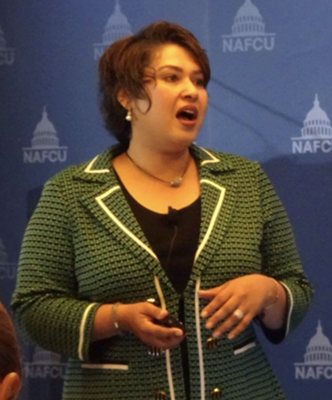
Shazia Manus speaking at NAFCU meeting
The world is now well into the second phase of a technology wave that is all about the much-discussed “disruption,” said Shazia Manus, chief strategy and business development officer with CUNA Mutual’s AdvantEdge Analytics. “And that is what is driving everything, including the opportunity to look at the world differently,” including through the use of analytics, said Manus.
Manus divided her remarks into three parts that examined big data, big processing, and big algorithms.
What is new today in the context of big data is the sophistication and complexity of the algorithms and the ability of the machines to build their own algorithms, she said.
Market Realities Driving Digital Transformation
Manus said three realities that need to be recognized include:
- Digital emboldens consumers
- Technology shrinks barriers to entry
- Digital transformation is bearing fruit
Manus reminded that consumers now benchmark their credit union against experiences obtained from other providers, and when they don’t get it, they take to social media to talk about it. The end-goal for those other providers as well as credit unions is to be ready and waiting at the right point in time so when the member arrives with a need (or, ideally, before they even know they have a need), the CU is prepared with an offer.
Freaking Out
“The word disruption is freaking out every single incumbent in financial services,” said Manus. “The legacy providers are really looking hard to transform themselves and creating new business models. Look at CUNA Mutual: we are moving into analytics and investing in fintechs. We want to build new muscle and transform ourselves for the new world we are in.”
Credit unions and other organizations need their feet in two states of mind, according to Manus:
- Exploit: This is about improving the existing business model.
- Explore: This is about inventing new and disruptive business models.
“Exploit is all about mastering the business you are in today. Exploration is about having the stomach to explore uncharted territory where you don’t have a lot of data but you have a gut feeling. You will have a lot of failure on the explore side, but it is the failure that gives you the learning.”
Not Separate Issues
While many executives have approached “digital” and “data” as separate issues, Manus said they are two sides of the same digital transformation coin. “This is an ‘and’,” said Manus. “Digital is ultimately the end, and the means to get there is getting your data strategy aligned.”
In the simplest form, a credit union is basically about buying money, selling money and moving money, Manus observed. But that doesn’t mean it’s simple for the member.
“The money business is extremely annoying, it’s complex and it’s worrisome for the consumer,” said Manus. “You have to ask yourself what are the one, two or three frictions that are worth solving for. Start by curing the migraine before you try to cure cancer. Start with the member journey, map it out, and then identify the junctions where you can solve.”
In doing that, a credit union must identify the personnel talent for doing so (or acquire it), pull together data and then translate it, and prepare for the investment needed, said Manus.
Call to Action Tips
Manus offered these call to action tips, beginning with understanding the steps in the process, which include source of value, data ecosystem, modeling insights, workflow integration and adoption and execution.
Manus offered these steps:
Strategy
“Don’t begin with technology; begin with strategy,” advised Manus. “You have to ask, are we ready internally for this multi-year plan so we know what to invest in and how we will see the value. Start anchoring with the board and the senior management team and then the digital strategist. This takes a good 12 months. Follow the signal and not the noise.”
Establish a Culture of Experimentation & Agility
Begin with the organizational structure and ownership of the data, Manus recommended. She urged against a completely decentralized or completely centralized organization of big data, as there are plenty of cons with both. Instead, she urged a middle ground, usually a chief data officer role, who bridges both.
“A person in a translator role is critical to bridge the different functional areas,” said Manus. “Most importantly, they ask the difficult questions. They must have business skills, analytics skills and technology skills.”
Build a Data Corpus
“A strong data foundation is a key enabler,” said Manus. “Data governance needs to be a bedrock.”
Citing an ethical framework created by the Information Accountability Foundation, Manus said a credit union must ask itself when it comes to data: Is it beneficial to members? Is it a reflection of our progressive commitment to continuous improvement? Is it sustainable, respectful and fair?”
What it Takes
Manus said to be successful in the move to digital, the following must all be in place: Culture (empowerment and experimentation), community (data enthusiasts and experts), customer oriented (focus on attitudes and behaviors), clarity (understanding problem to be solved), clean data (sources and methods).
“Three things will separate losers from winners,” said Manus. “Skills, mindset and data.”