

KEY WEST, Fla.–How can your credit union attract great people and how can you get them to stay for the long run?
A Harvard professor who has studied those questions offered some answers, including some questions to ask during the hiring process in order to really win the “war for talent.”
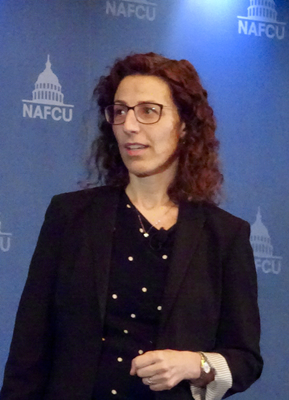
Francesca Gino
Francesca Gino of Harvard Business School told NAFCU’s CEOs and Senior Executives Conference the secret lies in “rebelliousness,” and her remarks were delivered just one day after an audience poll at the same meeting revealed “staffing issues” was the number-one concern expressed.
How do you win the war for talent? “Go for talent that I call the rebel talent,” said Gino.
Gino, who is a native of Italy, used as an example for several of her points a three-Michelin Star restaurant in that country, Osteria Francescana. Its owner/chef has earned the stars by rebelling against a number of assumptions/practices in high-end restaurants. For example, after overhearing a young child sitting at a table with his parents say that what he really wanted was pizza, the chef phoned a local pizzeria and had one delivered.
“When I walk into an organization and ask about rebels, people think about that annoying person in the business who always seems to get in the way of getting work done,” said Gino. “We think of the jerk who brings up ideas to slow us down as we make decisions. We think of them as troublemakers and show-offs. But what I want to suggest is there are also people out there who break rules who are rather positive for the organization. They are people who help move the organization forward.”
According to Gino, the ingredients of rebelliousness also include:
Vulnerability
“We think that making ourselves vulnerable makes people think badly of us, but it’s just the opposite,” said Gino. “Rebels are people who choose the path of making themselves vulnerable, even though it means allowing people to see they have some weaknesses. It’s important to have discomfort, to do things that are new. We tend to choose the comfortable and the familiar, not the uncomfortable.”
As an example, Gino pointed to the regional and fast-growing restaurant chain called Pals, in which employees are given 135 hours of training per station, significantly above peer groups. To keep the work challenging, and to see who is willing to challenge themselves (and become vulnerable), it will ask employees to remember 100 orders for repeat customers, and if they do, they are rewarded.
“Rebels are people who choose novelty,” said Gino.
Power of Authenticity
Gino said authenticity can be key in retaining people. She shared that she and several colleagues worked with a call center in India, Wipro, which found most people were leaving 45 to 60 days into the job. Exit interviews found those who had quit said, “It was as if we had to check who we are at the door.” Gino and the analysts began studying how to allow Wipro employees to reflect and express authenticity, and after implementing some changes, saw drops in turnover and increased satisfaction, especially the feeling of control over their jobs.
“Authenticity pays off. It helps us to perform better in the jobs we do,” said Gino.
In the case of the restaurant Osteria Francescana, the owner/chef said he had to overcome a lot of objection from traditional Italian cooks. “They wanted to see us dead, because they didn’t want me to touch their grandmothers; recipes,” the owner/chef said, saying the biggest lesson learned came from another chef who gave her the freedom to find her own “fire.”
“This story is not unique,” said Gino. “When we experience authenticity, we persist longer when we encounter challenges in our jobs.”
Gino also offered an example from closer to home when Harvard researchers used local Bostonians in an experiment in which half were given Boston Red Sox wristbands to wear, and the other half were given (over their objections) New York Yankees wristbands to wear. Again, it found those wearing the wristbands of their teams—and feeling more comfortable—persisted longer in experiments that were designed for everyone to fail.
“Most people new to an organization go for conformity,” said Gino. “But if we’re able to bring out authenticity we have much better results in terms of engagement and creativity.”
Rebels Have a Talent for Curiosity
According to Gino, curiosity is critical to innovation; unfortunately, curiosity in most people peaks at age four and five, and declines steadily from there.
“I thought that when we choose our jobs, that’s when curiosity comes back, we choose what we want to do, but I was wrong,” said Gino. “Curiosity is really important to the work you do and to performance.”
Some organizations that have sought ways to encourage curiosity include Intuit, which has a program called Scott’s Innovation Awards, said Gino. But just as importantly, it also has Failure Awards. “The best part is the Failure Awards come with a Failure Party. It keeps us exploring and experimenting. They are making sure people understand intelligent exploration that leads to learning is important,” said Gino.
At Osteria Francescana, after a chef had dropped a dessert, it created a new deconstructed menu item called “Oops, I dropped the lemon tart,” that is among the most popular items on the menu. “It’s a beautiful example of a leader modeling curiosity for others and asking, ‘What if?’ It’s important because you keep curiosity alive,” said Gino.
Hiring Tips
In response to an audience question, Gino offered these tips for hiring:
How to hire for authenticity: Gino said many interviewees are asked, “What is one of your major weaknesses?” “If they say, ‘I am too much of a perfectionist, show them the door,” Gino advised.
How to hire for curiosity: “It’s about asking questions beyond the work. Ask, ‘When was the last time you found yourself eager to get an answer to something even unrelated to your job?’”
How to hire for perspective: Gino said one company asks people questions based on challenges the company itself has faced, and then looks for people who come at the problem differently from the way the company and even the person doing the hiring has done. The person who is doing the hiring is “looking for people who are different from her,” said Gino.
What kind of rebel are you? Gino directed people to RebelTalents.org to take a test and find out.