

KEY WEST, Fla.–There’s no recession in sight—or at least not until mid-2020 at the earliest–and, besides, what’s really needed is just more amorous young people, one economist told credit unions gathered here.
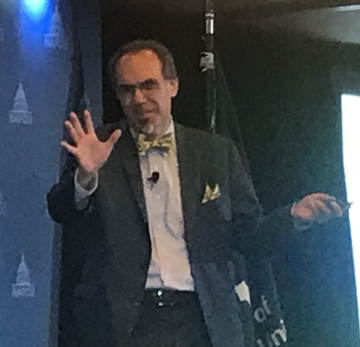
Elliot Eisenberg
Dr. Elliot Eisenberg, president of GraphsandLaughs and well-known to many in CUs for his quick moving, humorous and animated insights on economic issues, told NAFCU’s CEOs and Senior Executives Conference that all-in-all, things are going pretty well, and will continue to.
“We have strong enough stuff to essentially prevent us from having a recession through year-end and the beginning of 2020,” said Eisenberg. “I think what we’re going to see now is a general slowing of economy. So, it could be 2% GDP growth by the end of the year, middle of next year. We are going there because this year’s 2.4%, 2.5% growth, and last year’s 3%, were abnormally good years. It’s not that we’re going back to somewhere bad. We’re going back to where we were. Things are going to deteriorate ever so slightly. But slowing growth does not necessarily mean a recession.”
Eisenberg said the data remain strong, with the stock market having recovered and household borrowings through Dec. 31 being “fine.” Total consumer debt to GDP is pretty low, with interest rates at near historical lows, he said, adding total delinquencies also remain at near historical lows.
“The big thing is student debt. It’s crazy high. But it’s not going to do anything to drive a recession, but it’s like a slow-moving cancer. Young people can’t spend,” he said.
While some have pointed to potential problems in the data, Eisenberg said the increases in delinquencies in various lending products mask the reality that the overall trend shows the numbers remain low.
Mortgages, with the exception of FHA loans, are good, he added, as house prices continue to rise.
A Deeper Dive
Driving down deeper into the data and looking at auto loan defaults, he said more Americans than ever are at least 90 days behind on their auto loans. But, again, Eisenberg said that data point is deceiving and the best way to look at auto delinquency data is as a percentage, and that figure remains well below high points. The other issue is many of the delinquencies are in subprime auto loans, which generally aren’t made by credit unions.
But what could affect CUs is that as the vehicles come back into the market, they will push down residual values, which could affect CUs.
Why are auto loans growing? It’ not so much new car sales as the size of the loans–“because cars are frigging expensive,” said Eisenberg. “We’re all driving bigger vehicles. Something like 80% of vehicle sales are SUVs.”
Among the more interesting data points, according to Eisenberg, is the big difference between delinquency rates among large and small institutions, with much higher default rates at smaller banks.
Other Observations
Other points made by Eisenberg:
- Small business confidence remains strong, at near-historical highs.
- Hotel occupancy rates are excellent, meaning people are going on vacations and companies are investing in staff travel.
- Home improvements. There is some decline in growth in housing improvements and repairs, which will affect HELOCs. Growth should really start flagging by Q1 2020, he said, again stressing that overall, the numbers are still “nothing awful.”
- Personal Consumption Expenditures (PCE), which drive 68% of GDP, remains between 2% and 3%, which is strong, he said, adding there is “no way” non-PCE aspects of the economy will slow to the point of driving any significant recession.
- Bank net interest margins are growing, with higher interest rates helping, and perhaps a change in loan terms also contributing.
- Manufacturing numbers have declined, but manufacturing is less important in the U.S. than in decades past.
- Factory utilization rates down slightly, due to a combination of slowing global growth, trade wars, weak oil prices and a strong dollar.
- ISM Non-Manufacturing numbers are good, with the service sector holding up. “We are spending an increasing amount on services to feed the unending need to show off on Instagram,” said Eisenberg.
- GDP is slowing down, and the main reason is the tax cuts are done. “The benefits of the tax cuts are probably gone, but maybe not. Maybe companies will drastically invest in plants and equipment and that will increase worker productivity, but I’m not holding my breath.”
- Democrats and Republicans have three things they must accomplish: Must pass a budget, must raise the debt ceiling (that’s even more important than passing a budget), and must stop federal spending from going negative, he said.
- Global growth is slowing, but it has been better than many had projected. But Eisenberg said the $250-billion trade war is hurting GDP, although it will be worth it if Trump gets a new trade deal with the Chinese. Eisenberg said China has been “lying and cheating” at trade.
- Why GDP will slide to 2%--“I’m telling you this is going to happen. GDP only grows for two reasons: More people working, or getting the people who are already working do a better job and become more productive. The problem is there aren’t a lot of people to hire.” Eisenberg pointed to data showing many younger people aren’t in relationships and young couples aren’t having children. “If you really want to make America great, or greater, go home and make love for God’s sake. I had to get a job so I could get a car so I could make out. But, now that you’re not making out, what’s the point in getting a car?”
- The Yield Curve. While everyone went “bonkers” when it recently inverted, Eisenberg said the real reason it did so is because the long-end of the curve slid, and if necessary, an easy solution is for the Fed to lower rates on the short end. To really matter, a yield curve must revert for a very long time to lead to a recession, and in this most recent case the inversion was very short-lived, he reminded. “So, at a minimum, on average, based on the yield curve, we’re at least two years from a recession.”
- Chances of a Recession. Eisenberg forecast the chances of a recession in the next year at 25%-28%.
- Wage growth. Wage growth has “hardly been spectacular” given how strong demand is. There are multiple reasons, said Eisenberg, with many offering theories. One reason, he said, is pure demographics. When correcting for demographics, average wage growth corrects a bit (reflecting older, better-paid employees retiring and being replaced by younger, lower-paid employees).
- Inflation. Eisenberg called the absence of inflation “the most amazing thing.” By historical trends, inflation should be rising faster. “This late in a cycle, there is no inflation, and this is unnerving. Fear of the Fed jacking up interest rates goes away. This is so new and so poorly grasped that economists don’t know how long it will last and a lot of second-guessing is going on. If inflation goes up, the party ends. That’s why this recovery could go on for a much longer term.”
- Fed Rate Hikes. “I’m optimistic we get one more rate hike this year. I’m an outlier. Only about 30% of economists expect this rate hike. After that, we’re done. We’re at the peak of the cycle here.”
- Housing. Non-residential is up 9%, public is flat, and residential is down 20% from peak. The problem: “Builders can’t afford to build an affordable home. I talk to builders all over the country. They can’t build a home at the entry level and make any money. And the number of people working in construction is less than it was 11 years ago.” House price appreciation is at 3%-3.25%, which is same level as wage growth. “This is shaping up to be a decent year for housing, not great. It’s not going to be a spectacular year for mortgages or refi’s.”