

KEY WEST, Fla.–Some questions and rumors surrounding the implementation of the upcoming CECL standard were answered and debunked by a FASB official here. One issue around which there is no debate: CECL is coming, and no credit union is going to be exempt, he said.
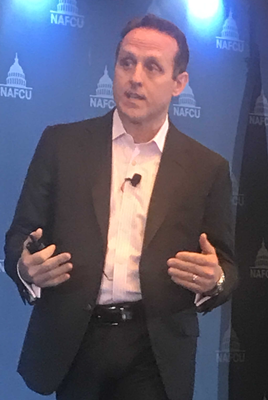
Shayne Kuhaneck
Shayne Kuhaneck, assistant director with FASB, walked attendees at NAFCU’s CEOs & Senior Executives Conference here through an overview of the Current Expected Credit Loss standard that many in credit unions have viewed like the pending arrival of the Night King.
“We need to keep in perspective this is an estimate,” said Kuhaneck. “We can all agree that whatever you book is wrong. What is booked is not what is going to actually happen.”
Kuhaneck said the Financial Accounting Standards Board has now moved beyond the rule itself and the focus is on training. That, in turn, has led to some rumors and mischaracterizations, he said.
A ‘Science Experiment’
“We have been hearing some folks are turning this into a science experiment never intended by the board,” he said. “Some have said that because the standard says you have to have a forecast, everybody has to forecast GDP and a national unemployment rate, even if not related to your business. That is not true. If I could go back and take out one word from anything we’ve written, it’s the word forecast. There is no need to boil the ocean if you operate in a pond. If national unemployment rates are not relevant to you, you do not need to project them. If you are a small credit union and a factory shuts down a shift, that’s what you have to forecast.”
Kuhaneck noted most credit unions already are not doing incurred losses by the book, and instead have in place an “incurred plus” or even “incurred plus-plus” model. So any move to the CECL methodology will not be at all significant, he suggested.
“I would suspect a lot of credit unions and community banks are pretty close to CECL already,” he said. “You’re booking a lot more than the incurred loss model would tell you to.”
CECL does not change the ultimate loss that will be realized, said Kuhaneck. “A bad loan is a bad loan. The only thing CECL does is change the time.”
Why CECL?
Why was CECL ever devised in the first place? Kuhaneck offered this explanation.
“When you think about losses and the financial crisis, heading into the crisis loans were increasing by 35% and loan loss reserves were decreasing by 10%. Either those new loans were so good that not only did they have no losses on them, they also made up for all the other losses already on the book. It just didn’t seem right,” he said. “During the financial crisis we saw a wild spike in loan losses, and the board wanted not to eliminate—and that’s the misconception—but take the big spike and squish it down and pull it forward. You’re going to have increases just by nature of how things happen. The reasons they settled on day one is when you think about loan loss reserving from a practical perspective, you have two other choices: book on day one or book over time. And we looked at multiple models that booked the loss over time. And what we heard back from nearly everyone is it’s impossible to do. It’s operationally a nightmare. So, practically, from an operability standpoint, you’re left with day one.”
Exemption Isn’t Coming
Credit unions, especially smaller CUs, holding out hope for an exemption from CECL, need to recognize it’s not coming.
“There are zero plans, zero, by the board to scope out credit unions,” said Kuhaneck. “You need to be ready to go. You will have to follow GAP, regardless of size, and that’s according to NCUA.”
Kuhaneck said FASB is now developing educational materials for smaller institutions, including information showing CECL can be done on a spreadsheet. In January, it produced a FASB Staff Q&A showing the Weighted Average Remaining Maturity (WARM) method that can be used to show loss rates on a spreadsheet.
FASB will also release a new Q&A in mid-May, he said.
He urged credit unions to go to the FASB website if they have not done so and download the extensive materials available there on questions that include recoveries, reversal of accrued interest for nonaccrual loans, transfers from HFS to HFI (loans), AFS to HTM (debt securities), refinancings and prepayments, and capitalized interest, among other issues.
What About Examiners?
Asked by a NAFCU exec about whether the position among NCUA’s top management will actually reach the examiner level, Kuhaneck responded, “You’re right, at the top of the house, we are on the same page. They are the ones who wanted a Q&A for the smaller institutions. I know for a fact they are committed to driving this down to the examiners.”