

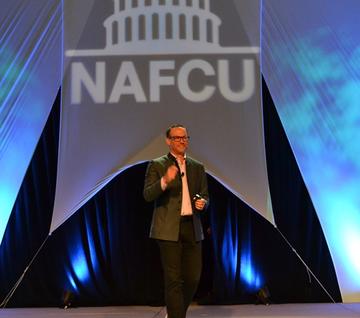
Bernie Brenner
HONOLULU—Sixty-one percent of consumers shopping for cars are not ready to buy the first time they walk into the dealership—which is why credit unions should get better at inserting themselves in the car-buying process, according to one person.
Bernie Brenner, co-founder and chief strategy officer with TrueCar, made that point during NAFCU’s Annual Conference here, emphasizing that what the statistic points out is that credit unions need to be ready with a loan offer during the “car buying journey.”
“You don’t want to jump in before buyers are ready—send them to the dealer when they are not ready to buy,” said Brenner.
Brenner shared a great deal of data TrueCar has assembled on consumers’ car-buying habits. A key point he made is that while a growing number of consumers want to do a lot of car shopping online today, the need for the physical aspect of the process—going to the dealership—remains an important and desired step, even for Millennials.
“Our research shows that 80% of car buyers will not buy a car without a test drive, so there is the physical aspect of the shopping journey no matter how much is done online,” Brenner said.
Brenner said TrueCar data shows there are three steps in the car-buying journey for consumers—going online, then offline and then to the dealership.
“So in terms of this broad market, only a small percentage is ready to initially take the step to apply for a loan, which is important for you to recognize.”
But to find the right time to step in with the loan offer can be difficult to spot, since the consumer journey through these three steps is not linear, he said.
“You might naturally think this process is a straight line,” Brenner said. “But, in fact, what typically happens is the car buyer goes online to do research, then goes offline, such as making calls or seeing a car in a parking lot.”
But instead of moving on to the dealership after first gathering online and offline data, buyers typically go back online to verify what they just learned and do more research and perform car and price comparisons.
“So this journey is actually up and down through these steps,” said Brenner.
While consumers are hungry for data and are finding much more of it online today to help their decision making, all of the data, and often the inconsistency of information—particularly car values—among different car buying website confuses and frustrates buyers, Brenner said.
Besides confusion and frustration impeding car-buying decisions, a lack of trust of used and new car dealers slows consumers from signing on the dotted line.
“Dealerships, unfortunately, are still at the bottom of the list for trust ratings among professions,” Brenner said. “This can be an issue for your credit union’s indirect program.”
But Brenner believes credit unions, in working with their members, can help them overcome the lack of trust for dealerships, especially since credit unions are typically rated highly among consumer polls for trustworthiness.
“Your car-buying members trust you,” he said.
Brenner described all of the data resources car shoppers use, such as search engines, carmaker and car buying websites and “industry experts.” He suggested that credit unions can better work with potential car buyers by positioning themselves as trusted automotive industry experts.
Brenner said that to be effective in making loans to members, CUs must understand the car-buying journey members are on, try to recognize at what point in the journey the potential buyer is at, and then determine the right time to present the loan offer.
“I think credit unions can help buyers through this journey,” said Brenner. “You can help them get some context and comfort in their steps through this process.”