

SEATTLE–The missing link in strategic planning at many organizations is usually the execution piece, according to one expert who challenged credit unions to address the reasons why.
Speaking to NAFCU’s annual meeting here, Deedee Myers, CEO of DDJ Myers and well-known to many in CUs, said it’s imperative that credit unions understand the status quo mindset in strategic planning will only lead to status as an also-ran in the future.
“What got us here won’t get us there,” said Myers in remarks to NAFCU’s annual meeting. “We need to learn faster than the pace of change. We need to be a learning organization, to look around corners and problem-solve, to look at different options. It helps us to get bigger. Learning has to be a part of every executive meeting and every board meeting.”
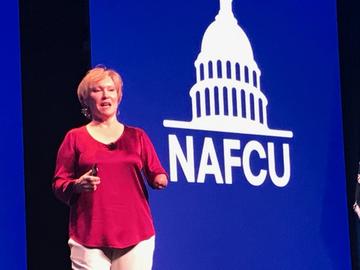
Deedee Myers
The struggles in execution, according to Myers, include:
- Organizational blockages and contradictions
- Top-down dissemination no longer viable
- Competing goals or organizing principles
- Blindsiding or unanticipated collateral damage
‘Not Enough Anymore’
“We have learned that having a strategic lens or perspective about strategy is not enough anymore,” she said. “It’s well intentioned, but can be limited in perspective if we don’t keep looking around the corner. It can be very narrow in scope. We need to embody in mid-level management the ability to flex and adapt.”
Myers said her company’s research has found many credit unions remained mired in old-fashioned, military-based processes, with 82% still using the Strengths, Weaknesses, Opportunities and Threats (SWOT) framework.
Not only must that change, but the “one-day wonder” of strategic planning–that is, the one day meeting–isn’t sufficient any longer either, said Myers.
Beneath all of this is another reality, according to Myers, which is that many employees are experiencing “huge work/life issues,” with 35% of employees feeling disconnected at work.
“There’s a big elephant in the room, and that is a lot of people go to work exhausted and not strategically focused, and yet they are on fire, they want to be connected, they want to have passion,” said Myers.
The Missing Link: Mid-Level Management
Myers said every credit union needs to ask itself if all its employees, from the bottom up, are aligned with the CU’s mission and are meeting your directives?
“Credit unions score the highest of the 4,000 organizations in our study on mission and vision,” said Myers. “However, we are seeing they don’t understand the competitive advantages and don’t see the core competencies.”
For many CUs a strategy is more of a “project checklist” rather than an ingrained culture. That strategy as it executes on the credit union’s mission can have great resonance, she said.
“Making a difference or wanting to be needed isn’t generation specific,” said Myers. “Just 42% of employees feel accomplishment, partnership and joy at work. Imagine if you could raise that and what it could do in the fintech market.”
Organizational Pace
Myers said many organizations need to improve their “pace.”
“Succession and people development are often the most overlooked competitive advantages,” she said. “Organizations with an aligned focus between people development and short- and long-term strategic scenarios are better able to keep pace with the market changes and, in some instances, stay ahead of the learning curve.”
While Myers said she has had client credit unions admit they are satisfied to be “average,” a problem eventually arises.
“But what if (the member) experiences excellence?” asked Myers. “Are you average? Are you excellent? How do you know?”
Don’t ‘Obsess’
What credit union leadership teams can’t do is “obsess about the fear of failure or become mired in the angst of change and not respond to the demands of the situation,” said Myers. “In strategic planning we get mired in the process before we ever adopt the vision. Instead of ‘how’ questions, ask ‘what’ and ‘why’ questions.”
Every strategic scenario must include both a people scenario and a culture component, according to Myers. And just as critically, she added, the credit union must “rigorously adopt a learning organization mindset that includes succession planning,” and not just on paper.
“What is the responsibility of the board and senior leadership team to ensure that employees buy into what we are doing, feel respected and included, are more productive and happier, stay longer, and add unexpected value?” she said.
A credit union must also ask itself how the board and senior leadership teams are collectively accountable to each other in strategic planning.
“You must create an environment to foster strategically oriented employees,” said Myers.