

SEATTLE–It’s time to face it: members increasingly do not want a face-to-face relationship with their credit unions.
And that means a host of challenges around relevancy, cross sales and more, says one person who encouraged CUs to leverage partnerships to take advantage the “powerful” opportunities that are developing every day.
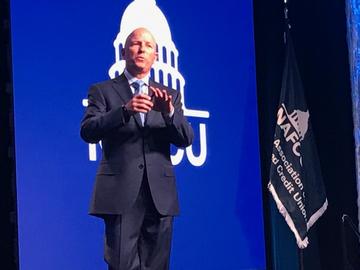
Pete Hilger
Pete Hilger, president and CEO of Allied Solutions, said “yesterday’s member” who visited the branch to have products and services explained to them face-to-face and who valued relationships with those who handle their money, is also yesterday’s news.
What every credit union must realize, he said, is how tomorrow’s member will choose to interact and the challenges that has for many long-held assumptions and practices.
Tomorrow’s members, he said, are people who will tell the credit union “everything,” who prefer making digital transactions online or through mobile apps, and who want variety when it comes to interaction both in person and digital.
“They are not loyal to one organization, and are focused on what is important to them,” Hilger said. “They want convenience and speed and don’t want to come in and talk to you.”
He noted 46% of all consumers now interact via digital channels, skipping physical channels altogether, which is up from 27% in 2012.
‘Scares the Heck Out of Me’
“Only25% of consumer banking products are available online. This one scares the heck out of me,” he said. “Seventy-five percent of our products are only available face-to-face. That’s billions of dollars in transactions. As an industry we do a very, very poor job of figuring out how we can engage and interact with the member without being face to face.”
Why that issue is so critical, said Hilger, is that face-to-face interactions are often the best opportunity to make sales. He urged CUs to recognize just how important non-interest fee income is to their bottom lines.
“Without it, many of you would be in the red,” he said.
The research shows 80% of consumers view their banking relationship as transactional, not advice-based, even though playing a trusted advisory role has long been a credit union strength.
“It used to be credit unions had a huge advantage, because credit unions had the trust,” he said. “Not anymore. But you will lose if you try to win by price. You do not want to be a commodity. If you are, you will be irrelevant. You need to focus on the why.”
The Emerging Competition
Plenty of other organizations see the opportunity in the relationships credit unions have with their members. Hilger cited statistics showing 2,407 fintechs startups had $90 billion in funding.
“We as an industry don’t spend anywhere near that. These companies don’t care if they fail. Here’s why: there is more and more money behind that,” he said. “There are all these firms trying on a daily basis to find the new shiny object for your members. I visit credit unions on a regular basis and there needs to be a serious wake-up call in this industry. We depend on that member, the engagement with that member, getting more loan share, and maintaining relevancy.”
He said members are easily attracted by competitors such as SoFi. Quicken Loans, and Lending Club. “It’s not a cozy experience. It’s fast and transactional,” he said.
“You are losing your traditional tools and not just on the lending side,” continued Hilger. “That is your ability to transact and communicate with your member. Those tools are very dynamic, expensive to invest in, and as a group our investments will give us a significant advantage. For each of these challenges there is an opportunity.”
Other Points Raised
Some of the other points made by Hilger include:
- Loss of non-interest fee income. “It’s not just the revenue it represents, it’s the things your member receives when they buy them, the education you give them to protect their families and assets. For those who do not believe that B2C (business to consumer) is real and can’t have a significant impact, you are completely not paying attention. In B2C they get rid of layers and lower their margins and charge prices close to what you’re offering today. That’s scary.”
- Changing relationships. “How will you nurture member relationships? Have you looked at how many services you have an indirect lending relationship vs. a direct lending relationship? The big difference with direct is you have a relationship. With indirect, you’re a transaction. Think about what happens after that transaction.”
- “Another thing this industry needs to do is focus on how to become relevant post-transaction,” said Hilger. “How do you keep in front of that consumer, identify their needs, and deliver solutions in a digital, virtual world?”
- Losses and charge-offs on loan portfolios. “Who thought years ago we’d do auto loans with 10-year terms. A 10-year loan is in year seven before the value of that collateral and the amount owed begin to cross and you are out of negative equity.” Hilger noted that in 2013 Allied Solutions budgeted $21 million for skip losses on auto loans. This year it’s projecting $56 million.
- Shrinking lending opportunities. “For every car loan you have on your books, I promise you that household has another car loan somewhere else. And I bet that might even be two car loans somewhere else, and you don’t even know it. There are tools there to help you out. You need to focus on being creative and to partner up with organizations that can help you. You cannot carry the flag on your own. You will lose.
“Members are changing,” said Hilger. “There is no more business as usual. You need to build a strategy on how to engage with your member on an ongoing relevancy basis. There are companies out there coming after you every single day. Be committed to change. It is inevitable and powerful. Take advantage of it.”