

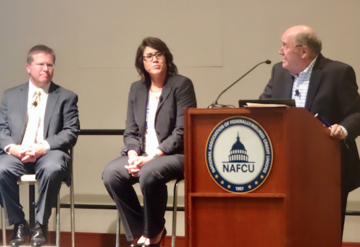
From left, Rodney Showmar, Kathy Chicas and Robert Marquette
HONOLULU–Three credit union executives talked branching strategies here, including why they are investing, where they are investing, or why they are not investing.
Here’s a look at the strategies and experiences outlined by each of the three credit union leaders during NAFCU’s 50th annual meeting here.
Robert Marquette, CEO, $3.6-billion Members 1st FCU, Mechanicsburg, Penn.
Members 1st is aggressive with branching, with 59 offices and plans for more, according to Marquette. It has also invested in robust call enter and electronic delivery systems, he said.
“This has to be an individual decision for every credit union. What’s your strategic vision? What are your growth goals? What is your FOM? What are your membership’s needs?” he asked.
Members 1st has a unique FOM situation. A former community charter, a banker lawsuit led to its FOM being changed to SEG-based. As a result, it now has more than 8,000 SEGs in its markets, according to Marquette. Despite the lack of an official community charter, it is aggressively out in its communities, he said, participating in 241 community events in 2016 as it seeks to be “very visible.”
Regardless of whether the contact is the branch or another channel, Marquette said Members 1st’s “Delivering Unparalleled Experiences” ethos, which is based on a model built by The Ritz Carlton, seeks to “deliver an experience to our members however they interact with us so that they come away wowed by that experience. It is a differentiator. We can’t compete with big banks on resources, but we can compete with them on service.”
Growth is a key component of Members 1st’s strategy, said Marquette, and that includes branching.
“We feel our branches project our community identity,” he said. “We use the same architecture and locate along heavily traveled routes. The more branches people see, the more it reinforces to them we are very convenient.”
The credit union uses four different branch prototypes based on size.
“Our strategic plan also focuses on delivering convenient service and very personalized service to connect with consumes,” Marquette said. “We feel it’s something people absolutely want.”
But why does it build multiple branches in the same community? Marquette said it’s the “networking effect,” in which growth becomes exponential. For instance, if the credit union builds three branches rather than two in a market, it sees 50% more assets as a result.
Marquette said 50% of Member 1st’s new members joined via the branch channel in 2016, and that 140% of its loan growth came from those new members, as well.
“After they join us we try to educate them to the convenience of our electronic services, but we do have a significant portion of the membership who for whatever reason like to come into the branches,” he said.
While Marquette said there is a clear correlation between its branch and membership growth, and that branch transactions were up by 12%, he noted that actual branch-transactions-per-member were down 7.8% from 2013-16.
Members 1st saw record membership growth in 2016, as big banks bought two local bank brands and disgruntled customers streamed to the credit union. In all, 66,000 members joined Members 1st in 2016; overall, it has 317,000 members.
“We really feel the branch strategy is optimal for us and to me the statistics prove that,” said Marquette.
Rodney Showmar, President CEO, $1.2-billion Arkansas FCU, Jacksonville, Ark.; 95,000 members; 14 branches.
Having just completed a core conversion, Showmar said Arkansas FCU is now focused on a branch expansion strategy in Central Arkansas where it has good brand awareness.
“We struggle to overcome what a credit union is, a lot of times,” he said. “Our focus is going to be on the part of the state where we are strongest.”
Showmar said there are approximately one-million people in its target market and that it has been growing approximately 4% each year.
“We know exactly where we want to focus our branch growth,” he said, adding Arkansas FCU is working with a third party to identify where it wants to be.
“At first, we were thinking we would just put one branch in one city, but now I now agree with the strategy of putting more in one area and backfilling some holes in areas where we are better known,” he said.
Showmar noted Arkansas FCU acquired one branch from a bank and the result has been some lessons about what NOT to do. “What we ARE going to be doing in new markets, and we’ve done this successfully, is start with a storefront (1,200-2,000 square feet) and get out into the community and let it grow, and not be locked into a long-term commitment if that doesn’t work out. We will grow that out under a five-year lease, and we are now going to build a complete standalone branch in that market. It lets us learn and grow and move forward.”
AFCU’s goal with a branch is 3,000 total members, 2,200 DDAs, $14 million in loans and $23 million in deposits within a three-to-five-year timeframe.
Showmar added Arkansas FCU has also looked at purchasing smaller banks in rural areas where it fits the CU’s strategy.
“So, we are looking for those opportunities in rural locations,” said Showmar. “And we have a merger strategy that if an opportunity arises both in-state and out-of-state, we are open to an expansion.”
Kathy Chicas, COO, Farmers Insurance Group FCU, Los Angeles; $761 million in assets.
SA single-sponsor CU, Farmers Insurance Group FCU has 50,000 members and a limited number of branches, although it does offer access via CO-OP Shared Branching.
Membership has been growing approximately 4% annually, even though the sponsor company has actually been closing some locations. Given that it has two types of members—individual agents and employees in its corporate office—not surprisingly, 25% of its members are small business owners.
“We have seen lots of growth in digital usage. Members are making the switch. Our online banking system performs two times more transactions than our branches,” said Chicas. “In April 2016, mobile transactions surpassed shared branch transactions for the first time. Digital adoption is a key trigger for ea00rning membership rewards.”