

LONG BEACH, Calif.–How old were you in 1994? It matters, especially to the future of your credit union, according to one person.
Speaking to NAFCU’s annual convention, James Robert Lay, a “digital anthropologist,” author of “Banking on Digital Growth: and CEO of the Digital Growth Institute, pointed to 1994 as a critical shift in consumer behavior as it was the year “the Internet reached the mass consciousness of humanity.”
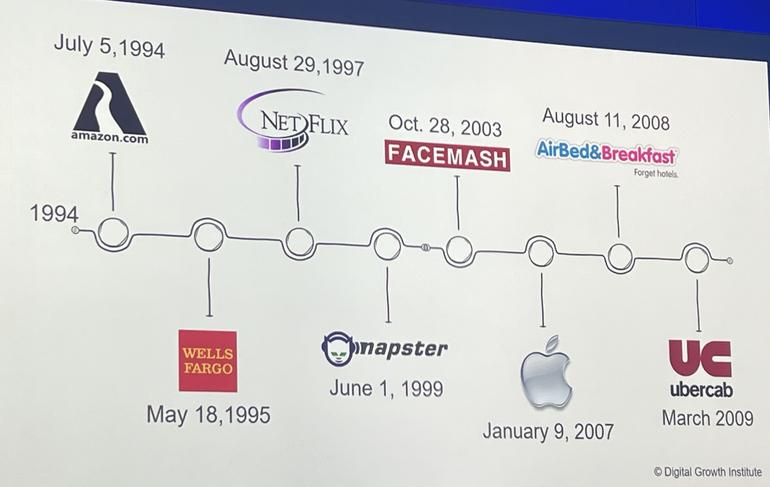
And another such shift is underway, he said, suggesting “we can’t understand where we are today until we pause to reflect on where we have been for a bit.”
Looking back a bit, he pointed to two other such transformational shifts that have come in short order: the shutdowns that came with the pandemic lockdowns, and Nov. 20, 2022, “the day AI reached the mass consciousness of humanity through the launch of ChapGPT.”
“If you have not played with ChapGPT, my strong recommendation is that you do so. It has the potential to truly transform consumer behavior once more over the next decade,” said Lay.
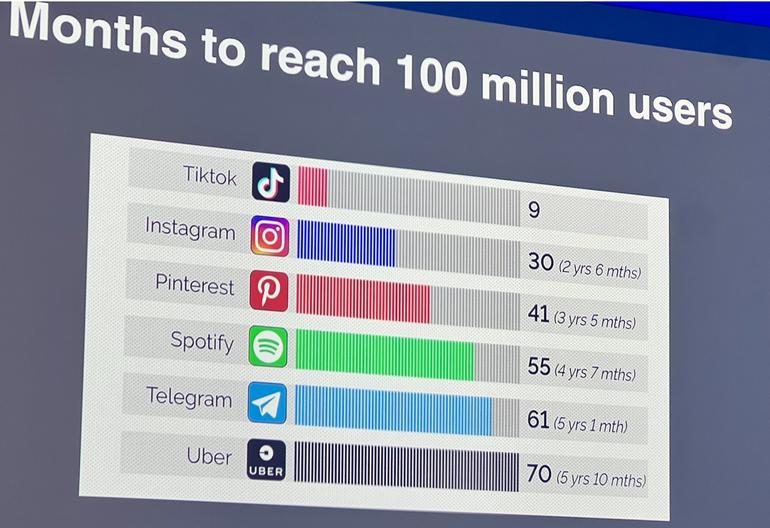
An ‘Entirely New World’
What every company/technology in the chart above has in common, said Lay, is that all are dependent on that connection to the Internet that began in 1994.
Now, Lay noted, his 10-year-old daughter is growing up in an entirely new world, as is a whole generation.
“How are their behaviors and habits, informed by their experiences, being shaped and reshaped?” he asked. “The challenge here is humans are linear thinkers and when technology is moving at an exponential curve, it creates a gap, and that’s where we experience confusion, complexity, conflict and chaos. And not just for leaders, but for our teams, our members and what they are experiencing.
Question is Posed

James Robert Lay presents at NAFCU's Annual Conference.
“So, my question for you is what is your perspective of the future over the next five to 10 years?” continued Lay. “Your perspective in the present moment is going to directly impact how you transform the operational model at your credit union to keep pace.”
He also urged CU leaders to take a breath to clear their minds in order to find calm, clarity, courage and confidence.
“All transformation starts by telling the truth about where you’ve been, where you are and where you’re going,” he said. “Only then can you take action to guide your credit union. Our brain is the most important technology to master in the age of AI.”
The Silent Epidemic
Lay said there is a “silent epidemic” taking place, and that is financial distress, which he said is taking a toll on people’s mental and physical well-being. He cited data showing 85% of Americans are feeling stressed about funds. Half of those with debt also struggle with mental health, he added, further noting that 31% of people say they are losing sleep due to financial stress.
Some Good News
Meanwhile, more than a third of people are too embarrassed to discuss financial matters because they think they’re worse off than their peers, according to other data cited by Lay.
Credit unions should also note, he advised, that 72% of Millennials and 59% of Gen Z’s feel pessimistic about achieving financial security in their lifetimes.
But there is good news, according to Lay: 79% of Millennial and/or Gen Z members said they have found financial advice on social media.
“That’s an opportunity for us as credit unions to really facilitate financial dialogue,” said Lay. “My question is, where is your credit union on YouTube, on Reddit?”
The Real Opportunity
The real opportunity to transform financial behaviors is in transforming minds, according to Lay.
“When you transform the mind you can really begin to transform the wallet. When you transform the wallet you can have an impact on people’s mental and physical health. When we help people experience new mindsets around money, they will experience new results.
“This is why human transformation is the key to unlocking digital transformation,” he continued. “More than 60% of digital transformation projects fail, not because of the technology, but because of the humans. Human transformation is the key to unlocking your transformation as a leader.”
What It All Comes Down To
According to Lay, everything comes down to the fact people are looking for two things: help and hope.
Lay said there are two simple questions to ask members and teams that will lead to exponential growth through human transformation. Those questions are:
- How do you want to GROW? What are your goals and roadblocks?
- What’s been going WELL? “Where has the credit union been winning? It’s so important as we move into the age of complexity to focus on our wins and to also explore the present and where we feel excited and energized,” Lay said. “And then, ‘What are we looking forward to and what have we learned along the way?’”