

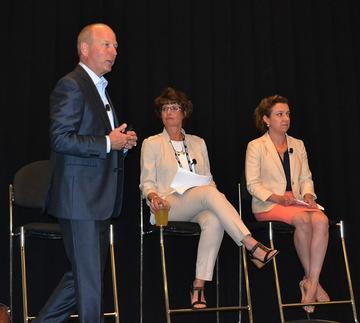
L-R: Pete Hilger, Anne Holtzman, Carrie Hunt
NASHVILLE—Credit unions that have done well with direct auto lending only to jump headlong into indirect have led to some CU “horror stories,” asserts one expert.
Pete Hilger, president of Allied Solutions, shared that point as he moderated a panel session on optimizing the lending portfolio during NAFCU’s annual meeting here.
Hilger asked panelists Anne Holtzman, SVP of claims and recovery at Allied Solutions, and Carrie Hunt, NAFCU SVP-government affairs and general counsel, to share advice with attendees on how to avoid producing their own indirect tales of woe about how delinquencies sharply rose along with charge-offs.
Holtzman emphasized that a key is understanding that the collections team at the CU, which has done well with the direct loan members, is likely to struggle in the indirect space.
“Your collections folks are ready to work in their environment; they know how to work in the footprint they deal with,” she said. “But you make them enter the indirect world; it’s like asking an English teacher to teach math.”
Holtzman emphasized that the credit union must quickly get some honest answers from the collections team about what they feel they do well in working with indirect members and where they feel they will struggle.
“So you go out to some third-party collections firms and get the help where it is needed,” said Holtzman.
Holtzman said one of the biggest problems the in-house collections team will have when moving to indirect is having to adjust to working in a more widespread geographic area, possibly in other states, as a result of indirect relationships.
Third-party solutions understand how to be compliant with repossession and collections in many states, and have the ability to manage large groups of repo agents, Holtzman said.
“That makes this model very attractive when you go to indirect,” said Holtzman. “Third-party firms generally have high recovery rates, in addition to having the resources. So investigate the use of nationwide resources in the skip and repo market.”
A big mistake credit unions often make when entering the indirect space, said Holtzman, is applying the same collections practices and standards used for direct to indirect. One important adjustment to make is to markedly shorten the amount of time before the CU repossesses the vehicle from an indirect member.
“That indirect member will move more quickly to default on you than the direct member,” she said.
She also cautioned credit unions not to sign on with a third-party recovery program with a partner they are not certain is compliant with repossession laws across the country.
“Never sacrifice compliance for a higher recovery rate,” Holtzman said. “Which is more important to you, recovering a car or avoiding a lawsuit?”
Hunt cautioned that collections and auto recovery practices are coming under CFPB scrutiny, and that new rules are likely coming soon.
“The CFPB has broad authority regarding unfair and deceptive lending practices,” said Hunt. “They are looking at collections practices closely. The Bureau is working on a debt collection rule we expect will be released shortly, and it potentially could raise some issues in the debt collection space.”