

LAS VEGAS–There’s a “new age” for credit unions and CUSOs when it comes to investing in fintechs—and it’s an age that’s more sophisticated, challenging and potentially more rewarding or costly, depending on the decisions a CU or CUSO makes.
Seeking to help credit unions and CUSOs to make smarter, more profitable decisions was the subject of a panel discussion during the NACUSO Network meeting in Las Vegas.

From left, David Milkes and John Dearing
The discussion was led by Nick Evens, president and CEO of Curql Fund, which now has 56 CU investors and a total of 68 limited partners backing it, representing $252 million in committed capital. The CUSO has done 17 fintech investments to date, with one exit. It has deployed $88 million in investments over 23 months.
And there is no shortage of fintechs looking for credit unions as investors. Evens said Curql has 1,200 fintechs in its CRM.
Evens was joined by David Milkes, director of M&A and strategic services with Doeren Mayhew, and John Dearing, a partner with Capstone. Both Milkes and Dearing have worked with CUs AND CUSOS on a number of transactions, acquisitions and more.
The object of the discussion, according to Evens, was to share knowledge around opportunities and possibilities in fintech as well as how to have the right kinds of conversations between credit unions and fintechs.
“The sophistication involved in investing in a fintech or a CUSO has substantially increased over the last few years,” said Evens.
Rapid Growth Slows
Evens shared with the audience a slide showing the growth in investments in fintechs (below), activity that has slowed this year in large part due to higher interest rates and cost of funds.
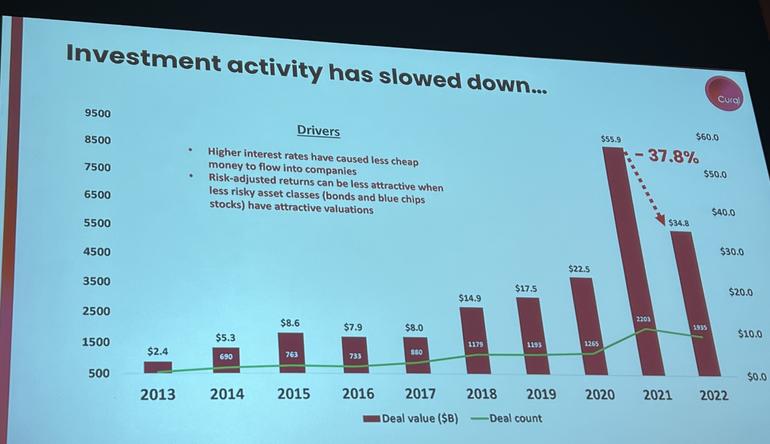
“Risk-adjusted returns are starting to look less attractive in certain asset classes,” said Evens, saying the trend continues.
The other side of the coin, however, according to Dearing, is there could be deals to be had as others move to the sidelines.
Evens said fintech valuations have also started falling, a key trend he said credit unions should give attention. As an example, he cited one group of CUs that recently invested at too high a valuation, meaning they overpaid.
Lots of Dry Powder
“There is still lots of dry powder in the market with lots of funds chasing fewer good deals,” said Evens. “The problem is there is so much money sitting in the market that when things break loose, I think we’re going to see a spike in valuations.”
Asked if they shared that view, Milkes said he is “optimistic” about the market, agreeing many companies have been over-valued but now valuations are more realistic.
Dearing added there are also a lot of people who had been pursuing capital or who have now pulled themselves out of the market, due to conditions. For that reason and others, he said his company often must “manage expectations” with CUs, CUSOs and other investors looking at investing in the fintech space.
What Needs to be Considered
At Curql, Evens said the company looks at five investment criteria when making investments (see chart, below).
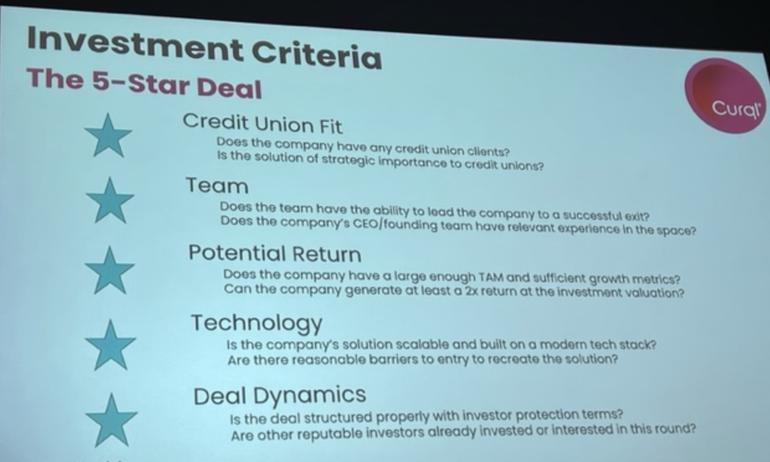
In follow up, Dearing said he concurred with the five Curql criteria, adding, “It’s strategy first for us. It’s about looking yourself in the mirror and deciding what kind of investor do you want to be? Are you early stage? Later stage?”
Meanwhile, how the fit is defined with every organization is going to be different,” said Dearing.
“When people talk about fintech there are a lot of different subcategories,” he said. “When I see strategy first, pick your poison. The first question for the board is what category do you want to look in? You want to be proactive and strategic about it.”
Milkes said every discussion he has had with a credit union or CUSO has always begun with defining the criteria. “It’s a difficult process to narrow down. It’s about is this someone I can partner with that I can trust?” he said. “For a lot of credit unions and CUSOs we work with it’s a highly emotional point, the terms of the deal. And once it’s over, it’s about making sure the credit union is protected.”
One Test Scenario
Evens asked his fellow panelists about a different scenario—six smaller CUs coming together, seeking to buy their core, which is struggling. But they need to keep it together yet can’t come up with all the money needed.
“What do you do?” he asked.
Dearing said the first step would be bringing everyone together upfront over where the commonalities, nuances and polar opposites are around the reality of the deal’s structure. Some may bring funds to the table, others may bring people.
Then there is the oversight/governance piece, which don’t have to be equal regardless of the capital invested by each, Dearing said.
“Then, if they can’t get the deal done without needing more capital, it’s about filling that void, followed by the needs, wants and desires of the seller,” he explained.
Another Key
Milkes said he has been in a similar situation with a number of credit unions, and he agreed it’s key to decide how decisions will be made and who has control. One CU may want more control, for instance.
“Then it’s really about trying to filter through the potential deal dynamics. You have to ask what is the objective of acquiring the core?” Milkes said. “Is there an actual future or is this a Band Aid? If it’s a Band Aid, it’s going to be expensive and you may need to move to new core.
As for the lack of equity issue, Milkes said questions will need to involve raising more debt or potentially prepaying for a period of years.
Active Vs. Passive?
Another big issue, said Evens, is whether a credit union making an investment plans to be active or passive.
“In other words, will it be a user and investor or an investor only?” Evens asked. “It’s no secret there’s no bandwidth in credit union IT staffing, so making plans to integrate a new solution demands some hard questions and analysis occur first.”
Evens said when it comes to investing, credit unions also need to ask themselves if they prefer to hire the expertise? Go it alone? Partner with other CUs? Just let the experts do it via a fund?
So, how does a CU find and evaluate investment opportunities? Evens said it can:
- Hire the expertise
- Let them come to you
- Leave it up to the experts via a fund
In the case of Curql, Evens said the CUSO’s investor have told him “we hired you to be our outsourced eyes and ears for what’s going on in the fintech space.”
Structuring the Deal
How does a CU/CUSO structure investment opportunities? Evens said it’s about knowing what the key negotiation points to highlight are, including valuation, terms, note vs. equity, preference and exit.
“This is where the sophistication has come into play in the market today,” said Evens.
Of those five bullet points, Milkes said “this piece is critical to protecting yourself as an investor. There have been a couple of opportunities’ where we have had to ask the company to prove their valuation, and then we asked them to hit X, Y, or Z targets in a year or two, so then the investor will pay more.”
Item to Move to the Top
Dearing said the last bullet point, exit, is the one he would move to the top of considerations.
“Until you have those conversations you may not see some of the nuances that need to be brought to the forefront. On the valuation side, it’s about making it very simplistic,” said Dearing. “It’s a very different negotiation if the (founders) are going off to an island, or are they are going to remain onboard? Be open and honest and transparent about assumptions, realities around expenses, what needs to be done to grow the organization faster. There is the dialogue today but also opportunity for growth moving forward that can be weaved into that dialogue, as well.”
It’s Called Fresh for a Reason. And We Offer Home Delivery. For Free!
The biggest, best and freshest news reporting in credit unions remains free in ’23! Each morning CUToday.info delivers its daily Fresh Today news update offering the latest headlines and breaking news right to your email, with the easy-to-read headlines format allowing you to click on the stories that interest you most in order to learn more.
If you haven’t yet signed up for the new email solution on which CUToday.info has partnered with ResponseGenius, you can do so here. Signing up requires less than one minute of your time—and it’s free!
Please note that after signing up you may need to go to your Spam/Junk folder and mark the morning headlines email as safe. CUToday.info does not provide its list of readers and emails to outside parties, and we will not be contacting you to sell you an extended warranty or sending you any links so you may cash in on an inheritance you didn’t know was coming.
And did we mention it’s free?
Please note and/or make your IT department or email administrator aware the emails will be coming from the domains CUTodayinfo.com and CUTodayinfoReply.com