

LAKE BUENA VISTA, Fla.–The challenges to credit unions and CUSOs when it comes to attracting and retaining talent are well-known and changing, and a trio of experts here offered their insights into how to best respond.
Participating in a panel during the NACUSO Network meeting were Jill Nowacki, president of Humanidei; Heather McKissick, CEO of CUES, and Renee Sattiewhite, CEO of the African American Credit Union Coalition.
They joined NACUSO CEO Ronaldo Hardy in a Q&A on a variety of issues related to building talent in organizations. Here’s some of what was discussed:
Hardy: What about Generative AI and the human element? With it on the rise, how will it effect recruiting and the human element?
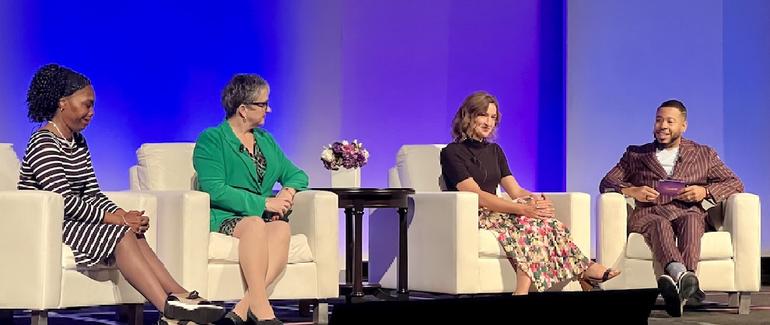
From left: Renee Sattiewhite, Heather McKissick, Jill Nowacki, and Ronaldo Hardy.
Nowacki: AI is kind of like when Google came along. The question was will people Google everything and no one will have a thought? You still have to ask the right question. And that is true with Generative AI. We have to ask the right questions about the candidates we’re looking for or the algorithm isn’t going to find them.
If you are a job seeker out there, let me give you some advice. We asked candidates (in one search) to tell us about a brand you love and why? A lot of candidates all cited the same Nike example. They had used ChatGPT. As recruiters, we recognize we have to ask another question of our candidates. We have to ask, ‘Tell us about your personal experience working with a brand?’
McKissick: This is about issues, skills and relationships. The idea is that AI is here to help us generate content, to help us understand the issues to be potentially more informed about the industry or the movement. It can be a really helpful tool for us.
I think we need to get past being concerned or afraid of that as long as it is used with integrity. When it comes to talent and leadership development, we really need to remain mindful of these other two key components—and that is the skills and the relationships. So, what do you do once you have that content generated with integrity? How do you approach being a leader or developing the talent that we are recruiting to best utilize those issues or that information in your organization? How do we help people develop the relationship management skills that they need in order to do well?
I'm not concerned about AI in the world of talent and talent development, because it's going to provide some great content. But the process of understanding what it means to be a leader and how to develop the leadership skills that we need remains the same.
Sattiewhite: I keep having these AI conversations. I'm working with Microsoft now and am having an up close look at how AI is created. I still go back to the human element.
I remember when we went from DOS to Windows I went kicking and screaming. I look at AI as a tool. There's an opportunity to be better. It's an opportunity to have more content, to have people who are looking at things in a different way. I think recruitment and AI will go hand in hand.
Hardy: There is a really big shift in what organizations are expecting from leaders, one of which has grown significantly, EQ. Tell us about the evolution in skills needed to be successful?
Sattiewhite: For example, when we talk mental health, we had a staff meeting and my staff was burned out. On a Wednesday, I told everyone that on Friday they shouldn’t do any work because they were just that tired.
But one of the things I'm challenging them to be is to not be unreasonable with themselves about kindness. I believe when people are kinder you get so much more done. So, I'm telling leaders to make sure that you're being kind, make sure being respectful. Those things matter.
McKissick: I think that what we have seen recently is a swing in the pendulum around emotional intelligence to the self-awareness components of that, not that there's anything wrong with. A lot of employers are starting to look for a balance of those things now to swing that pendulum back to the center where there is an equal emphasis on self-awareness.
We talked a lot about resilience and I've been talking a lot about resilience myself lately. I'm starting to even shift that thinking to think less about resilience in terms of bouncing back to thinking more about this idea of needing to be elastic leaders. I think that that's the idea around real emotional intelligence, that we can we can expand or shrink to fit the appropriate situation based on our and our organizations. That’s really all about change management. That's about communication, which goes back to your question around technology. The faster technology moves, the more we are dependent upon and reliant upon technology…We cannot clutch much longer to the legacy ways of doing things if we think that we're going to remain relevant as an industry.
Nowacki: One of the areas we look at in our assessments (of candidates) is paradoxical leadership, which fits well with elasticity. (The old assumption was you) can get either a leader who is more empathetic or get a leader who insists the rules be followed. It shouldn’t be either/or. You want someone who can build rapport, but also hold them to the highest level of accountability. I don’t think you need to make that trade-off. Yes, you have to manage the business, but you should do that with kindness and resilience. Your organizational culture will never be better than your most toxic employee.
Hardy: Tell us about addressing toxic employees?
Sattiewhite: I had an employee who had incredible performance and who did great stuff for me, but she was really mean. I had one person say to me, ‘I can't work for you if she's still there.’ That made me really aware that one person can mess it up for everybody. So, the other lady is gone and I'm so glad I did that.
McKissick: The false dichotomy is something many of our organizations still default to, which is the performance metrics and the financial scorecard or whatever the case might be, is the ruling rubric for the organization, instead of equally considering the importance of the organizational culture. (CUs) emphasize business or financial acumen. But there are a lot of chief human resources officers out there who would make a phenomenal CEOs. Why are they not being given the same opportunity as the chief financial officers across the industry?
Hardy: What about mental health wellness>
Nowacki: With progress there is always some pushback. One thing I’ve observed in some cases is there is this fear that if we give people this much latitude (with hybrid work or work from home), there is this lack of accountability and we won’t get the results we need.
Managers look to control the input points. I’ve seen a bit of a surge in some organizations recently where people are locking things down and creating more negativity, and the employee response –the mouse-jigglers (in organizations that measure whether a person working from home has moved their computer mouse)—where controls are being put in place, are in places where management is saying, ‘If you are going to work from home, from 9-5, you’re mine. They are then saying, ‘Great, but after those hours don’t contact me.’
Sattiewhite: I can't even imagine tracking them like that. That would unnerve me. If you don't trust your employees, why would you have them?
McKissick: Balance is a process, it’s not a state to be achieved and maintained. But a lot of folks still believe that to be true. They want to have all 10s, all the time, which we all know at this stage leads to burnout for everybody.
It’s more like a (sound) mixing board, this idea of balance. You're going for the overall balance of the sound. If you’re going to dial up on something, something else is going to have to automatically be dialed down. I think that's the process all of us are still working through, especially now, post-pandemic,
is how do we make sure that we know what that optimum mix is and stop trying to push all the dials to the top? That is something that I think women workforce have noticed doesn't work. There are more and more men in the workforce, and we are focusing on working families, working parents, not just working mothers.
I think that idea of what is the balance process is something that leadership and management can do a better job of paying attention to.
Hardy: How can leaders better tell their story?
Nowacki: The mistake candidates make is if a question wasn't on the test, they don’t answer. The reality is that it you know that human experience, that leadership journey, it's still unique, so if I've never asked you about you know how you overcame a specific challenge, the candidate thinks, ‘I guess I kind of talked about this.’
Even if the recruiter says or hiring manager says, ‘Tell me these three things,’ and you know your story is different than that, make sure you tell that story. Look for that opportunity to stray a little bit more and look at the process, not with some prescribed formula for check these boxes. This is an opportunity to get to know your perspective employer, let them get to know you.