

LAKE BUENA VISTA, Fla.–Credit unions and CUSOs here were given an update on legal issues they need to be watching across a broad array of functions, some of which they may not even know about.
Speaking to the opening session of NACUSO’s Network Conference here, attorneys Brian Lauer, Amanda Smith, Michael Mulvey, Jennifer Winston, and Mike Heller of Messick Lauer & Smith P.C., which has been the long-time legal counsel to NACUSO, discussed everything from CUSO regulations to the CFPB to the Chevron Deference to open banking rules.
Here is a look at some of what was discussed:
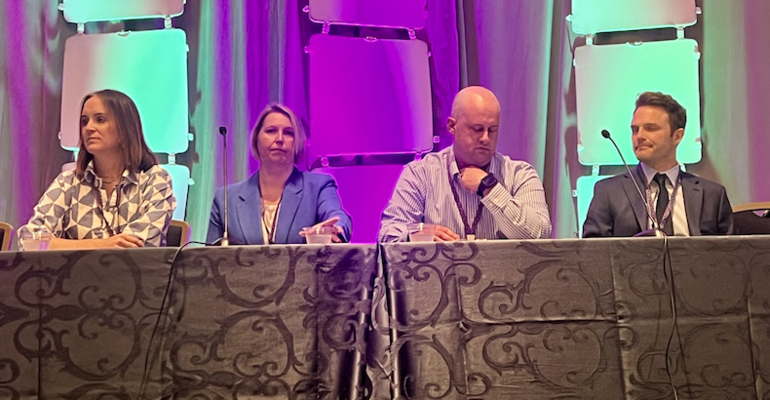
Panel discusses legal issues during NACUSO Network in Lake Buena Vista, Fla.
Regulatory Advocacy
“We have been advocating for several years to allow CUs to have the investment authority to invest directly in fintech,” Lauer said. “Right now, credit unions can only invest in financial technology if that company is a CUSO. We believe that credit unions, and fintech for that matter, would be much better served if CUs can invest directly without having to have that company comply with the CUSO regulations. Banks are able to invest at a much quicker pace, and we think credit unions should have the same opportunity.
Lauer described CUSO regulations as “arcane,” noting most were created at a time before the vast adoption of the Internet.
Brokering Deposits
Lauer said NACUSO also wants credit unions to have the ability to broker deposits, which is currently prohibited in large part due to FOM rules. He said the trade group believes NCUA could provide the leeway needed to broker deposits, which he said would be especially important now given the liquidity crunch.
Uniform Member Application
NACUSO also met with members of the NCUA over the issue of a uniform member application, which would allow for “more robust” relationships with fintech originators of both savings and loans, according to Lauer. He said many fintechs struggle with the membership issue.
‘It will help with CUSOs to be the gateway into credit unions for these lenders,” said Lauer, adding that the NCUA board members were at least open to the proposals and did ask questions.
Opposition to Oversight
What is NACUSO opposed to?
For the most part, the trade group is advocating against NCUA having third party oversight authority, for which both NCUA Chairman Todd Harper and Vice Chairman Kyle Hauptman have both expressed their strong support.
Third party vendor oversight authority would require approval of Congress.

Brian Lauer at NACUSO Network meeting.
Mike Mulvey: The Corporate Transparency Act
Mulvey directed his comments toward the Corporate Transparency Act, which went into effect Jan. 1 and which was passed with a goal of giving the federal government powers to combat occurrences of money laundering, tax fraud, drug trafficking and terrorism in the United States through the use of shell companies.
“So, the first thing you want to think about is whether or not you're even one of these reporting companies, and the definitions are fairly broad,” said Mulvey. “As I mentioned, (reporting companies are) any corporation or LLC or other entity created through the filing of a document with the Secretary of State or similar office in the United States.”
But he noted there are also 23 exemptions to the rule, including credit unions. It’s the companies with which many CUs may partner that are not exempt, hence the reason to be aware of the rule.
As a result, reporting under the CTA would need to be done on a “case by case” basis, he said, and that includes beneficial ownership information along with a long list of other data.
Mulvey said there are third party services that can provide assistance with compliance.
The General Advice
In any case, he said the general advice is to collect the information now and then hold on to it until it is required to be reported, in case there are any other changes.
Penalties for noncompliance can include fines of up to $500 a day up to $10,000 Mulvey added.
Access to Info
“From a credit union perspective, another aspect of the Act is it gives financial institutions access to the information for due diligence,” Mulvey said.
He also shared one other caveat, noting there has already been one court case that found the Act is unconstitutional for those specific plaintiffs.
Jennifer Winston: Consumer Financial Protection
For those hoping the CFPB’s powers will be watered down by the Supreme Court, Winston said that is very unlikely to be the case, as the questions asked by justices in a case involving the Bureau’s constitutionality indicated they seemed to support its funding mechanism.
“We don't have an opinion yet, but we’re pretty sure the CFPB is here to stay. We see no slowing down,” said Winston. “Every day on LinkedIn they are posting a new job for an examiner.”
No Deference to Chevron Deference
On the other hand, based on those same justices’ questions in a case involving the so-called “Chevron Deference,” in which courts generally defer to regulatory agencies’ interpretations of laws, could be on its way out, she said.
“What’s the impact going to be for you?” asked Winston.
She answered by saying it could mean interpretations of various laws on a “jurisdiction by jurisdiction” basis.
“You may have one ruling in one state and a different ruling in another,” said Winston. “You could have a different interpretation of what a federal agency regulation means. If you're a regulated entity, you may not be able to rely on an agency's interpretation, as you may not be in compliance. You may be thinking you're doing something correctly and, ultimately, the court in your jurisdiction could say, ‘No, that's not correct.”
One result, said Winston, could be venue shopping by plaintiffs aiming to challenge regulatory decisions.
Additional Points Made
Other points made by Winston:
- Advisory Opinion and Circulars are different ways the CFPB has been making rules. This includes rules related to UDAAP.
- The CFPB is in its sixth in a series of rulemakings related to supervisory authority over nonbanks that participate in the market for general use payment apps, such as digital wallets, P2P, etc. Its rules apply to those with more than five-million annual transactions.
- The NCUA. Winston cautioned credit unions and CUSOs to watch for more of a focus on consumer protection from NCUA. She noted NCUA Board Member Tonya Otsuka has said “safety and soundness and consumer financial protection are not two separate things.” It is also a priority of Chairman Todd Harper.
Amanda Smith: Much Attention on ‘Junk Fees’
Smith reinforced for her audience just how focused the CFPB is on what it sees as “junk fees,” noting the Bureau has an entire webpage dedicated to the issue, along with blog posts, enforcement actions and more.
“It’s probably one of their top priorities at the moment,” said Winston, adding the objective seems to be to eliminate all fees, and not just at financial institutions.
“The first question is, what is a junk fee? And I half-jokingly say it is anything that makes you money,” said Winston. “There’s not a definition out there and there likely won't ever be. This is going to be something that's going to be handled on a case by case basis.”
‘Characteristics’ Being Targeted
But there are “characteristics” the CFPB looks for in defining junk fees, according to Winston, and those are fees that are charged at the back end of a transaction, that are not initially disclosed at the onset of a transaction, and where it believes some deception is involved.
As CUToday.info has reported, that umbrella term “junk fee” is one the CFPB and other regulators have been applying to overdraft and NSF fees.
The Bureau has also targeted credit card late fees with its new cap of $8 for the largest issuers (although the rule is expected to affect all issuers, due to competition in the market).
In addition, it has targeted debt collection fees, “convenience” fees (such as for asking for account information), paper statement fees, and fees related to mortgages, including discount points.
Mike Heller: Watch Data Management
Heller stressed the importance of having “practices and procedures” in place to manage data, although he said he also believes there's also a “big opportunity” to collaborate with third parties on the issue.
As CUToday.info has reported, in October of 2023 the Bureau proposed rules around “personal data rights” as a preface for support of open banking, for which Director Rohit Chopra has expressed strong support.
Heller said that rule is expected to become a final rule in the Fall.
“The purpose of this rule is the better facilitate open banking in the industry and to provide consumers with greater control and access over their financial data,” said Heller.
That will involve not just credit unions and CUSOs, but data providers of many types, along with fintechs that provide products and services in concert with credit unions, he noted.
“The reg is to make it easier for passengers and authorized third parties to gain access and control of certain data, and this should be in a usable electronic format,” he said. “This data also can be can't come at a cost to the consumer. You can't charge…to perform an actual data access request.”
The Challenge Ahead
He added there is a specific requirement that data providers publicly disclose and update developer interface response metrics to enable data providers to actually evaluate their performance against other types of interfaces.
Yet indicative of the challenge ahead, he added, “But then the rule also states that it must be considered consistent with similarly situated interfaces without giving any further guidance about what that actually means. So, that's something we'll look forward to more in the final rule.”