

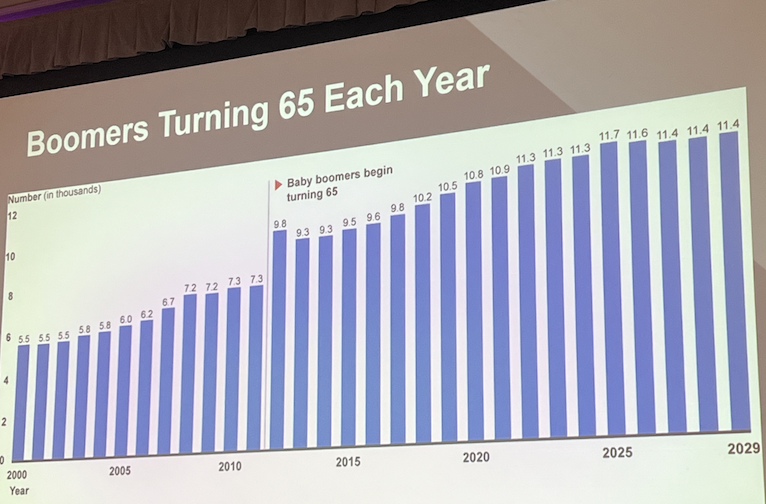
LAKE BUENA VISTA, Fla.–With 11,000 Americans turning 65 every day in the U.S. during 2024, credit unions and CUSOs gathered here were told they have a huge opportunity in offering Medicare services to members to drive new revenue, provide member services and recruit non-members.
Credit unions that aren’t offering a product to members need to understand that members, especially those turning 64, are going to be inundated with phone calls, mail and email from companies seeking to sell them Medicare services, according to a panel discussion here.
Many of those “bombarded” consumers won’t and don’t know who to trust—and that’s where the credit union steps in to help, according to those same panelists, who cautioned that many of those pitches are from investment firms and big banks that aren’t really about Medicare as much as they are about getting control of financial relationships and assets.
Discussing the issue during the NACUSO Network meeting here were Nick Bloxham of the Selco Group; Cara White of AmeriCU Insurance Services; Eric Neumeyer of My Member Insurance Agency; Rock Carter and Stanton Furness of MedicareCUSO; and Lous Marinaccio and Kyla Von Reuden of IHC Medicare Benefits.

Panel discusses Medicare during NACUSO Network meeting.
The How & Why
Bloxham of The Selco Group, a CUSO of SELCO Community Credit Union in Oregon, outlined how and why credit unions should consider exploring the distribution of Medicare services to members through an owned solution, such as a CUSO, or thorough a partnership with companies that specialize in the complex offering.
The key is being flexible and putting the member first, according to Bloxham, who outlined the fundamentals around Medicare, which was created in 1965 with parts A and B, with subsequent additions since then.
“Most of your members, 98%, are not going to stay on original Medicare,” said Bloxham. “But the ones turning 65 today will stay on original Medicare. That’s where we come in as a credit union. They are going to choose some type of coverage beyond original Medicare. You can help them answer questions. This is a huge hole when your member turns 65.
“This is a small offering in our credit union, but in terms of feedback this might be the most amazing thing we do,” Bloxham added.
A Huge Market
He illustrated the opportunity in terms of Americans becoming eligible for Medicare with the two slides, below.

Bloxham said CUs can help members sign up for coverage beyond Medicare by advising on their two options: Medicare supplement plans (for some members it’s the only option available, due to location); and Medicare Advantage Plan—Part C, which is offered by private companies. Part C includes Parts A and B and portions of Part D.
“(The latter) is the one that gets the most coverage because it’s super competitive with benefits and often there are no premiums. How often do you sell something to a member in which you don’t ask for any money?” he asked. “They are just making an election. There may be a premium, but they have options for zero premium.
Where the Revenue?

Nick Bloxham during NACUSO Network meeting.
How do CUSOs and credit unions generate revenue thorough the program?
According to the panelists, three ways: agent commission, agency override and per-click payments.
A Case Study
Kara White of AmeriCU Insurance Services, a CUSO of AmeriCU Credit Union in New York, shared her CUSO as a case study. She said it:
- Uses only 1099 contractors
- Acquires top contracts with carriers like UHC, Regene, Aetna
- Attracts the best agents by providing them with leads
- Pays the agents the full agent commission and makes money on the agency override (which it own indefinitely)
- Makes money on any enrollments completed by the agent (agent owns their renewals)
One CUSO’s Offering
Rock Carter of MedicareCUSO in Salt Lake City, said his company offers a variety of Medicare solutions to credit unions using a partnered approach.
“Our approach for the Medicare market over the years has been one of flexibility and to meet you where you are,” Carter said. “As a CUSO we tend to understand how you approach your business model. Do you have the expertise and agents? What level of renumeration? We help you to walk through all of that, plus the risk and reward.”
Added Carter, “The feedback and stickiness and positivity in this opportunity is absolutely brilliant. The challenge is how you get into it.”
Carter stressed that when a person’s healthcare is involved it is imperative to be careful with everything, as it involves doctors, medications and more.
What’s Available
MedicareCUSO offers:
- Fully managed option in which it provides the agent in both remote or local environment to work with member and provide fully outsourced service
- Self-directed option in which the credit union provides the agent to work with members and is involved with management of the program.
- Hybrid option, in which the credit union can prove the agent but have MedicareCUSO manage the agent and have call center based agents supporting the program.
‘Very Comfortable’
“We are very comfortable in our CUSO role. In each market we try to get as many carriers as possible, and that has some challenges,” said Carter. “But everything associated with those, such as doctors, is very important. You don’t want to force people to change doctors. Ultimately, you want to make sure every decision is in their best interests. Education and bringing that member to the right decision is how you want to focus.”
Other Points
Other points made by panelists included:
- “The member has to make a choice. If not, they will have late enrollment penalties for the rest of their lives.”
- “Everybody who is 65 or older was at one point 60, 61 or 62. Think about monetizing your database so those people so they are loyal to your credit union. When they turn 64 they will be inundated with every single offering. I think the value proposition in credit unions today is member loyalty. Let’s show members you are ahead of the curve on Medicare and Medicare products.”
- “We offer a very comprehensive marketing plan. People 65 or older like something in print.”
- “Let’s treat it as a profit enter. It can be if it’s managed properly and the members are treated right.”
- What member information is needed from a partnered CU? Public, non-private information. “Date of birth is a key piece, and then basic info beyond that. It’s low risk on part of the credit union.”
- “This isn’t something you can dabble in. There is a lot to understand, especially with compliance.”
- “Credit union joint marketing agreements should require that CU investments be sold.”