

LAKE BUENA VISTA, Fla.–NCUA Vice Chairman Kyle Hauptman said he continues to be driven by the three priorities he brought with him while he joined the agency, while also pressing credit unions to play a role in improving the “customer service” at NCUA.
In remarks to NACUSO’s Network meeting here, Hauptman said those three priorities are:
- Improving the process involved in starting a credit union
- Improving the level of service NCUA provides to credit unions. “We are a monopoly providers. Monopolies provide high prices and poor service. We owe you quality service.”
- Prioritizing attention to blockchain and crypto.
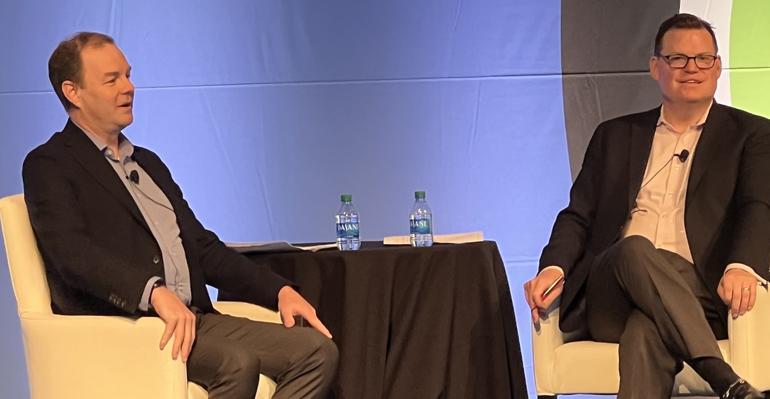
Brian Lauer, left, with NCUA Vice Chairman Kyle Hauptman.
On the latter point, and before an audience made up of numerous CUSOs and fintech startups, Hauptman touched on a point he has made before: “I don’t want to see credit unions go the way of Blockbuster Video because their regulator wouldn’t let them be innovative. You shouldn’t be losing mindshare and marketshare because you think your regulator won’t let you do new things.”
Moreover, Hauptman said he believes crypto and blockchain can play a role in improving inclusion.
Helping the Have-Nots
“Ownership of crypto skews young and non-white. Anything that is better, faster and more secure generally leads to more financial inclusion,” he said. “Technological innovation usually helps the have-nots more than the have’s.”
But what about risk, asked Brian Lauer, who moderated the discussion:
“One thing I’m trying to push, and it’s not easy at a government agency where the thinking is very short term, is a new view on risk. As a fiduciary for the NCUSIF, not getting new members is a long-term risk. If we don’t allow new things and drag our feet, then that is high risk.”
Speaking to the issue of start-up credit unions, which remain relatively rare, Hauptman said, “It’s not our job to say how many credit unions there should be. It is our job not to be an obstacle. There is ‘too big to fail,’ but we don’t want ‘too small to succeed.’ A group of people in a place saying we are not satisfied with our current financial services offerings, saying we want a de novo, that’s financial inclusion.”
Other Questions, Answers
Other questions posed to Hauptman during the Q&A:
Q: What about the recording of exit interviews?
Hauptman: If it were up to me be automatic. Now a credit union must request it. (The recording) changes behavior. I think more communication makes for better customer service. Please, please, please request a recording. Recording in-person is a little harder, it was easier in a virtual environment. But you’ve been allowed to record your exit exam for years, you just have to give a copy to NCUA. I think it would be very useful. If I were a new CEO, I’d like to be able to listen or watch the last exit interview. This is long overdue. It should make it easier for us, too.
Q: NCUA’s guidance around third-party due diligence is so ambiguous that our compliance officers and others are taking the path of least resistance around the new innovators coming into the marketplace. Please clarify the guidance.
Hauptman: Vague guidance is brutal. The whole point of guidance is it’s not the rule. It’s supposed to be further clarification because times change. All I can ask you to do is this: if an individual credit union doesn’t want to communicate with us directly, use a trade group or a vendor and say, ‘We want to do X. We are unclear if we can. We need these words on NCUA.gov.’ We need your help. Spoon-feed it to us.
(One audience member also called on NCUA to move faster on guidance around machine-learning and AI, saying financial services is on the “precipice” of a significant change and credit unions are in danger of falling behind.)