

LAS VEGAS—With the Federal Reserve all but admitting it’s likely to make a mistake and push the economy into a recession, one economist offered credit unions and CUSOs gathered here a forecast for what’s ahead, including a recession—but he could also be mistaken, plus, it appears there is some good news.
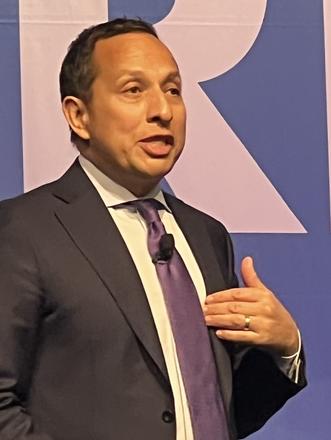
Gene Goldman addresses the meeting.
Sharing his viewpoint with the NACUSO Network meeting was Gene Goldman, chief investment officer and director of research with Cetera Investment Management.
Goldman, who also spoke to NACUSO’s 2022 event, said three themes he stressed last year remain true in 2023: the Fed remains aggressive, the Fed has said a policy error is likely, and market volatility remains elevated.
“Think about this: last year the S&P 500 was down, while the 30-year Treasury, a conservative investment that should have done better, was down 33%,” said Goldman. “Diversification didn’t work.”
Goldman said the Fed’s statement that a “policy error is likely” is the “fancy way of saying the Fed is going to mess up and put us into a recession.”
How Did We Get Here?
How did the economy get into this situation where inflation is so high? All economists point to the 2020 recession—the shortest in U.S. history at two months, and it was a services-led recession—while personal income rose. “This has never happened. Combine all this with supply chain issues and you have what created the recession and the inflation story. But it’s not just that story. It’s also household formation.”
A Look at Households
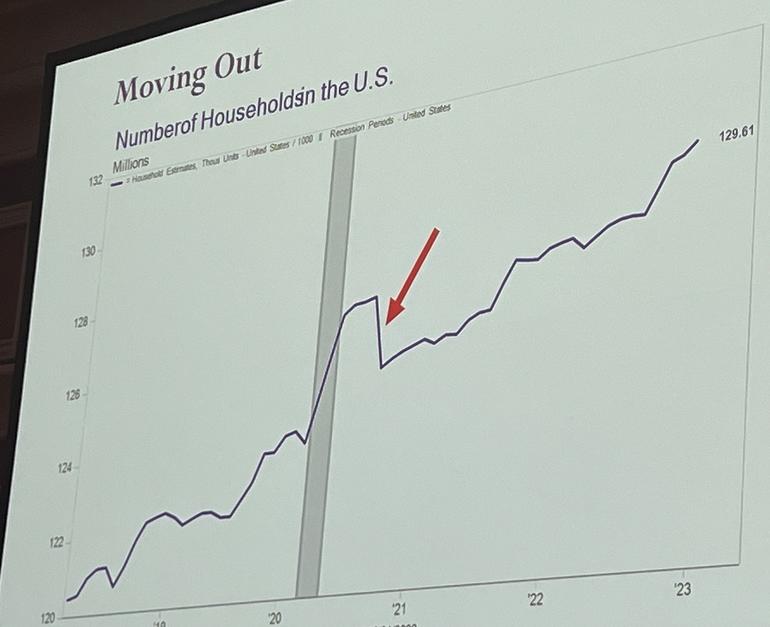
Goldman showed a chart (below) showing the steady growth in number of households, although the number fell off a cliff in 2021 when 1.8 million households suddenly disappeared for a variety of reasons. But as the chart also shows, there was a big rebound in households, with both home prices and rent surging and driving inflation.
In looking to the stock market, Goldman said there are better valuations, but higher rates and inflation. The current P/2 ratio is 17.5 or so, down from 22 a year ago.
“Valuations are lower and not reflective of where interest rates and inflation are at this time,” Goldman told the meeting.
In looking at the Fed, before citing the old adage that “bull markets don’t die of old age, but rather they are killed by the Fed,” he said, “The Fed makes so many mistakes. They have pushed us into recessions 11 of the last 15 times they raised rates. The do too much, too fast. Everyone is watching the Fed.”
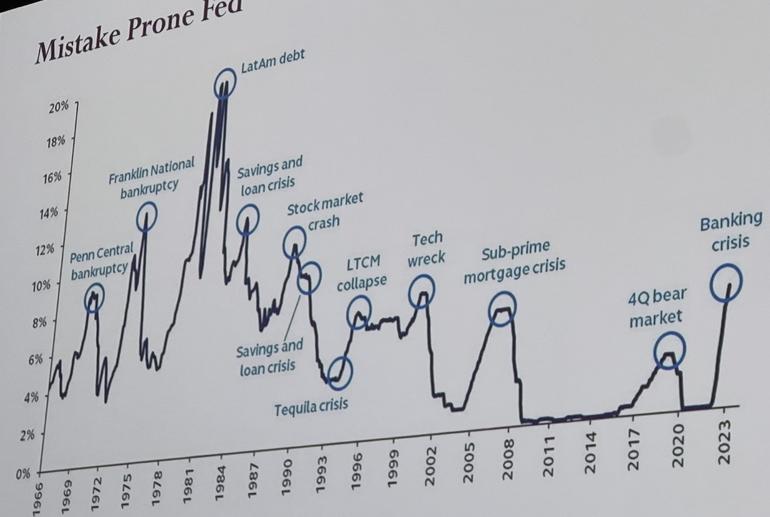
With the Fed being extremely aggressive in attacking inflation, Goldman pointed to the latest Fed “dot plot” that indicates one more rate increase is coming and rates will be at more than 5%. The bond market, meanwhile, is predicting rates will be at 4% by year-end because the Fed will make a mistake and push the economy into a recession, he said.
What to Watch
Goldman urged CUs to watch the 2/10 spread, the difference between the two-year Treasury yield and 10-year Treasury yield. The former is a proxy for where the market believes rates will be in a year. The two should be below the 10-year, but it is inverted and is above the longer-term vehicle.
“Whenever this has happened we’ve had a recession within 12 to 24 months,” said Goldman.
He further noted there is lots of other data indicating the economy is heading to a recession, but his favorite is the Institute of Supply Management’s Purchasing Management Index, which polls purchase managers. If above 50, the economy is expanding; if below, the economy is contracting. It’s currently at 47.
“Watch the PMIs. It’s a great data point,” he said, adding the big banks are also “dramatically” tightening lending standards.
Goldman urged credit unions to visit Cetera.com to see its “Recession Riskometer” to get the company’s overall view on the economy.
When Will Recession Arrive?
So, when is the recession coming? According to Goldman, it takes 12-15 months for Fed rate hikes to work through the economy, so a recession is likely in the second or more likely third quarter of 2023. The Leading Economic Index, which typically peaks 13.2 months before a recession, peaked in February of 2022, again indicating a Q3 slowdown.
Times to Get Better
Looking forward, Goldman said he expects the last half of 2023 to be a “much, much better year.” He said there are three reasons, including:
- Lowered expectations are easier to beat. He cited Citgroup’s Economic Surprise Index, which measures pessimism and optimism, as one indicator of better days in the second half of the year.
- The Fed is Doing an OK Job in Tamping Down Inflation. “Why is it so important for the Fed to bend inflation?” Goldman asked. He said the answer can be found in data points around P/E ratios, noting the markets need the Fed to bend inflation, although services inflation continues to rise. “We think the Fed is going to be OK with an elevated level of services inflation, because that is typically the lower cohort of incomes in our economy.”
In terms of deflationary pressure, Goldman said the ratio of inventory divided by sales has begun to seriously improve, with retailers cutting prices and energy prices also declining. Rent, which is a “sticky inflation” data point, can be seen declining in data around “asking rent” by landlords, he said.
- He Could be Wrong & There is No Recession. Goldman acknowledged he and others could simply be wrong. And “if we have a recession it could be very, very mild,” especially given the strength of the labor markets. “There are 5.1 million more jobs out there than people looking for a job,” he said. “Even if someone doesn’t want to get a job, they can get a job.”
Positive News & Other Factors
In addition, Goldman said the housing market remains strong as prices are coming down, but people aren’t being forced to sell in a declining market.
Finally, in what he called the “most interesting point,” it could be a “rolling recession,” which is a mild recession that rolls through the economy sector by sector. Housing, autos and manufacturing are in a recession right now. But as those improve, others will weaken, such as lending and capital spending.
There are “wild cards,” Goldman said, including China’s economy (he noted economic data out of the country isn’t exactly reliable), and cash that is sitting on the sidelines.