

LAS VEGAS–What have credit unions and CUSOs learned from the pandemic? What trends will stay, which will fade away, and what would CUs and CUSOs do over if they could?
Those questions and others were discussed by a panel of CU leaders during the NACUSO Network Conference here. Participating on the panel were Scott Patterson, president and CEO of CU Student Choice; Kyle Stutzman, CRO with Pure IT Credit Union Services, and Mary Beth Spuck, president and CEO f Resource One Credit Union.
The discussion as moderated by Becky Reed, CEO of Lone Star Credit Union and co-founder of the PureIT CUSO.
Here’s a look at what was discussed and the views shared:

Scott Patterson
Reed: How did you adapt when the pandemic struck? How did you change?
Patterson: I think if we try to remember back to what it was like in March/April of 2020, it was a massive time of uncertainty. Massive. No one knew if they would lose their job. From the CUSO perspective, it was about the evolving needs of members. There are two types of borrowers, the existing borrowers and the new borrowers coming in. On existing borrower side, we knew borrowers were worried about employment and their payments. We looked at forbearance options and ways to help them.
On new borrower side, the big uncertainty was ‘Will my kid even be able to go to campus in the fall?’ They knew they would need money but didn’t know how much. We rolled out some product changes. Our flagship product is a line of credit. We instituted a change where you don’t need to tell us anymore what you need for the first draw. We said, ‘Get the line established, and then you can cross that line in the future over how much you would need.’”
Internal Changes
On the internal side, how we worked with credit unions had to change, too. We have been largely a virtual organization since our start in 2008. We were used to working from home,. But we still favored in-person meetings, especially for clients. So, it became a lot more Zoom meetings, a lot less travel, and there was a question over how to maintain culture in that environment. Now there is a lot more intentional talking among the team, more check-in calls. We are now getting back to in-person meetings and there is no substitute for that.
What would we do differently? During the first year we were really busy. There was a lot of blocking and tackling and helping members respond to changes in the environment. It was not until earlier this year that we took the opportunity to retool and make some investments. If I could go back in time we would fast forward on that from day one.
Stutzman: When we think about technology, at PureIT it’s people, process and technology. And then we break technology down into data and security. As a CUSO focused on 100 credit unions across the country, the technology initially was not the challenge for us. Where I think our biggest challenge was in identifying the certain positions that needed a lot more care and feeding. You need to make sure things and people work in accordance with one another. The people and process side are the things we had to pay close attention to.
On the CU side of our customer base, one stark and immediate thing that hit us was focusing on the here and now, but from our viewpoint it was hard to have all future direction and journeys all put on hold. It took much longer than we expected for credit union leaders to pick their heads back up and start looking to the future. We ended up helping a lot of institutions begin working remotely using the tools they already had.
Just a Band-Aid
One thing I think we would do differently for our customer base is we took steps to help and tried to communicate. But this is one step of maybe three or five or 10 of a journey you are starting down. There were a lot of credit unions that needed help in their mobility journey. It was a Band-Aid, but that was only sustainable for a short period of time. We could have better prepared those leaders for how this is step one. This was probably overdue for many institutions.
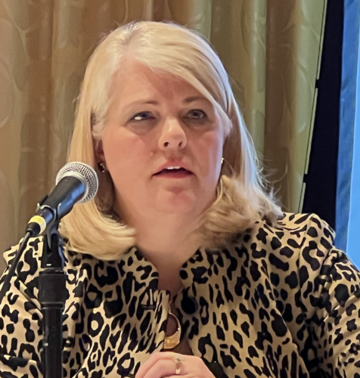
Mary Beth Spuck
Spuck: I always find that whenever there is a crisis you can find opportunities. If someone would have told me we could close our branches for a year and we would have our best year financially, I never would have believed it.
We had started telecommuting a year prior. Then management started to drag its feet and hadn’t really bought into remote work. The one department we had put out a year earlier was doing great. When the pandemic hit 50% of staff was at home within two weeks, but that small unit made it much easier for the whole organization and now everyone has bought in.
Now, we are just being able to make decision much more quickly. We also had to completely change some practices. We would force members to come into a branch. I never would have thought shared branching transactions at the drive-through; now we’re thinking we may not need to bring them back into the branch.
Onboarding Employees
With onboarding new employees—our HR department had been notoriously paper heavy. We have been able to revamp and get rid of all that paper.
We have virtual training, but there is still something about missing the people connection, so we are working on that. We had to onboard our CFO virtually in May and she didn’t meet the rest of the executive team until December. But it worked. It was really all about, yes, we are risk-adverse on the CU side, but it’s really more about managing risk. I found my team was able to do that faster because we had to.
What Do Differently?
What things would I do differently? I would have communicated more with staff, although we communicated a lot, you can never overcommunicate. With everyone remote we tried to do the remote happy hours, a drive through at Christmas time. It was a weird thing, but it worked. I also would not have tried to open my branches early in June of 2020. It was awful. We had so many COVID cases we closed three weeks later and then didn’t open up again until March of 2021. It’s not just the pandemic. At the same time we have all of these social changes going on. I would start ERGs up early. I think that would have helped with the employee engagement piece.
Reed: Now, two years in, what are some trends that have accelerated? What has taken off?
Patterson: I think work from home is something that is going to stay. Most credit union executives I talk to are making it part of the organization and how it functions. When you think about the entire economy and professionals across the country dealing with this new option, what does that do for lending? I think you’re still going to need the commuter car, but you may not put as much wear and tear on that car. So, you may need a new car less often.
On real estate side, work from home is the future and people want bigger homes. That’s a preference that is going to continue. Second properties is another trend for people who want to escape.
With remote service offerings, members’ expectations of being able to do anything they can do in person online. We are not going to not have branches, but I think the credit unions investing in high-touch remote services are going to be the CUs seeing a lot of positives.
Further diversification of the loan portfolio is going to be more important. When we look to the future and what the loan portfolio needs to be to be robust and stand test of time is a much more diversified.

Kyle Stutzman
The big question is inflation. The best case is it’s moderate. The worst case is it’s going to be pretty material, and that could impact a lot of these consumer lending trends.
Stutzman: The member expectations trend is one that has changed and is one that will continue. We talked about it as a trend before to serve a certain generation, but it’s not just a generation anymore. The members now know they can do banking differently with us.
On the tech side, overall, for training I would agree that hybrid with remote and on-site is going to be there. I think the trend is not going to be thinking about remote vs. in-person, it’s going to be about how we think about working at all. It’s how do we work with concept of security, data protection and remote access no matter where your employee or member is.
Cloud enabled tools is the other thing. It was blatantly obvious to us as a tech company that our tool sets that we provided were not really prepared to manage remote workers. When it came to cybersecurity and risk we were not really doing what was needed. These cloud-enabled tool sets are what allow us to compete and are going to change.
Advancing Quickly
On the member-front side, data and business intelligence is going to continue as a trend and will advance quickly. There are a lot of tool sets now that can get us to a level of data maturity that didn’t even exist two years ago. What isn’t there, but is a trend slow to start off, is understanding what it is we are trying to do with these tools and the data.
Fintechs have doubled in the past year to more than 10,000, up from 3,000 before the pandemic. It’s a huge opportunity to figure out how to address that.
Spuck: The trend that will remain is the reduced transactions in the branches. A lot of credit unions lobbies are still closed. I know some have completely closed and are 100% virtual. We have some branches with five-lane drive-through’s and people were lined up. We have reduced our transactions and our mobile and ATM deposits have gone way up. I think that is going to stay.
We are also looking at reducing our branch hours but increasing the hours of our call centers. One thing we brought in during the pandemic was video banking.
One of the things I hope will stay is this willingness among credit unions to collaborate. There has been a lot of talk about forming CUSOs. There has been lot of talk about we need each other to survive. There was a lot of that during the recession, and then it kind of died off. But I really hope the trend stays.
Reed: What is dead and gone and not coming back?
Patterson: A big one is consumer deleveraging. You are seeing it in credit card portfolios, we see in student loan portfolios. I think if history is any indication, that will change. I saw a Fed survey showing a third of the government stimulus checks that went out went toward paying down debt. If you’re one of the people gainfully employed during pandemic, a lot of that went to paying down debt. With the pandemic in the rearview mirror, we are going to see more spending.
On student loan side, about 90% of student loans are federal student loans. About 40% of Americans who have one have not made any payments in nearly two years. All that comes due in January.
Real estate financing I think is pretty interesting. May it will be a little further out, but we’ve had nearly 20 years of continually lower interest rates. We bought a house 20 years ago and we’ve been refinancing ever since. So, rates could be much higher in five years. A lot of (the mortgage volume at credit unions) are refinances. When it switches to a purchase market, that is really, really competitive. What are you doing to get that business to continue to drive the real estate side of the portfolio?
The cost of attending school is expected to rise dramatically, especially as you look at state schools. If you think cost of education is expensive now, we think it’s going to be going up even more in the future.
So how do we partner with fintechs, CUSOs to excel in all these areas of lending?
Stutzman: With remote work, there are two sides. On the tech side it’s been more negative. Your resources can now leave and work elsewhere and your costs can be 25% or 50% more than two years ago. We are still going to see areas like data analytics that are going to be in high demand, we just haven’t been able to get the people.
What I hope doesn’t fade are the conversations around data security. That has to sit alongside all of our business goals. It has to be a catalyst.
Spuck: With I think will fade away will be Zoom sales calls. We did a core selection and payments selection and all those calls were via Zoom. They are brutal. But on a side note, I do like that you can actually see them. I’m afraid the credit unions’ ability to make quick decisions will fade because we are not in a crisis mode. I get it, it’s part of our structure, many decisions have to go to the board for approval. I don’t know how we keep them ingrained in the mode we need to move quickly.
From political advocacy, we did all these Hike the Hills virtually as people had time on their hands. We also had the highest attendance at our annual meeting and I’m afraid that engagement with our elected officials and our members will fade because now people have to take the time rather than sit at a desk.