

LAKE BUENA VISTA, Fla.–In a discussion described as a “Curious Conversation,” America’s Credit Unions’ CEO Jim Nussle and NACUSO CEO Ronaldo Hardy shared their own curiosities around a variety of issues, from the merger of NAFCU and CUNA to what the word “helping” means in people helping people in today’s market.
Here is a look at what was discussed:
Hardy: You have been pretty busy doing something historic. I feel our industry is in a great transformational stage. What is your vision for the organization?
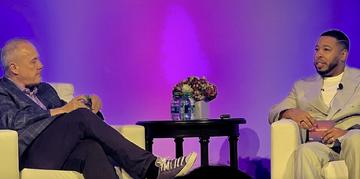
Jim Nussle (L) with Ronaldo Hardy.
Nussle: It’s not just my vision. It started with the members. They prodded and cajoled. They asked why do we have two voices for advocacy? It was our boards that showed leadership and said let’s come together on a common issue. That’s first and foremost.
Their vision was that we want people everywhere to have access to credit unions to improve their lives and deal with their challenges. We know the motivations behind what credit unions do and how we do it, who we do it for. The way we are structured is just different. And that difference makes a whole lot of difference in the lives of people we touch.
One of the best ways to use our cooperative superpowers is to come together. It’s not that complicated, and yet we all know that human beings, pride, tradition can get in the way of that.
Hardy: When you bring together two organizations like NAFCU and CUNA, it is a significant mark of collaboration. From the lens of collaboration, what has it been like to explore that?
Nussle: It’s been a fun journey and I am trying to ensure it continues to be fun, invigorating and meaningful to my team and to the people who have invested so much in our movement. America’s Credit Unions and our former organizations is where it all comes together. To create an environment where all of us can thrive requires everyone. We are constantly on the lookout for ways to raise the bar. How can we level up?
When you come into something like this, do you find it easier to make the transition you’re making because you have fresh eyes, or do you find it just as challenging to come into an organization?
Hardy: It’s been very interesting. It’s joyful for me. I do enjoy the process and taking on the largest challenges in an organization. I have self-selected to run toward the problem. The reason is I knew, one, there would be a learning experience—and he who solves problems will always have a job—and two, I’m learning in the most difficult circumstances. Now, where others see problems, I see opportunities.
What’s been more exciting for me is when I am privileged to work with some very good boards, and this board is absolutely amazing to work with. When a board sees the vision and supports it in every way they can. It makes it even more joyful for me.
On this journey I have been both listening and launching at the same time. I had to be ready to do something, but had to listen at the same time as we work through change.
Nussle: You’re making this more than a transition year, you’re making it a transformation year. That’s what we’re doing. Our credit unions, our industry, our professionals are needing and demanding something different. Just because it has worked for X number of years doesn’t mean it’s going to work in the future. The demands from our members, in fairness, are going to come more quickly and more value is going to be expected from us, in the same way (CU) members are demanding that from them. I agree, start with listening.
Hardy: Sometimes while you are talking you are missing the greatest insights and advice and the things that will help you make the most transformative decisions. You started talking about the future. The theme of this conference is ‘Advancing the Future of Credit Unions.’ From your perspective, what does the future of credit unions look like?
Nussle: I’m not sure I’m good enough to tell you. It’s going to be faster, it’s going to be more technologically driven, there’s going to be more competition. The talent we will be striving for and need to recruit used to come exclusively from within the family, but then we started branching out to other financial services. When talking people helping people, it’s going to be about what the ‘help’ means. That is going to continue to change. It’s not going to be good enough to offer a share account or a form on how to do a budget. The people in this room are helping to define what help means.
We call it ‘financial well-being.’ It’s understanding that financial wellbeing is not just about does your checkbook balance. We know this. But policymakers have put us in a box of what we do. ‘Help’ is defined is ensuring the security of your finances is so good it helps improve your mental health, your physical health, your family life, your ability to deal with challenges and to advance yourself personally. All of that is connected to what we do when we say people helping people.
Hardy: I feel the genesis of our work is to uplift those who would otherwise not have opportunities. I grew up like that. I’m hoping that we do get back to more of that work of serving those communities and not find ourselves running to prime borrowers or being the lowest-priced banks.
You’ve not been the CEO of a credit union, if you were one today what would one look like?
Nussle: I have no earthly idea. My credit union is probably an amalgamation of many I have had the opportunity to visit. I would want to combine the best in tech with the value proposition of trust. The (latter) has always been our secret sauce. I think that’s going to have to be delivered human to human. I know the costs, but that’s the kind of credit union I would at least try to run.