

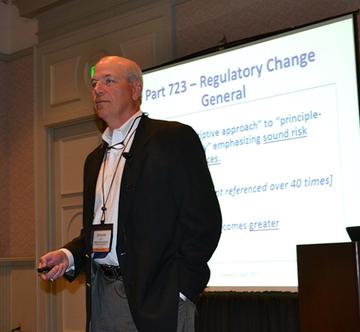
Ricky Gulliot
ORLANDO—Is the new MBL rule good or bad for credit unions?
A room full of credit union and CUSO leaders at NACUSO’s 2017 Network Conference are uncertain, based on their response during a breakout session.
NCUA this year introduced its new MBL rule, passed by the agency’s board last year with a goal of providing credit unions with greater flexibility in MBL lending.
But with the flexibility comes concerns over greater regulatory scrutiny, which led to the uncertainty among CUSO execs when they were asked whether the rule is a positive or negative.
Kirk Wiebusch, SVP at Centennial Lending, and Ricky Guillot, CEO of Business Alliance Financial Services, who led the breakout, emphasized that credit unions are going to have to do a better job of performing ongoing portfolio management and following loan progress regularly—updating risk ratings when necessary, more so than many have likely done in the past. Credit unions will have to provide more detailed documentation to examiners outlining their MBL policies and procedures, as well as an accurate assessment of risk measurement with each loan, the experts stated.
Principles Based Rule
The new rules, while moving away from a prescriptive approach to MBL to one that is principles-based, provides greater lending flexibility, which will have examiners watching even more closely, said Wiebusch.
“With the new regs CUSOs will face an even higher level of requirements, all the way back to the credit union level,” said Wiebusch. “And this goes all the way up to the CU board. It’s incumbent upon CUSOs to make sure (MBL documentation) is picked up regularly and accurately in a clean manner, and that they help CUs understand this rule when they push MBL information up to their boards.”
Wiebusch said that some of Centennial’s member credit unions that have faced examinations this year indicate NCUA expectations are greater.
“There is a much heightened level of expectation placed on the boards of our partners to understand this information and know what the risks are, and, have their concentrations well defined and tracked within the portfolio,” said Wiebusch.
Not only will credit unions need to do a better job of regular portfolio monitoring, the board will have to have a greater understanding as well.
“We have created a video to be used for board training,” said Guillot. “We focus on what NCUA requires them to understand from a risk tolerance perspective.”
Guillot cautioned meeting attendees to avoid the MBL “honeymoon,” which he suggested happens when the credit union makes the initial loan and does its due diligence, but then moves on once the loan is closed and does not look at the loan closely as it did when the loan was being booked.
Honeymoon Phase
“The underwriting phase is the honeymoon phase—everyone is all giddy and happy,” said Guillot. “But the real work begins once the loan is closed and booked. We have to assess the risk on the front end, but the ongoing monitoring of that credit is most critical, as that loan will change over time. It is a living, breathing animal.”
With greater flexibility comes greater responsibility, summed up Guillot.
“The prescriptive approach said don’t go more than 75 miles an hour. Now the principles based approach says don’t go too fast,” said Guillot, noting that does not clearly outline all of NCUA’s MBL expectations.
But what is evident is where NCUA is focused, said Guillot.
“In the first five pages of the new regulations risk management is mentioned more than 40 times. NCUA is getting that message out loud and clear,” he said.