

ANAHEIM, Calif.–One of the least innovative things in credit unions is how often they talk about innovation–and don’t innovate.
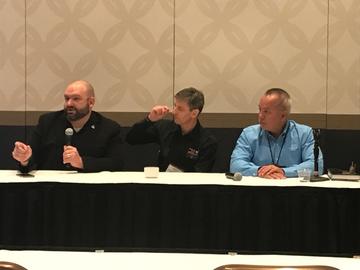
From left: Kris Kovacs, CEO of Constellation Digital Partners; Keith Kelley, CU Rate Reset CEO, Ben Morales, Q-Cash Financial, CTO and Washington State Employees CU
But three people here from three different CUs/CUSOs shared specific examples of innovations they have been a part of, and further shared ideas on how they keep that culture alive and flourishing within their organizations.
Sharing their observations and lessons learned with the NACUSO annual meeting here were:
- Keith Kelly of CU RateReset, a digital platform that provides an alternative to members seeking to refinance a loan by making it very easy to do so. It also offers some deposit products and preapproval solutions.
- Ben Morales of QCash Financial, a CUSO of Washington State Employees Credit Union that offers a small-dollar digital lending platform that provides an alternative to payday lenders.
- Kris Kovacs of Constellation, a new CUSO that has just finished the largest capital raise in credit union history that will soon be $32.5 million. Constellation provides its investor credit unions with ability to create services that are pre-integrated to online and mobile banking solutions.
The discussion was moderated by Mike Atkins of OTS. Here’s a look at what was discussed:
Q: What does innovation mean to you?
Kovacs: To me it’s the practical innovation of a new idea against an existing problem. We drew inspiration for our platform design not from existing banking solutions but instead from the app environment now available across all kinds of domains and functions. For me, innovation is not about solving a problem, but looking at it in a new and different way to provide a practical solution.
Kelly: To me, it’s also about doing whatever it takes with that idea. Anybody can come up with an idea; it’s getting it to market, pivoting along the way and making it a reality. What I love about credit unions is credit unions aren’t afraid to try.
Morales: We look at innovation as solving members’ problems. How do we make members’ lives easier? Without execution, an idea isn’t doing anyone any good. Q-Cash Financial started with identifying a member issue and then having the courage to ask questions about that. We have had to take off our blinders on what we believe and look at the member journey.
Q: As you look at your organizations, what does a culture of innovation look like and how do you build it?
Kovacs: I think the best way to answer is to go back to my experience at Coastal Credit Union, where I worked for 13 years prior to spinning off this company. At Coastal, we really liked as part of our brand to play on our IBM heritage. Part of it was telling our story and developing it and then telling it again and again and again. We told employees ‘You have joined an innovative organization. We were the 13th institution in the world to move money over the Internet and we invented video-tellering in the early 2000s.’ When you tell that story enough, your employees begin to believe it. Not everything was a success; we failed a lot. But if it didn’t work we tell our employees it was in the spirit of our company, and we reward you for trying.
Kelly: We also have a lot of storytelling behind what we do. Our weekly meeting is every Friday and that talks about every team member. We don’t have a big team. Everyone wears different hats interchangeably, so multiple team members can be on projects. It’s imperative that the team members work well together. We’ve had some that weren’t good fits. The team we have right now is absolutely amazing. Our motto is “I Believe,” and we actually have the same goal in mind with the end-journey. It’s about laying out a clearer path to our team and seeing the benchmarks along the way and then working to achieve it.
Morales: For WSECU, it was really based on this idea of open communications and having permission to share and talk with anybody. Our CEO, Kevin Foster-Keddie, is very much management by walking around. He inspires people to talk to him about anything and he gets feedback and creates this culture of open communication. And that’s how we got started. There was this teller who was curious about something a member was doing, and that started the ball rolling. We continue to emphasize that no idea is a bad idea, it’s just about when is it the right time.
Kovacs: Sometimes, the innovative idea is to not do something or to stop doing something bad. At this hotel, there is a portrait of Walt Disney and a quote below it that says, ‘While it took many years, I started with many ideas, threw them away, and started again and it eventually evolved into Disneyland today.’ One of the things we do periodically is look at existing services and solutions and ask, “Does this still matter to the member.” Sometimes you have to have the bravery to say we’re going to stop doing that. But that lets us focus on the next thing, not the last thing.
Q: How much failure are you willing to accept?
Kovacs: I used to work for Navy Federal for 12 years and one of my experiences in how I treat failure came from my own failure there. I was running a project in the late 1990s and my boss was a retired Marine colonel and I had to walk into his office and say, “I’ve lost a million dollars.” I had to say, “I can’t deliver what you expected.” I thought he would rip my head off. But instead, he said “What did you learn?” I went through the list and he said, “It was an expensive lesson, but it sounds like one worth learning.”
There is going to be a cost. The organization is going to get better, but share the lessons from your failures and not just the lessons from successes.
Kelly: For us, it’s classifying what is a failure. The only failure I can say we actually realized and acted on quickly was related to personnel, where we failed to recognize how devastating some individuals can be inside an organization, and we took action quickly. As far as products, we didn’t see them so much as a failure as the time just wasn’t right yet.
Morales: I would say building a culture of innovation means having failure as part of the ecosystem. We have a ‘build, measure, learn’ culture. This is about continuing to move forward. Continuing to innovate and iterate is critical.
Q: What measurements do you use for success?
Kelly: We put surveys behind our products. It’s the membership we try to measure success by.
Kovacs: It’s not a formal measurement but one I suggest you look at is how often are you talking about innovation. Are you just talking about it at a conference? At a board planning session? Every month, you are looking at every ratio in your credit unions; how many of those are looking at progress of new ideas or adoption of new innovations? If that’s included in your management reports, that’s how you measure how innovative your credit union or CUSO is being.
Q: What about ROI?
Kovacs: If you’re taking every day to ask what is the ROI on this, you’re missing the boat. At Coastal, it always comes back to what is the member getting out of this. If you take the ROI of every single idea, my fear is you won’t get done one-tenth of what you could do.
Q: What are some of the prompts that cause you to look at something where innovation might occur?
Morales: What we didn’t understand when we started delivering small dollar loans is the issue we’re solving, which is issue of financial stability and health. There is a realization that we have a big problem in the United States with people’s ability to manage their finances. Once we did understand it, it was how can we build more product to help that? We are now building a savings component into our program and a coaching component. Diving in deep into a problem you are solving unlocks at lot.
Kelly: We get a lot of our direction from the credit unions. Joe Brancucci is the head of our CUSO and every time he goes to visit a credit union he asks for two hours of time. Some of it is demo, but a lot of it is just talking to people and having an innovation session. It’s think of anything, what would you like for the member that brings efficiency to the members’ lives? It’s asking upfront about ideas, and then acting upon those.
Kovacs: It’s about zeroing in on what’s the problem. There are lots of great ideas out there, but half the people who have them won’t get off their asses and do anything about tit. (Coastal CU CEO) Chuck Purvis beats into us, ‘How do you know where the problems are if you don’t use the credit union’s products and services?’ When you do you have the insight that it sucks and we need to do better and you put together a team. We found we as executives got service different than what the members got. Now we look at how do we give the members the service we get. That’s what they deserve.