

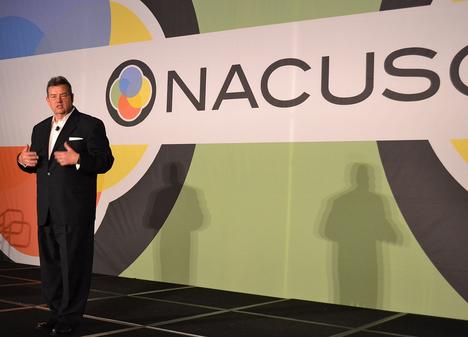
John Ainsworth
ORLANDO—One payments expert believes most credit unions are “out of touch” with their members when it comes to payments.
John Ainsworth, EVP of North American Markets for Mastercard, emphasized to attendees at the NACUSO 2017 Network Conference here that consumers’ payments needs, service expectations and definition of loyalty rewards are changing—and that not a lot of credit unions are paying attention to this shift.
“Your members’ expectations are changing and you don’t know it,” he said, stressing that credit unions need a well-planned digital payments strategy to avoid disintermediation.
Credit unions need to wake to this issue, argued Ainsworth, who added he believes CU can do so as payments now represent 30%-40% of non-interest income.
Ainsworth provided several examples of how the payments landscape, consumer expectations, and consumers themselves are changing rapidly. He spoke about connected refrigerators that do food ordering for homeowners, wearables that double as payment devices, and the ability able to order fast food in advance.
“I know, I go to Chick-fil-A and I see the double lines standing inside and cars wrapped around the restaurant waiting for the pickup window,” said Ainsworth, who added that he often orders his Chick-fil-A sandwich on his phone and then picks it up about as soon as he drives up.
King Of Chick-Fil-A
“They geo locate my car, know I am there,” said Ainsworth. “I get my sandwich quickly and I see all of these people waiting. I feel like the king of Chick-fil-A.”
Ainsworth said that the opportunity for consumers to make better use of time is becoming one of the most valuable “loyalty rewards” associated with digital payments. As a result, he emphasized that credit unions need to be right in the middle of the digital payments ecosystem, finding ways to be not only top of wallet but top of app.
“The point here is that for consumers, expectations are changing. And credit unions should be aware that the only thing that is consistent today (within payments and consumers’ use of them) is that change is constant,” said Ainsworth.
“All of these different complexities are coming into payments and it’s really become chaotic,” said Ainsworth, “I have empathy for you, trying to manage your way through all of these variables. Just a lot of complexity to manage through—and most of you don’t have the capital, time and people to do this. You need to rely on your partners.”
Ainsworth emphasized how consumers’ buying habits are shifting away from brick-and-mortar stores to online, evidenced by the rapid growth of Amazon and PayPal, as many retail chains suffer declining sales.
“If I get an hour and 20 minutes back in my day, that means a lot to me,” said Ainsworth.
Credit unions must pay close attention to the “dynamic shift” that is occurring, urged Ainsworth, and ensure they are heavily involved in digital payments and understand the changing needs of their cardholders.
Harder To Categorize
He noted those changing needs are becoming harder to categorize, according to a new Mastercard study. He said that credit unions can no longer simply slice consumers just by demographics, such as age. Credit unions have to better understand their members’ habits and needs based on who they are—such as a dad, a weekend warrior, or a professional.
“The credit union has to be relevant with its members,” said Ainsworth. “Digital is here. I encourage you to be relevant in any digital solution your members want to be part of. Remember the need for speed and that your members want choice.”
Ainsworth noted that tools like card controls and alerts are essential.
In closing, Ainsworth reiterated that if credit unions are not paying attention to this digital shift that they are at risk. But he said that credit unions have an advantage in being authentic, local, and trusted.
Ainsworth said that the Mastercard study—as other reports have noted—shows that consumers want to do business with CUs based on their cooperative attributes.
“Our study shows consumers are starving for authenticity,” he said. “You have this advantage, so focus on your members’ expectations, make sure you are relevant in payments, avoid disintermediation and drive revenue.”