

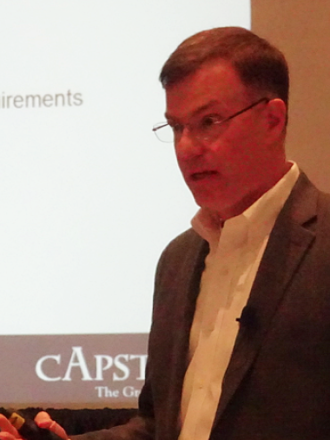
John Dearing
ANAHEIM, Calif.–Just how much is a CUSO worth? It’s an inexact science, according to one person, but there are guidelines that can be used to arrive at a number.
Speaking to the NACUSO annual meeting here, John Dearing, partner and managing director of Washington, D.C.-based Capstone, said the valuing of a CUSO is both art and science, which is the reason “any one data set can lead to more than one valuation, depending on the number of people reviewing that data.”
“The art piece of the valuation includes the forecast for the future for the organization and the business plan of the CUSO being valued,” he said.
The science part follows protocols and guidelines, explained Dearing, such as the cash flow statements, balance sheets and more quantifiable information.
In brief, valuation is a process and set of procedures used to determine what an organization is worth, according to Dearing. “It takes preparation, solid information and believable data and experience,” he said, putting emphasis on the word “believable,” before adding, “There is no one way to establish an organization’s worth.”
There are two major approaches to valuation, both of which are perspectives:
Fair Market Value
- Price the organization would have if it were on the market for a reasonable period of time
- Neither buyer nor seller forced to buy or sell
- Used for appraisals
Investment Value
- Takes into account investor’s motivations and requirements
- Used for strategic investment opportunities
- May be higher or lower FMV
“Purpose drives assumptions,” said Dearing. “Investment value can be a very, very different output than market value. In valuation you are looking for baseline value of the enterprise. Price is totally separate. Valuation gives you a benchmark from which to leap; price is what comes out of the other end of the process. Price could be a lot higher or lower depending on the situation. In a competitive situation, you might want to make sure that someone doesn’t get to a set of your clients, so there is additional value there you could look at from a strategic point of view. Price can also just be an overall equation of attempting to get something done.”
And none of that takes into consideration the different ways the purchase price is paid, added Dearing.
Dearing said getting the driver piece in place, the inputs and outputs in the model, is a good place to start. The pieces of the equation are strategic fit, due diligence, negation, deal structure, owner relationship, valuation, board communication, M&A process.
The three steps recommended by Dearing include build the foundation, build the relationship, and build the deal, under which there are individual steps.
Different Applications
The different applications to be employed include:
- Benchmarking: Sometimes people want to know where they stand versus others. “I am an advocate of understanding what the marketplace looks like,” said Dearing.
- Venture Funding: “Venture funding can help your organization to grow, but you really need to go into this with your eyes wide open,” said Dearing. “You’ve got to learn how to deal with what their expectations are going to be. But there are also very, very good opportunities right now to get capital. It shouldn’t be ignored. I always suggest people to talk to at least two or three venture capital firms to understand how they think and what they look for. Whether you execute is up to you.”
He said the two approaches to valuations are:
Income Approach
- Capitalization of earnings
- Discounted cash flow
Market Multiples Approach
- Deal comps—complete transaction method
- Public comps—guideline public method
Discounted cash flow includes various earning streams and assumes the total value is the present value of the projected earnings plus the projected value of the terminal value. Earnings are discounted using a discount rate, said Dearing.
The key assumptions that need to be addressed in a valuation include:
- Revenue growth. The income line items need to be individually forecast
- Expense expectations
- CAPEX and working capital
- Term of interest
- Discount right or weighted average cost of capital
- Scenarios—base, best and worst
“scenarios is key,” said Dearing. “What we get into debates over typically is people have different perspectives on the assumptions going into the model. First thing you need to get alignment on is what is the base case of assumptions.”
When it comes to the multiples being used in a purchase or sale, he recommended:
- Compare your organization to other organizations/transactions
- EV/Sales and EV/EBITDA are the most common
- Used for organizations that are profitable and expected to continue to make profits
“The crown jewel is discounted cash flow,” said Dearing.
While the methodologies in valuing a typical company and a CUSO are similar, CUSOs do have some unique differences and comps can be difficult to find, he said. The limited customer base of a CUSO can also impact forecasting.
Nevertheless, when looking to boost a valuation, Dearing said the best practices include:
- Preparation (books in order, documented process and systems)
- Have a strong growth story
- Recurring revenue. “The more the better”
- Keep “cutting deals” to a minimum
- Reduce concentration risk
- Depth of leadership
- Straightforward ownership/membership
- Help credit unions help members/win members. “In this world it’s not just about the economics, and make sure that is woven into your story,” recommended Dearing