

ANAHEIM, Calif.–There is a lesson to be had in the fact many people still wear an analog watch despite the digital technology around them, according to one person who said credit unions need to answer five questions.
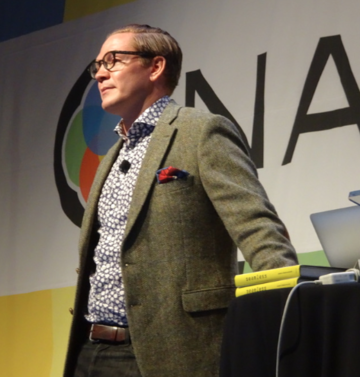
Anders Sorman-Nilsson
The lesson to be found in the analog watch is that looking to the future doesn’t mean completely abandoning the past, but instead seamlessly interweaving together both the analog and the digital to create a consumer experience that meets the expectations of members and future members, according to Anders Sorman-Nilsson.
In remarks to the NACUSO annual meeting here, Sorman-Nilsson told the meeting, “The analog really holds the key to the expectations of your members and those you want to win over to the credit union movement. Increasingly, our information-focused minds are digitizing and mobilizing, but our hearts are still in analog and are emotional and traditional. The question for us is how to weave those two worlds together seamlessly.”
The ability to weave those two seemingly disparate worlds together will be what separates the credit unions and CUSOs that will be around in the future from those that will not be.
Sorman-Nilsson, a futurist who has written several books, including “Seamless,” is a native of Sweden who now lives in Australia and who said the “ethos of credit unions is close to my traditionalist heart.”
But the tradition of credit unions alone simply won’t cut it by itself moving forward, he said. Instead, that tradition must transition to the digital world.
“This future is digitally dehumanized,” observed Sorman-Nillson. What that means for credit unions, he explained, is the need to find a way to weave tradition and the future together to win the hearts and minds of members is becoming increasingly important.
A Mother of an Example
Throughout his remarks Sorman-Nillson used his mother and a clothing store she owns in Sweden as a proxy for older generations and traditional businesses as he illustrated his various points. For instance, he noted customers annually came into her store to be measured and then ordered new clothes. Now, they still come in for the measurements, and then they exit, go outside and around the corner, and order the clothing on Amazon.com.
“My mum doesn’t like change and I think that’s kind of universal,” he said. “Change can be extremely difficult. The problem with change is change doesn’t care if you or I like it; it’s always going to happen without our permission. When the rate of external change trumps the internal ability to deal with the change, we are potentially in a lot of trouble. We all have someone like my mum in our business. And sometimes we have to make sure we don’t throw away the digital baby with the analog bathwater.”
The Huge Need
But credit unions must also be prepared to embrace fintechs and new technologies, he said. Sorman-Nillson emphasized at several points that there is a huge need for people to better manage money, citing research showing 47% of Americans can’t cover a $400 emergency bill, and that the personal savings rate peaked in 1971.
“Money is the number-one stressor in the United States,” said Sorman-Nillson. “Is this something you can help with?”
Sorman-Nillson observed that many people still live by the old brand connotations, including many within CUs. “Who feels this when you go to explain what a credit union is and does?” he asked.
The next generation feels it can do banking without accessing a bank, he added.
This is about bricks and clicks,” said Sorman-Nilsson. “It’s about digital and analog together. One is face to face. One is interface to interface. Particularly as we enter the trust economy, where there is a massively low trust for banks and corporations, I believe this is the golden moment of opportunity for credit unions. How to do it? It’s by mixing the best of the analog and the digital.”
Five Questions to Consider
Sorman-Nillson urged all credit unions to ask themselves these five questions:
1. Is your credit union changing at least as rapidly as your most demanding client or member?
2. What percentage of your work involves frequent high-volume tasks?
3. What percentage of your work involves complex problem solving or novel situations?
4. Are you training the leaders of tomorrow for jobs that won’t exit?
5. What banking tasks ought not to be handled by machines?
Sorman-Nillson noted that the member journey is no longer a purely linear progression from awareness to engagement to evolution to decision to usage. “We now do so increasingly in a journey that skips between the digital and analog touchpoints,” he said.