

WASHINGTON—A majority of mortgage lenders continue to expect near-term profitability to decrease amid rising mortgage rates and declining refinance activity, according to Fannie Mae’s Q1 2022 Mortgage Lender Sentiment Survey (MLSS).
The survey found 75% of mortgage lenders believe profit margins will decrease in the next three months, up from 65% in the prior quarter, while 17% believe profits will remain the same and 9% believe profits will increase.
Competition from other lenders, market trend changes, and consumer demand were the top reasons cited for the decline in profitability expectations. Mortgage lenders also grew more pessimistic about the larger economy in Q1 2022, with 59% now reporting that the economy is on the wrong track, compared to 29% in Q1 2021, Fannie Mae reported.
Reduced Consumer Demand
Compared to 2021, across all loan types more lenders this quarter reported reduced consumer demand over the previous three months for both purchase and refinance mortgages, the survey found. Looking ahead, again across all loan types, fewer lenders than last quarter expect purchase mortgage demand to grow in the next three months, while the vast majority of lenders continue to expect refinance demand to decrease, Fannie Mae forecast.
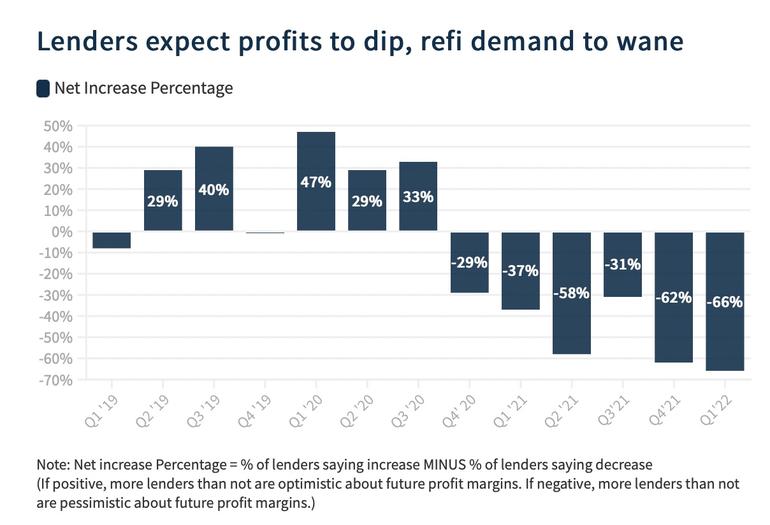
“For the sixth consecutive quarter, mortgage lenders expressed bearishness about near-term profit margin expectations amid headwinds from declining refinance activity, slower purchase mortgage demand growth, and narrowing spreads,” said Doug Duncan, senior vice president and chief economist at Fannie Mae. “For consumers, rising interest rates, lack of supply, and strong home price appreciation have reduced refinance activity and further constrained home purchase affordability, which, of course, is dampening lenders’ expectations of future business activity.
Numerous uncertainties, including heightened inflation and the Fed’s monetary policy reaction, which must now also account for the inflationary impact of Russia’s war on Ukraine, suggest increased market volatility, but the general underlying, upward rate trend aligns with lenders’ expectations.”
Survey Highlights
According to Fannie Mae, highlights from the most recent survey include:
Primary-Secondary Mortgage Spread Remains Elevated
“The primary-secondary mortgage spread averaged 127 basis points in Q3 2021, 9 basis points above the 2019 average, though down from the peak of 174 basis points seen in Q3 2020,” Fannie Mae stated. “Consumer demand expected to remain largely stable for purchase mortgages but decline for refinances.
“For purchase mortgages, demand growth for the prior three months continued its downward trend. The net share of lenders reporting demand growth over the prior three months reached the lowest reading for any first quarter over the past two years across all loan types. For the next three months, the net share of lenders expecting demand growth climbed significantly from last quarter across all loan types, but still showed the lowest reading for any first quarter in survey history.
“For refinance mortgages, the net share of lenders reporting demand growth over the prior three months, as well as the net share expecting demand growth for the next three months, remained similar to last quarter but generally continued its downward trend across all loan types – reaching the lowest readings in three years (since Q1 2019),” Fannie Mae continued. “For government loans, the net share expecting demand growth over the next three months reached a new survey low (since survey inception in Q1 2014).
Lenders Expect Credit Standards to Remain Largely Unchanged
The net share of lenders reporting easing credit standards over the prior three months, as well as the net share expecting easing over the next three months, remained generally flat across the past four quarters, Fannie Mae said.
Consumers Continue to Report Widely Conditions
In coordination with PSB, Fannie Mae noted it also surveys consumers monthly as part of its National Housing Survey, of which the Home Purchase Sentiment Index is derived. In February, consumers continued to report widely divergent views of homebuying and home-selling conditions. Only 29% of consumers reported that it was “a good time to buy” a home, while 72% believe it’s a “good time to sell.” More consumers also reported expectations that mortgage rates and home prices will continue to rise in the next 12 months, Fannie Mae said.
Don’t Forget to Check the Spam Folder!
Don’t forget to check your Spam/Junk email folder if you didn’t receive your free, popular and daily CUToday.info news headlines on Monday.
And if you haven’t yet signed up for the new email solution on which CUToday.info has partnered with ResponseGenius, you can do so here. Signing up requires less than one minute of your time.
CUToday.info has received very positive response from readers following the move to an improved provider of the daily headlines, but many also noted they did need to go to their Spam/Junk folder and mark it as safe.
The new email solution has not only improved every reader’s delivery experience, but it also features a fresh, new format that is easy to read, especially on mobile devices.
Please note and/or make your IT department or email administrator aware the emails will be coming from the domains CUTodayinfo.com and CUTodayinfoReply.com.