

WASHINGTON – For the third consecutive quarter, an increased share of mortgage lenders expect profit margins to retreat further from last year’s highs, according to Fannie Mae’s Q2 2021 Mortgage Lender Sentiment Survey.
According to the second quarter survey, 69% of lenders believe profit margins will decrease in the three months ahead compared to 52% in the prior quarter, while 19% believe profits will remain the same and 11% believe profits will increase.
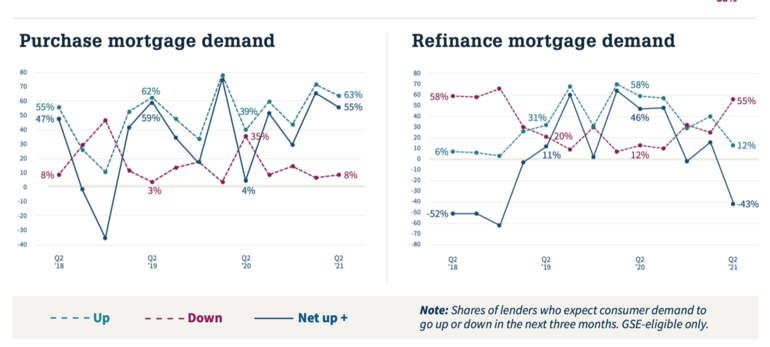
Looking at consumer demand over the prior three months, across all loan types, Fannie Mae said more lenders reported increased demand for purchase mortgages but significantly reduced refinance mortgage demand. In fact, for refinance mortgages, the net share of lenders reporting demand growth over the prior three months turned net negative for the first time since the first quarter of 2019 and reached the lowest reading since the fourth quarter of 2018 for GSE-eligible and government loans, Fannie Mae found.
Looking ahead, lenders’ expectations for purchase demand growth over the next three months remain relatively strong but are down slightly from last quarter for GSE-eligible and government loans, while refinance demand expectations fell significantly across all loan types, Fannie Mae stated.
‘Cautious Outlook’
“Despite elevated optimism toward the U.S. economy, lenders show a cautious outlook for their mortgage business,” said Doug Duncan, Fannie Mae senior vice president and chief economist. “This quarter, the largest net percentage of lenders in the survey’s seven-year history are expecting a decrease in their profit margin outlook. This is the third quarterly decline from the lender profitability highs of 2020. Those who expected a lower profit margin continued to cite competition from other lenders and market trend changes as the primary reasons.
“Lenders reported a significant refinance demand decline over the past three months and expect the decline to continue, with their refinance demand growth expectations reaching the lowest level seen since Q4 2018,” Duncan continued.
Duncan noted that with the shift from refinance to purchase business, some lenders commented that purchase transactions are harder to complete and have lower margins.
‘More Positive Picture’
"Recent economic indicators, however, paint a somewhat more positive picture,“ stated Duncan. “Though the primary-secondary mortgage spread has continued to narrow, it remains wider than the level seen pre-pandemic, suggesting that lenders are still making profits, though not as much as they did in 2020. Purchase mortgage applications have trended slightly lower in recent weeks; however, they remain fairly strong, and higher than the pre-pandemic level, likely because of continued low mortgage rates. Our June National Housing Survey showed that consumer demand remains strong since ‘home purchase on next move’ is at a survey high, despite the challenges of accelerated home price appreciation and insufficient supply.”
Survey Highlights
Among some of the highlights in the analysis:
Rates Stabilize, Spreads Compress
According to Fannie Mae, after the impressive 40 basis point run-up of the 10-year Treasury in the first quarter of 2021, peaking at 1.72% in the first week of April, the 10-year has stabilized in the range of 1.55% and 1.65%. The 30-year fixed contract rate has also experienced a similar stabilization, peaking at 3.18% in the first week of April, but now hovering around 3.0%, though it reached as low as 2.94% in mid-May.
“While both the 10-year Treasury and 30-year fixed contract rate have fallen from their peaks in early April, the contract rate has fallen further than the 10-year,” Fannie Mae said. “Given this movement, the primary spread compressed further in May, falling 8 basis points to 134 basis points, the lowest level since April 2010, and well below the prior decade's average of approximately 170 basis points.”
Strong Demand, Weak Demand
Fannie Mae reported that for purchase mortgages, the net share of lenders reporting demand growth over the past three months increased from last quarter across all lender types. Bu the same can’t be said for second mortgages.
“Looking ahead, lenders’ demand growth expectations over the next three months are slightly down for GSE-eligible and government loans and about even for non-GSE-eligible loans,” Fannie Mae said. “For refinance mortgages, the net share of lenders reporting demand growth over the prior three months dropped significantly from last quarter across all loan types, turning net negative for the first time since Q1 2019 and reaching the lowest reading since Q4 2018 for GSE-eligible and government loans. Refinance demand growth expectations on net for the next three months also fell significantly across loan types, reaching the lowest levels seen since Q4 2018.”
Slight Easing of Standards
The net share of lenders reporting an easing of credit standards over the prior three months has gradually climbed since Q2 2020 across all loan types, according to the report.
“This quarter, the net-easing share for GSE-eligible loans remained relatively flat from last quarter,” Fannie Mae said. “For the next three months, the net share of lenders expecting easing ticked up slightly from last quarter for non-GSE-eligible loans but remained relatively steady for GSE-eligible and government loans.”