

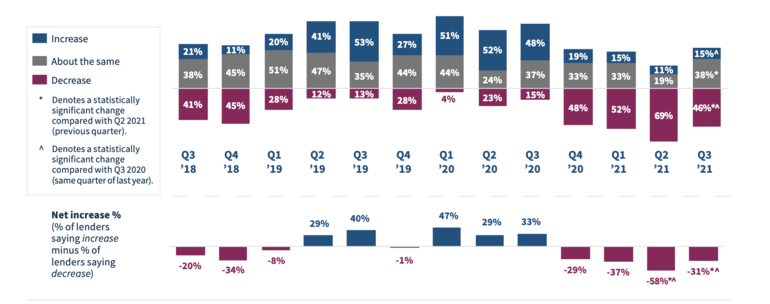
WASHINGTON–For the fourth consecutive quarter, a plurality of mortgage lenders expect near-term profitability to decrease, according to Fannie Mae’s Q3 2021 Mortgage Lender Sentiment Survey (MLSS).
According to the survey, 46% of mortgage lenders believe profit margins will decrease in the next three months, an improvement from 69% in the prior quarter, while 38% believe profits will remain the same and 15% believe profits will increase. Increased competition and changing market conditions were the top reasons cited for the pessimism, while GSE pricing and policies and strong consumer demand were the top reasons given among lenders with a more positive profitability outlook, according to Fannie Mae.
Additionally, across all loan types, more lenders in the most recent survey reported reduced consumer demand over the previous three months for purchase mortgages but improved demand for refinance mortgages.
A Net Positive
Nevertheless, Fannie Mae said the reported change in mortgage demand over the previous three months, as well as expectations for the change in demand over the next three months, remained positive on net for purchase mortgages but still slightly negative for refinance mortgages.
“Mortgage lenders appear to have adopted a more neutral posture, reporting to us via the MLSS mixed expectations for purchase and refinance mortgage demand over the next three months," said Fannie Mae Vice President and Deputy Chief Economist Mark Palim. “In the third quarter, more lenders than not reported expectations that purchase mortgage demand will continue to grow, though the total share expecting such growth fell substantially compared to the previous quarter. Meanwhile, a plurality of mortgage lenders expects refinance activity to continue to wane from the highs of the past year and a half – even so, their outlook on likely refi volumes was improved compared to the prior quarter. Of the lenders who expect purchase mortgage demand to decrease in the coming months, high home prices and a limited supply of homes for sale were the primary reasons given – these were also among the top reasons provided by the 63% of consumers who believe it’s a ‘bad time to buy a home’, according to our latest Home Purchase Sentiment Index results.
Improved Outlook
“On net, mortgage lenders’ profitability outlook improved slightly from last quarter, although more lenders than not continue to expect profit margins to decline in the months ahead,” Palim continued. “The primary-secondary spread, an indicator of potential profitability, remains wider than the previous decade’s average – a positive sign for lenders – though in August it was at its narrowest since February and 53 basis points below the peak seen in August 2020.
“While lenders continue to overwhelmingly cite increased competition as their primary concern regarding future profitability, the share citing personnel costs for their diminished profit margin outlook increased significantly, suggesting that mortgage lenders’ ability to efficiently manage their workforces will be critical to their bottom lines as competitive pressures remain intense,” said Palim.
Survey Highlights
Among the survey highlights:
Reported Consumer Demand Weakens Slightly for Purchase Mortgages, Improves Slightly for Refinances
“For purchase mortgages, the net share of lenders reporting demand growth over the prior three months fell for GSE-eligible and government loans, compared with Q3 2020 and Q3 2019, reaching the lowest reading for any third quarter in the last two years,” Fannie Made said. “Looking ahead, the net share of lenders expecting demand growth over the next three months also reached the lowest reading across all loan types for any third quarter in the last two years. For refinance mortgages, the net share of lenders reporting refinance demand growth over the prior three months, as well as the net share expecting demand growth for the next three months, ticked up from last quarter across all loan types, although both shares remained net negative.”
Lenders Continue to Report Easing Credit standards
“The net share of lenders reporting easing credit standards over the prior three months and the net share expecting credit standards to ease over the next three months ticked up for GSE-eligible loans but down for non-GSE-eligible loans. The net share remained flat for government loans compared to the previous quarter,” Fannie stated.
Consumers Continue to Report Divergent Homebuying and Home-Selling Conditions
In coordination with PSB, Fannie Mae noted it also surveys consumers monthly as part of its National Housing Survey, of which the Home Purchase Sentiment Index is derived. In August, while the overall index remained flat, consumers’ perceptions of homebuying conditions compared to home-selling conditions remains polarized.
According to the report, only 32% of consumers reported that it was “a good time to buy” a home, while 73% percent believe it’s a “good time to sell.” Not surprisingly, two of the top three reasons cited by consumers for their pessimism toward current homebuying conditions were high home prices and a lack of supply, Fannie Mae said.
The Mortgage Lender Sentiment Survey by Fannie Mae polls senior executives of its lending institution customers on a quarterly basis to assess their views and outlook across varied dimensions of the mortgage market. The Fannie Mae third quarter 2021 Mortgage Lender Sentiment Survey was conducted between Aug. 3, 2021 and Aug. 16, 2021 by PSB in coordination with Fannie Mae.