IRVINE, Calif.—Even though mortgage volume has slowed, mortgage fraud has actually increased, according to one new analysis.
CoreLogic said its Mortgage Fraud Report found that at the end of Q2 2014 there was a 3.2% year-over-year increase in fraud risk, as measured by the Mortgage Application Fraud Risk Index. That index estimates that applications representing approximately $3.3 billion in mortgage debt contained elements of fraud or serious misrepresentations in the second quarter of 2014. For the twelve months ending the second quarter 2014, the report estimates the total value of applications with fraud or serious misrepresentations at $19.8 billion.
The analysis also found that during the second quarter of 2014, approximately 11,100 mortgage applications, or 0.69% of all mortgage applications, contained elements of fraud, as compared with 19,700 or 0.67%, in the second quarter of 2013, when the total application volume was substantially higher.
The CoreLogic Mortgage Fraud Report analyzes the collective level of loan application fraud risk throughout the mortgage industry. The CoreLogic Mortgage Application Fraud Risk Index is based on residential mortgage loan applications processed by CoreLogic LoanSafe Fraud Manager, which includes a predictive fraud scoring technology. The report includes detailed data for six application fraud type indices that complement the national index: employment, identity, income, occupancy, property and undisclosed debt.
Among the findings of the report:
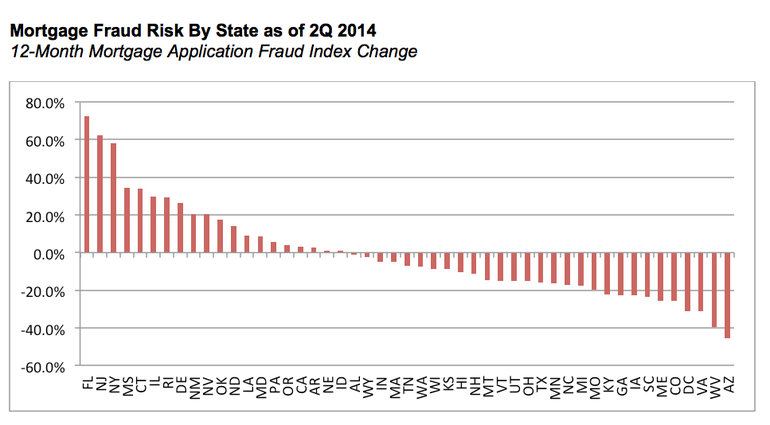
- Nationally, Florida experienced the highest year-over-year growth in mortgage application fraud risk; Arizona experienced the largest decline.
- Of the six components in the CoreLogic Mortgage Application Fraud Type Indexes, property fraud risk had the largest year-over-year percentage increase at 3.3%; undisclosed debt risk showed the largest year-over-year decline at 22.7%.
- As has been the case for the past four years, jumbo mortgages have exhibited the highest fraud risk, followed by low-down payment mortgages.
Related links
Anti-Fraud Effort To Cause Fraud Spike
New Fraud Tactic Fakes Chip-Card Charges