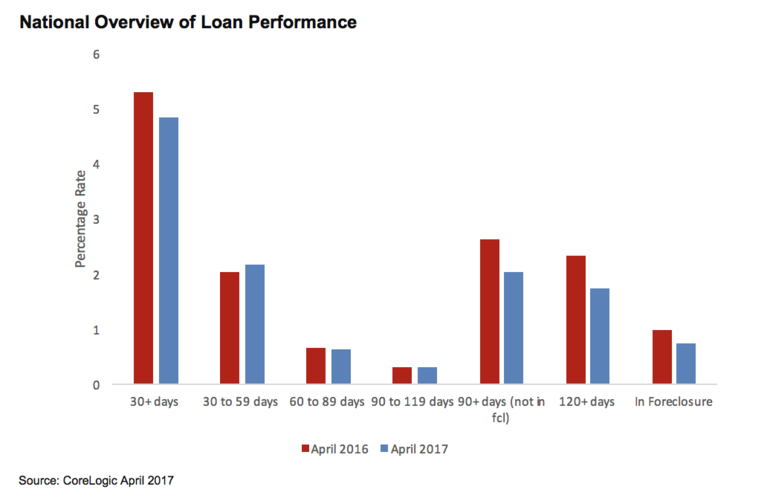
IRVINE, Calif.—As of April, 4.8% of mortgages were in some stage of delinquency (30 days or more past due, including those in foreclosure, a 0.5 percentage point decline in the overall delinquency rate compared with April 2016 when it was 5.3%, according to the Loan Performance Insights Report from CoreLogic.
As of April 2017, the foreclosure inventory rate, which measures the share of mortgages in some stage of the foreclosure process, was 0.7% compared with 1% in April 2016, the report found. The serious delinquency rate, defined as 90 days or more past due including loans in foreclosure, was 2%, down from 2.6% in April 2016.
“Measuring early-stage delinquency rates is important for analyzing the health of the mortgage market,” the company said. “To comprehensively monitor mortgage performance, CoreLogic examines all stages of delinquency as well as transition rates, which indicate the percentage of mortgages moving from one stage of delinquency to the next.”
CoreLogic reported that early-stage delinquencies, defined as 30-59 days past due, increased to 2.2% in April 2017 from 2% in April 2016. The share of mortgages that were 60-89 days past due in April 2017 was 0.63%, down slightly from 0.64% in April 2016.
“Most major indicators of mortgage performance improved in April, showing that the market continues to benefit from improved economic growth and home price increases,” said Dr. Frank Nothaft, chief economist for CoreLogic, in a statement. “Regionally, with the exception of several energy industry intensive states – Alaska and North Dakota – the rest of the U.S. continues to see improvements in mortgage performance. While overall performance is improving, it reflects the older legacy pipeline of loans that continue to heal, especially in judicial states which typically take longer to clear out.”
Since early-stage delinquencies can be volatile, CoreLogic said it also analyzes transition rates. The share of mortgages that transitioned from current to 30-days past due was 1.2% in April 2017 compared with 1% in April 2016, a 0.2 percentage point increase year over year, the company said. By comparison, in January 2007, just before the start of the financial crisis, the current-to-30-day transition rate was 1.2% and it peaked in November 2008 at 2%.
“Delinquency rates are down virtually across the board as the rebound in the U.S. housing market continues to gather steam. It appears likely that delinquency rates will continue to fall for some time, but at a moderating pace,” said Frank Martell, president and CEO of CoreLogic, in a statement. “As we look forward, improved fundamentals provide us with a firm foundation and we must now increase our attention to carefully expand the supply of affordable housing stock and ensure that mortgage lending policies help to prudently promote first-time homeownership.”