RALEIGH, N.C. – A new survey indicates that lenders may need to start doing a better job of storing more granular data on credit risk to comply with new CECL rules.
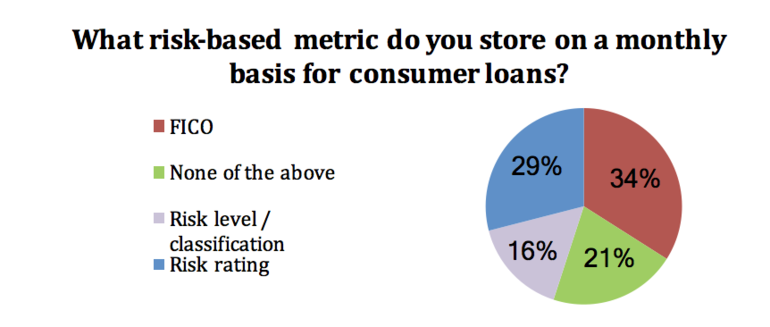
As might be expected, 34% of respondents to the survey of financial executives that asked how they measure risk on consumer loans said they primarily turn to FICO scores. Another 29% said that risk rating was the metric they store on a monthly basis.
The survey was conducted by Sageworks, a financial information company that provides lending, credit risk and portfolio risk solutions to banks and credit unions, during a webinar, Consumer Pool CECL Methodologies, which was part of the CECL Methodology Webinar Series. The poll asked webinar attendees which risk-based metric they store on a monthly basis for consumer loans. In preparation for the expected loss model in the allowance, institutions are evaluating their existing data aggregation policies to assess how those plans may need to change by pool, Sageworks said.
According to responses from 453 individuals on the webinar, 16% said risk level/classification is stored on a monthly basis for their consumer loans. However, 21% said that the do not store any of the risk-based metrics for consumer loans, which included FICO, risk rating and risk level/classification in this poll question, Sageworks reported. Each attendee chose a single answer and could not indicate if they used a combination of several metrics.
“What is most telling from the poll isn’t the heavy reliance on FICO; it’s that almost a quarter of the audience wasn’t collecting this data on a go-forward basis. It’s possible that the institutions in this segment are collecting it on a quarterly basis or maybe keeping only the most-recent snapshot,” said Neekis Hammond, a principal with Sageworks Advisory Services. “But given the forward-looking measures of CECL calculations, institutions will need data that allows them to more granularly measure credit risk and changes in risk over time. The metrics offered in the poll would be good proxies for credit risk in the consumer pool, where many small-balance loans can make up a significant part of the portfolio.”
Creating an automated or manual rating matrix that combines FICO with originated or recent LTV as well as historical payment behavior now may prove to be a very valuable move in financial reporting periods to come, added Hammond.