

SAN FRANCISCO–The Money Anxiety Index, which measures the financial behavior of consumers, skyrocketed 10.5 points in March, the first time it has seen such a dramatic jump since immediately after the Sept. 11 terrorist attacks.
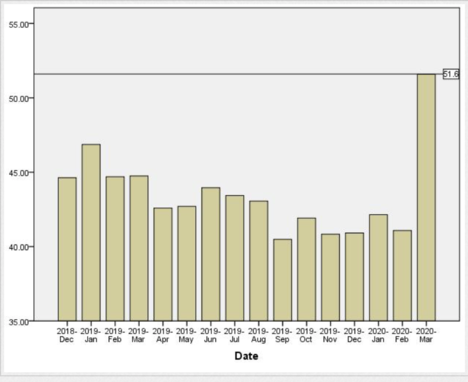
“The similarities in the financial anxiety of consumers between the coronavirus crisis and the Sept. 11 crisis make it plausible that we will experience a similar economic cycle in the coming months,” suggested Dr. Dan Geller, a behavioral economist and the developer of the Money Anxiety Index.
Geller said an analysis of the Money Anxiety Index during and after the Sept. 11 crisis shows that the level of financial anxiety leaped 10.8 points in October 2001 right after the attack, and continued to climb up for about 100 days thereafter. Since the initial money anxiety response of consumers to the coronavirus and the Sept. 11 crisis is identical, it is plausible that the Money Anxiety Index will start decreasing in mid-June of 2020, Geller said.
"There are two kinds of economic crises," said Geller. “There is a systemic economic crisis, which is what we had during the financial crisis of 2008/9, and there is a temporary economic crisis, which is what we experienced during Sept. 11, 2001. The economic experience of the current coronavirus crisis is likely to be similar to the Sept. 11, 2001 experience."
According to Geller, the Money Anxiety Index is a validated behavioral economics predictor. It measures actual financial behavior of consumers rather than subjective responses to surveys. The Money Anxiety Index has been peer reviewed and published in the Journal of Applied Business and Economics. Geller said the Index is highly predictive and predicted the arrival of the Great Recession 14 months prior to the official declaration of the recession in December of 2007.