

LAS VEGAS–Talk about fortuitous timing: Just hours after CFPB Director Rohit Chopra made a big splash announcement at the Money 20/20 Conference that the Bureau will work to facilitate open banking and open finance in the U.S., a panel discussion on that very same issue was already on the agenda.
Tackling the issues of open finance, who will own data, what the world will be like for the consumer and more were Salman Syed of Fidel API, Stephany Kirkpatrick of Orum, and Kurtis Lin, Pinwheel. The session was moderated by Merritt Hummer of Bain Capital Specialists.
Here is what the panel had to say on open banking, regulation, what they expect and more.
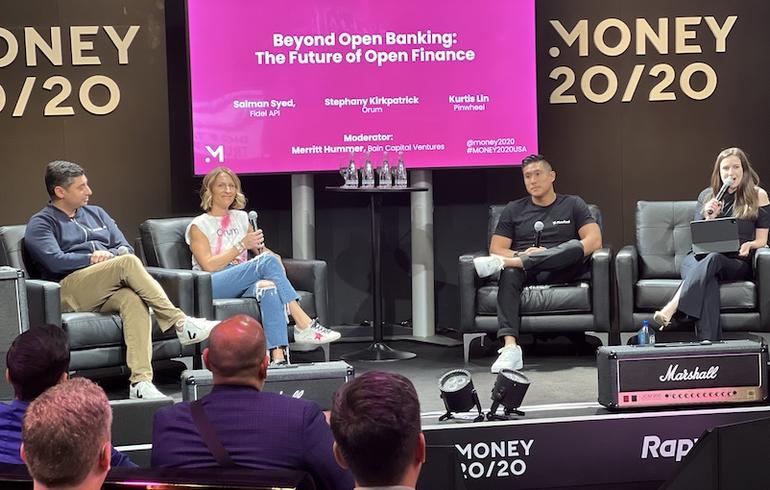
From left, Salman Syed, Stephany Kirkpatrick and Kurtis Lin
Hummer: What is open finance? How is it different from open banking?
Lin: Open finance to me is this idea that if you build the pipes to allow for the free flow of information, especially with the consent of the consumer, the more freely it flows. It allows that consumer to access better and, hopefully, cheaper products. In open banking, when that information is siloed, it’s hard for the consumer to fulfill the idea of portability.
Kirkpatrick: It’s also the ubiquity of access of point to point money movement. It’s ultimately the unlock for all financial products we are going to be building.
Syed: This is a global phenomenon. The net/net is one way or another this is the future. The fact is you will be able to take your data with you. How it happens is probably the most important thing.
Hummer: To what extend is this a pipedream vs. realizable dream?
Kirkpatrick: Green shoots have been planted. For years we have been accustomed to using an aggregator to unlock some of our information to go from one place to another, to be visible in a financial planning application, for instance. But now this goes further. There are very targeted things that we have slowly gotten accustomed to doing and understanding how this benefits us. Our information is collected by a bank, repackaged by a credit bureaus, and then scored as good or bad. Now we can use all the types of data that exist.
Hummer: The CFPB announcement suggests there is going to be regulatory support and that is going to unlock this further. We need to think about this on a whole new level.
Syed: I think there are a couple of layers to this. Open finance is going to be a thing. The next piece is the infrastructure. But for it to be a reality and not a pipedream means there has to be a killer app moment. We are in the early innings now. When building the infrastructure, the exciting part is you don’t know exactly how it is going to be used.
Lin: When you zoom out a bit and think about how this works phase by phase, the first phase is proving value; the killer use case. You need to provide them a use case and a case study to show them our existence is delivering value in this ecosystem. It’s hard. It’s this cold-start problem. For me to get the ADPs of the world to buy in we need to prove it works, but to prove it works we need to get the ADPs to buy in. We need to get to a point where supply side partners say we see the value here.
Hummer: As we think about the nearest-term use cases, what are those, which are most likely to emerge? What is the Utopia of open Finance?
Syed: First of all, timing is everything on these types of things. To answer it directly, we are very bullish on loyalty and rewards and expense management. We have seen good proof points on that. But think about what is happening. We had the CFPB announcement this morning, but look at how the market is changing. I think we are on the precipice of a lot of interesting use cases.
Kirkpatrick: My background is as a certified financial planner. I found myself working in payments. If I fast forward to Utopia, it looks like money moving instantly in all directions and data moving with that transaction from point to point. Now, the transaction takes like 10 steps. Imagine an automation layer where it isn’t going through 10 steps. It’s determining how to get money directly into a payment, there is automated optimization in the background. Imagine a world with an ‘Easy’ button.
Lin: If you think about where information sits, it is usually stored in a payroll system. Think about what we’ll be able to do with that. Have you ever tried to switch your direct deposit on your ADP? It’s super high friction. It’s terrible. One of the first things we looked at is can we at Pinwheel take that friction out and make it one click.
Now, next level, can take the payroll information for decisions. An API can enable instant pay at no risk. All of this starts with the aggregation of information.
Fitzpatrick: The question is how to block the bad actors. To me the question is how do we recognize the good actors? What is the token that goes with you and shows you are a good actor? How does that help us to know more about the consumer at the right moment in time?
Lin: We have talked for a long time about cash flow-based underwriting. It’s this idea of real-time underwriting. In 2022 we have so much data--why are we still making these point-in-time decisions? You can make a decision now and then continue to assess. You can understand as time goes on a person’s true profile. Now you have better margins, your more efficient, it makes the whole system work so much better.
Hummer: Is the real-time element necessary in all use-cases?
Kirkpatrick: It depends on the use case. With faster payments you are going to release a transaction in less than six seconds. It’s not reversible. Real-time information is very relevant to the use case. When you think about money movement real time is absolutely critical. Your risk profile from nine in the morning to two the next morning could change in real ways, good or bad.
Syed: It’s all contextual in terms of when real-time really matters. In loyalty and rewards it is actually important. When you see someone transact, you want to give some sort of feedback in the moment. It’s critical. But in personal financial management, if you get (information on) all the transactions done during the day at the end of the day, that’s all that needed.
The other thing to talk about is when we get really dependent on data, it either has to be completely frictionless or it has to be completely accurate every time.
Anytime you are changing how financial services worked, we have to be able to deliver.
Lin: At the beginning of COVID, we got a call from Fannie Mae saying we have people approved for mortgages, but three months later we don’t know if they are employed anymore. The other thing we have seen is when the need for access to liquidity becomes a real thing, real-time becomes more and more important. You want real-time because there is a really big vector of fraud.
Hummer: What about the regulatory trends in this market? What about the direction of financial data ownership? Who will own data moving forward?
Lin. We have a crystal clear position on this. We believe it is undeniably true that information about who you are, how much you make and where you work is information that belongs to the consumer. I think all the regulatory work to date points in that direction.
The other question is who else owns the data? That’s the interesting question. There is a question around can you share ownership of information and who gets to make up the rules over data ownership.
Kirkpatrick: We are conflating who collected the information with who owns it. I think it’s in my hands who I, as a consumer, want to give access to. I wouldn’t like the bank to use it for themselves and not tell me they’re using it, and I wouldn’t like for the bank to give it to someone else. There are a lot of places where information needs to be stored, but that to me doesn’t mean ownership. But it does mean responsibility. Ultimately, it’s my data. All consumers should have input into how they want that data utilized.
Syed: I think the answer is both. The reality is if used the right way, perhaps it’s better products for me. I think there is an aspect of ‘I am going to allow you to use it, but it has to be for my benefit.’ As these platforms evolve and new innovators come to the table, that I think is what we want to aspire to.
Kirkpatrick: Without the regulators, what is going to compel the top 10 banks to open up the data as they believe they own it?
Hummer: What does the new CFPB decision mean?
Syed: The first thing is does is bring this topic to the forefront. What is also does is put a lot of organizations on notice that there is going to be some level of expected change…I think this is a positive.
Kirkpatrick: I think it signals that regulators in general are paying attention. It used to feel like a lag, that they were years behind where contemporary fintech is going, but now they are catching up. Catching up late and curtailing (a technology) is bad. With the news today, I think we get an opportunity to sprint together and have less whiplash of a great idea being constrained. I think this is going to be very empowering, although we don’t ultimately know what it is going to look like.
Lin: I think this is a direction we have already been heading for a very long time. If I could encapsulate this into one word it would be ‘urgency.’ When you talk about urgency and speed it can go both ways, which to me signals there is some risk here as it may not go the way we want it to.
Syed: The only thing I would add is it’s important for us to be in the conversation. It’s good for business in many ways, but this could cut in a lot of different directions and make this harder. Or we could engage and give (the CFPB) some more perspective.
The Very Best in CU Reporting. Every Morning. To Your Inbox. At a Cost Any CFO Will Love
Don’t forget to check your Spam/Junk email folder if you haven’t been receiving your free, popular and daily CUToday.info news headlines.
And if you haven’t yet signed up for the new email solution on which CUToday.info has partnered with ResponseGenius, you can do so here. Signing up requires less than one minute of your time.
CUToday.info has received very positive response from readers following the move to an improved provider of the daily headlines, but many also noted they did need to go to their Spam/Junk folder and mark it as safe.
The new email solution has not only improved every reader’s delivery experience, but it also features a fresh, new format that is easy to read, especially on mobile devices.
Please note and/or make your IT department or email administrator aware the emails will be coming from the domains CUTodayinfo.com and CUTodayinfoReply.com.