

LAS VEGAS–While artificial intelligence has the capability to “rewrite your futures,” two people told the Money 20/20 Conference here their firms are already well into deploying AI in numerous ways.
During a session titled “AI and Data and Tech Adoption…Oh My,” Christian Mitchell, EVP and chief customer officer with Northwestern Mutual, and Lareina Yee, a senior partner with McKinsey shared their perspectives on what they are doing and advising, respectively.
Noting Northwestern Mutual is 160 years old, Mitchell said his priority and that of the company is to ensure it is relevant for another 160 years. It sees AI playing a fundamental role in helping accomplish that.
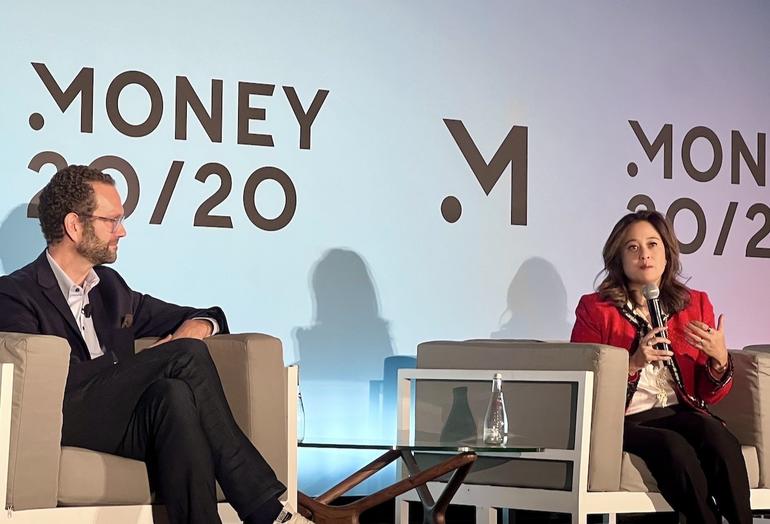
Christian Mitchell, left, and Lareina Lee speaking in Las Vegas.
“When we think long term, there is going to be up to $4.4 trillion in productivity value to be gained due to AI over next decade or two,” said Lee. “Seventy-five percent of that will be in four areas: Customer services, sales and marketing, product development and software engineering.”
Speaking to how AI will have consequences for Northwestern Mutual and other companies in the insurance industry, he noted that the technology is expected to significantly expand human lifespans as a result of more personalized medicines, treatments and more.
Two Scenarios
He shared a scenario in which a life insurance agent is meeting with a client and that client doesn’t know anyone who hasn’t lived to at least 100.
He shared another scenario in which AI is listening in on a conversation between the agent and the client, which is taking place in the metaverse, and the AI renders recommendations to help the client achieve their dreams.
“It’s going to significantly alter the demand for our products,” he said. “That’s the imagination we need to lean into.”
‘Speed is Your Strategy’
During the session, which was presented as a conversation that went back and forth between Yee and Mitchell, Yee responded by saying, “I would say speed is your strategy. What we try to do is bridge, what are those types of future scenarios you can imagine and how do you start building those now.”
Yee said she works with a colleague who is fond of saying, “Less toil, more joy’; in other words, instead of thinking about just the technology and its capabilities, reimagine the job with less toil in order to spend more time on the things that only humans can do uniquely well. Those include judgment, insight, synthesis and the interaction, she said.
“We're all here person,” Yee told attendees. “You're not looking at us on a work full screen it's actually incredibly wonderful to do that. So, how do you rethink how our work gets done and what's possible? I think that’s the strategic question. Then, how do you start moving quickly towards that vision?
Practicing What it Preaches
Yee said McKinsey’s own overarching views on those questions are that it isn’t about getting rid of humans but providing people with “superpowers” and the capacity to provide an experience that is “significantly better.”
Yee cautioned that no industry will avoid being disrupted by AI, but she also offered a twist on that view: “When I say disruption, I mean that in a positive way. We can start to reimagine our work, we can start to reimagine how we spend our time.”
Yee said McKinsey’s research suggests up to 60% of time will ultimately be repurposed for knowledge-workers, providing an opportunity to spend more time with customers/members, with teams, doing mentoring and development and, perhaps, even go to a four-day workweek.
Three Dimensions
Mitchell said Northwestern Mutual is looking at AI through three dimensions, including:
- Costs. “We can essentially self-fund some of the transformative stuff that's coming. we're generating capacity to do that transformative stuff.”
- Change Management. He said the company is using AI as a change management opportunity and for implementations. “I'm actually bringing in more leaders for the enterprise. It slows things down a little bit, maybe makes it a little bit more bureaucratic, but I have to upscale those leaders. They need to understand token costs and the differences between different models and all of that so that when transformation comes to their area, they're ready to go for it.”
- Near-Term Activities. In some areas the company is doing what he called “near-term intervention. We're trying to pick areas where the near-term activity bridges to something that's longer term and more transformative. So, we've got a GPT interface on top of all of the knowledge management for advisors. That's the first step in eventually having like a copilot for our advisors that's helping them in zoom calls with clients, helping them manage their day.”
Where it Starts
According to Yee, everything starts with education, saying the “amazing thing about generative AI is it’s a very accessible technology.”
She said a second imperative, and it’s the same advice McKinsey gives its clients, is that generative AI can be applied like a “rocket ship,” but it must be more than a “check the box” solution that is “sprayed everywhere.”
“We want to be really intentional about how we’re using it, and it should actually result in a cost improvement, better experience or more productivity,” she said.
McKinsey, for example, focuses on what it calls “two by two”: two productivity and two really bold innovation initiatives.
Yee noted again McKinsey always starts with humans—hence the phrase “humans in the loop”—but she also believes something “much more profound” is at work, and that is finding ways to take what can be a century’s worth of data and use generative AI in new ways to make it work effectively.
Deep Conviction
For his part, Mitchell said he has a “deep conviction we are headed toward a future where AI is going to be awash in everything. It’s going to be AI everywhere. Paradoxically, that future makes human interaction even more valuable. I joke with our team the artisanal, grass fed conversation is going to be even mor important.”
Employees Volunteering to be Involved
In terms of something actionable as parting advice, Mitchell said Northwestern Mutual has sought to tap into the discretionary effort of its employees to also benefit the company.
“The best engineers in my group are already playing with these tools outside of work,” he said. “What we've done is allowed those folks to actually volunteer their weekend time and evening time to work on some of the POC's that we've got going. They love it because, again, they would be doing this anyway. We get benefit out of it. There's an incredible opportunity to upskill the organization and, funny enough, we found that the folks that are actually volunteering this discretionary time they love it. It almost becomes a retention tool.”
Just Because It’s Autumn Doesn’t Mean Falling for Schemes to Overcharge You for CU Industry News. Instead, Try This Crisp Offer
The biggest, best and freshest news reporting in credit unions remains free! Each morning CUToday.info delivers its daily Fresh Today news update offering the latest headlines and breaking news right to your email, with the easy-to-read headlines format allowing you to click on the stories that interest you most in order to learn more. So stop paying those bank-fee-like subscription prices from other so-called “news”” publications!
If you haven’t yet signed up for the new email solution on which CUToday.info has partnered with ResponseGenius, you can do so here. Signing up requires less than one minute of your time—and it’s free!
Please note that after signing up you may need to go to your Spam/Junk folder and mark the morning headlines email as safe. CUToday.info does not provide its list of readers and emails to outside parties, and we will not be contacting you to sell you an extended warranty or sending you any links so you may cash in on an inheritance you didn’t know was coming.
And did we mention it’s free?