

LAS VEGAS–Should credit unions pull back the curtain on what traditional banks, neo banks and fintechs are talking about right now, they will find the conversation, concerns and investments sound a lot like their own.
During the Money 20/20 Conference here, a panel discussion titled “Banking on the Cloud: From Neobanks to Big Banks” centered on legacy systems, silos, AI and even underserved communities.
The panel discussion was part of a larger track at the conference that has more than 11,000 people in attendance called “Building Tomorrow’s Bank in Today’s Turmoil.”
The panel participants included Yolanda Piazza of Google Cloud, who served as moderator; Seke Ballard of Beta Financial Services and BetaBank, and Reetika Grewal of Wells Fargo.
Editor’s note: Due to a change in panel participants, CUToday.info was unable to confirm the name and bank affiliation of the fourth member of the panel. For that reason he is referred to as Bank Representative in the following report.
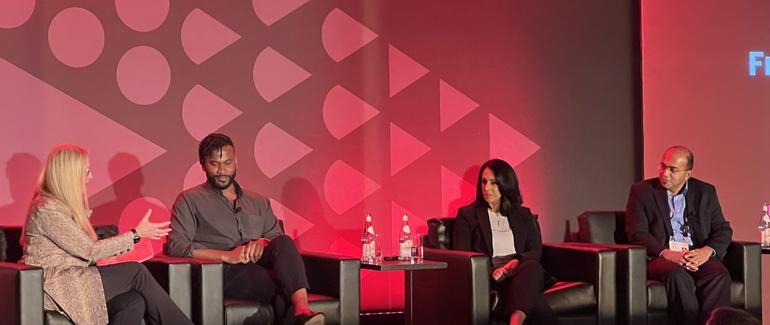
Here is a look at what was discussed:
Piazza: You represent a different customer base. With the change in customer expectations, how are you thinking about serving that in each or your markets?
Ballard: If a legacy bank received a loan application for $100,000 and a loan application for $1 million, the cost of processing those two loans is essentially the same. You’ve got the bricks and mortar, the loan officer, the meeting with the borrower. Because of that, the profit on the million-dollar loan is a lot higher, which means the loan officer is incentivized to go after that million-dollar loan.
The problem is the majority of small businesses are interested in loans under $200,000. So, the borrower is often routed to credit cards, which aren’t suited to their use case.
Technology is a massive part of the answer to those businesses interested in smaller-dollar loans. Rather than having loan officers shuffling papers and doing math, that is something technology can solve, help lower the cost and allow you to offer loans to a broader audience.
Piazza: This is something personal to you, right?
Ballard: I think most entrepreneurs start companies based on a problem they themselves are experiencing. My father shared an experience with me. When I was a kid my dad owned a pulp wood lumber company and he would sell to a paper mill. He grew it from a hand-me-down truck to having a couple-dozen employees serving North Carolina. He wanted to expand, but to do that he needed (capital) and he went to a number of banks and was rejected 13 times. His view was this had less to do with his business and capacity of taking on debt and more to do with color of his skin.
According to the Federal Reserve, if I go into a bank and a white guy goes into a bank, the Fed says I am 2.7 times more likely to be denied. If I get it, I pay 180 basis points more in interest. This is also true for women. When Sally goes into a bank and sits across from the loan officer, they are performing what’s known as a character test, and thinking about what a borrower looks like.
I believed this was a solvable problem, and the way you do that is by removing the human from the transaction. Remove bias, assess the risk. Everyone should be evaluated by the same measures.
Bank Representative: At community banks, regional banks, it’s all about relationships. Our branches are where people come to meet with a human, to interact. But times are changing. We used to have a branch-only segment and now we have a digital segment. We want to be where the customers are. We are also undergoing a digital transformation. We are building a digital banking ecosystem. Lending is where we see opportunity.
Piazza: Commercial banking is a much different customer. What are you seeing?
Grewal: They are also looking for that consumer-like experience. At the end of the day they are consumers, as well. They are looking for ease of use. How do you recognize that they are morphing and changing?
I love the commercial banking space. It’s a place where you can go from being a very tiny company to a unicorn overnight. How do you make sure when giving them the tools they need that it can scale and grow with them? Automation and simplification is really how we are orienting ourselves.
Piazza. How is a company the size of Wells Fargo thinking about this technology transformation? How can you compete with the with the neo-banks and the regional banks?
Grewal: You start with what the client experience needs to be and then you simplify. In the commercial banking space we are dealing with clients from two people to massive organizations, so we’re making sure we have the technology to right size it. Look to leverage cloud technology to do that and find areas to move more nimbly.
Piazza: How much of that is technology?
Grewal: It’s people, process, systems, right. It has to be. You can put really lovely technology in place but if you haven’t got the right people in place around it, you haven’t evolved it.
Piazza: In an era of superior technology and customer expectations, how do you think about AI and machine learning?
Ballard: One, I think it allows us to have a much more comprehensive view of the individual, and their business. I think today data tends to live in silos and those silos aren’t able to interact with each other. So, you might have a loan data silo and a transaction data silo and there is no mixing of the two.
When you think about how we’re building our bank (as) cloud native, headless core, it really resolves a lot of those problems because you are able to see that individual as a more complete whole. And when you do that you are able to manage the risk, and that leads to products that are more appropriately risked.
When I talk about Beta Bank, the people who come up to me most often are immigrants. They often talk about how intimidating it is to go to a bank. You go to an institution and there is this person asking for all these documents. It ends up being a barrier for them.
With our onboarding process, you don’t have to go into a branch, you don’t have to have all your documents, you don’t have to meet with anyone. You can do it from the comfort of your home with whatever device you want to use. That is simple but at the same time, profound. That means for those who say it’s an intimidating process, we can say here is one that is not so intimidating. We create access and have an incredibly comprehensive view of that individual.
Grewal: We do a lot in terms of fraud monitoring. The magic comes in when you can connect it across the silos; that’s where AI comes in in stitching it across all the (departments).
Bank Representative: We are using AI in two major areas. One is the credit underwriting model. We do see a big opportunity in credit for underserved communities. We feel there is more we can do there. Another focus area is fraud monitoring. We feel we can be more proactive than we are today.
Ballard: I also think the ability to see data across silos. It allows you to provide insights to the business owner that enables them to create efficiencies and achieve whatever their business goals are. We might be able to predict that next month you are going to have a bit of a cash flow gap. Here is a loan product that helps you overcome that gap. That is only available if you have that comprehensive understanding of that individual.
Grewal: There is a need for personalization and we are leveraging AI in that space. Clients want us to know who they are and they want you to know at scale, as well.
Piazza: Your customers are usually starting from different places. How do you think that is evolving?
Ballard: The vast majority of small business in America are sole proprietorships. I think their needs are markedly different from a business that employs people. They want tables stakes, they want it simple and they don’t want to pay a lot for it. I don’t believe what’s currently available to them really delivers in that way.
When I think of how do we change ourselves so that we can better address the needs of the majority of small businesses, we have to think about how do we use technology to lower the cost of serving that sole proprietor in a way that is comprehensive and gives them the tools they need to no longer be a sole proprietor.
Grewal: When we think about solving for our clients’ needs, we take a broader look around. What are the tools they are using and what are the rituals and processes they are using. So, we are spending a lot of time thinking about embedded finance and technology and putting our services in their tools, so they are not doing the swivel-chairing they are used to doing in entering things in one place and then another. And then it’s about finding the right balance between human beings and technology.
The Very Best in CU Reporting. Every Morning. At a Price Every CFO Will Love
Don’t forget to check your Spam/Junk email folder if you haven’t been receiving your free, popular and daily CUToday.info news headlines.
And if you haven’t yet signed up for the new email solution on which CUToday.info has partnered with ResponseGenius, you can do so here. Signing up requires less than one minute of your time.
CUToday.info has received very positive response from readers following the move to an improved provider of the daily headlines, but many also noted they did need to go to their Spam/Junk folder and mark it as safe.
The new email solution has not only improved every reader’s delivery experience, but it also features a fresh, new format that is easy to read, especially on mobile devices.
Please note and/or make your IT department or email administrator aware the emails will be coming from the domains CUTodayinfo.com and CUTodayinfoReply.com.