

MADISON, Wis. – Middle-class Americans are less optimistic about their ability to achieve upward mobility than they were six months ago, according to new data from CUNA Mutual Group.
The findings are similar to those revealed in a separate survey that indicates a growing number of Americans believe the American Dream is no longer attainable.
When CUNA Mutual Group first polled the middle class in fall 2018, survey respondents gave themselves a “B minus” grade when asked to evaluate their prospects for achieving the “American Dream.” Amid increasingly uncertain economic conditions, however, that grade has dropped to a “C,” the company said.
Cause of Anxiety
What’s causing the anxiety? For many, it’s fear the other shoe will drop after several years of strong economic growth. Close to 50% of respondents expressing worry the U.S. will enter a recession in the next year.
That contrasts, however, with what respondents have to say about their own personal economic position, with 61% saying they are somewhat to very confident, and 88% saying they feel their job is somewhat or very secure over the next year.
That said, the middle class could be doing better, CUNA Mutual said in its analysis. Of the respondents who say they are confident in their personal economic position, two-thirds are only “somewhat” confident, meaning they can comfortably pay their bills, but want to save more in the long run, CUNA Mutual Group said.
‘Mired in Uncertainty’
“The middle class is mired in uncertainty. We’re seeing stagnating job growth, limited wage growth and increasing market volatility attributable to headwinds from tariffs and unfinished trade negotiations,” said Steve Rick, chief economist, CUNA Mutual Group. “This should be a wake-up call to families to start shoring up their finances now, whether that takes the form of cutting spending, reassessing their savings to avoid having to cut into their retirement to stay afloat, or even refinancing a mortgage if that’ll put them in a better position. If there’s one thing 2008 taught us, it’s that you can’t afford to be caught on your heels if a recession hits.”
On the positive side, survey respondents are aware of their economic vulnerabilities. In the event of a recession, they say they would decrease discretionary spending (53%) and make lifestyle changes (52%).
Women & A Downturn
Overall, CUNA Mutual said it found female respondents appear to be more pessimistic when it comes to the current economy. Specifically:
- Women are less bullish about their personal economic situation, with 54% saying they feel somewhat or very confident about their economic position, versus 68% of men
- 18% say they don’t feel very confident about their economic position, compared to 11% of men
- Women are significantly less likely to feel their employment is secure, with 43% saying their job feels very stable, versus 51% of men
-
Female respondents are more wary of a recession, with 51% saying they are somewhat or very concerned, compared to 48% of men
More Dependents, More Problems
Women aren’t the only respondents with a heightened sense of uncertainty, with the survey finding more anxiety among parents than their child-free counterparts. People with children are more concerned the U.S. will enter a recession in the coming year compared to those without children (54% versus 47%), CUNA Mutual Group said.
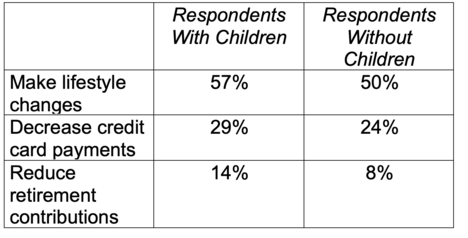
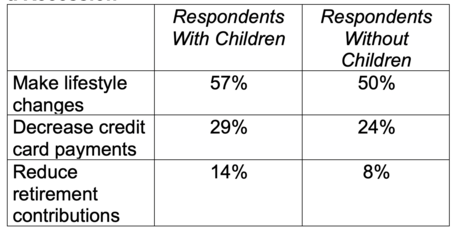
Parents are also willing to be more aggressive about steps they would take to maintain stability in a recession. Most notably, they are almost twice as likely as those without children to reduce their retirement savings contributions.
Actions Respondents Would Take in the Event of a Recession
“The middle class may feel uncertain, but the future isn’t bleak for them,” concluded Rick. “They have long been the backbone of the American economy and have shown remarkable resilience in the face of some real challenges. The key is using your current stability to plan for the future. Think of it as piloting a plane. You don’t wait until you’re flying through a storm to act; you plan, train and assess your flight path long before you ever leave the ground. Proactivity mitigates risk.”
These findings are from a CUNA Mutual Group survey assessing 1,288 U.S. adults ages 18 or older and making an annual income of $35,000 to less than $100,000. The survey was fielded in May 2019.