

MADISON, Wis.–Credit union performance data through June, the third full month of the COVID-19 pandemic, show new auto loan balances with their biggest negative reading since the summer of 2011, overall loan balance growth significantly below the pace set over the past five years (but with growth in mortgages), the loss of more than 100 credit unions in the first half of the year, and membership growing at half the pace of one year earlier.
The numbers were released as part of CUNA Mutual’s most recent Trends Report, which includes CU data for the first half of 2020.
Here's a look at how the Trends Report indicates credit unions performed per category:
Total Credit Union Lending
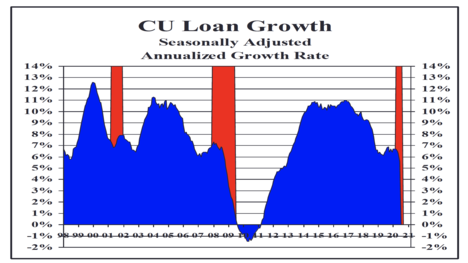
Credit union loan balances rose 0.5% in June, lower than the 0.7% pace reported in June 2019, due to slower growth in new-auto loans (-0.3% vs 0.1%) and credit card loans (-0.6% vs 0.6%), reported CUNA Mutual, noting June typically records the fastest loan growth of the year, with seasonal factors adding 0.39 percentage points to the underlying trend growth.
Credit union loan balances grew at a 5.6% seasonally-adjusted, annualized growth rate in June, significantly below the pace set over the last five years, according to the Trends Report.
“We are forecasting below trend credit union loan growth for the next few years due to the COVID-9 pandemic, little pent-up demand for durable goods and high levels of labor market uncertainty,” CUNA Mutual said in its analysis. “With mortgage loans currently making up 44% of all loans and with mortgage balances growing 13.4% during the last 12 months, multiplying these two numbers together contributes 5.9 percentage points to total loan growth, which makes up 92% of the 6.4% total loan growth.”
Credit Union Consumer Installment Credit (CUCIC)
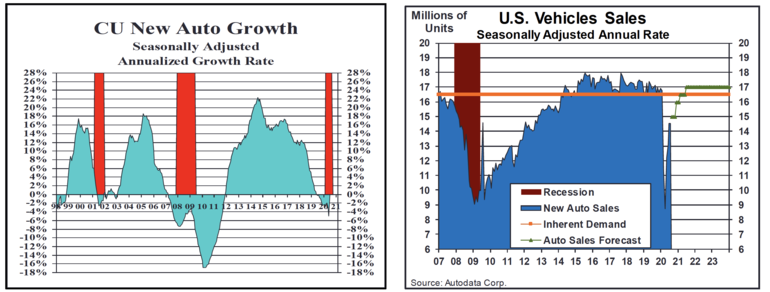
Credit union consumer installment credit loan balances (auto, credit card and other unsecured loans) rose 0.4% during the 12 months ending in June, below the 0.7% pace reported by all other lenders, the Trends Report states. Credit card growth has been decelerating lately, falling at a 9% seasonally-adjusted annualized growth rate the report added.
Vehicle Loans
Credit union new-auto loan balances fell at a 5% seasonally-adjusted, annualized growth rate in June, the biggest negative reading since the summer of 2011, according to the Trends Report. On a month-over-month basis, new-auto loan balances decreased 0.3% in June, slower than the 0.1% gain reported in June 2019, CUNA Mutual said.
“June’s seasonal factors usually add 0.5 percentage points to the underlying trend growth rate and June typically has the second largest season factor of the year. May through October is considered the new-auto buying and lending season,” the report states. “Credit union new-auto loans currently make up 38% of total auto loans, with used-auto loans making up the other 62%. Used-auto loan balances rose 1.4% in June, twice the 0.7% pace reported in June 2019. A typical used-auto loan is originated at roughly half the dollar amount of a new-auto loan.”

Real Estate Secured Lending – First Mortgages and Other Real Estate
Credit union fixed-rate first mortgage loan balances grew 1% in June, slower than the 1.1% reported in June 2019. A year-to-date growth comparison shows a 7.3% growth rate during the first half of 2020, up when compared to the 3.4% in 2019, the Trends Report states.
Adjustable-rate first mortgage loan balances reported 7% growth during the first half of 2020, up from 1% during the similar period last year. The report notes credit unions now hold $506 billion of first mortgages on their books, which are 4.5% of the entire mortgage market, up from 4.3% in June 2019. All credit union real estate loans grew 10.4% over the last year, faster than the 6.9% pace set in 2019.
“The housing market remains constrained by a limited supply, with only four months’ supply of homes on the market. Housing demand should be buoyed by lower mortgage financing costs via the recent 64 basis point decline in mortgage rates over the last year,” the report states. “Supply-side pressures will take some wind out of potential homebuyers’ sails with existing-home inventories still near multidecade lows weighing on housing affordability. Expect existing home sales to fully recover to prepandemic levels by the second half of 2022.”
Surplus Funds (Cash + Investments)
Credit union surplus funds as a percent of assets rose to 31% in June, up from 25.1% in June 2019, as surplus funds rose 42.5% over the last year while assets grew 15.5%. This is the fastest growth in credit union liquidity since the first quarter of 2002 when surplus funds rose 42.7% due to the S&P 500 stock market Index falling to 1,067.
The stronger growth in credit union savings over the last year resulted in credit unions relying less on wholesale borrowings, which fell by $4 billion, or a drop of 7.4%, CUNA Mutual reported. Credit unions’ capital balances increased by $15.2 billion, 8.9%, during the last 12 months. The credit union movement’s capital-to-asset ratio fell to 10.5%, below the 10.5% reported in June 2019, due to capital growing slower than assets.
CUNA Mutual noted the obverse of the surplus funds ratio is the loan-to-asset ratio, which reached 65% in June, below the 70.5% reported in June 2019. Credit unions can expect downward pressure on asset yields over the next year as the lower rate investment portfolio grows faster than the loan portfolio, the report forecasts.
Savings & Assets
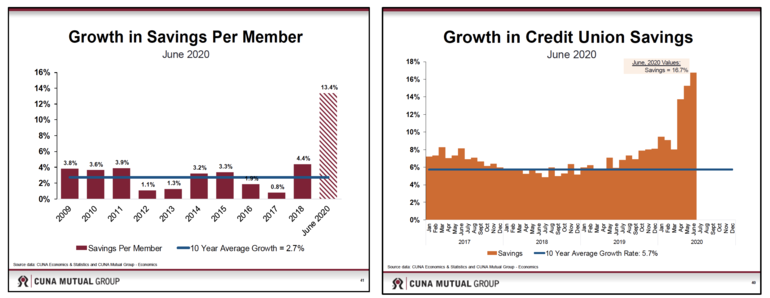
Credit union savings balances grew 16.7% during the 12 months ending in June, almost three times faster than the 5.7% average annual growth rate recorded during the last 10 years, according to the Trends Report. The 16.7% credit union savings growth rate was caused by the combination of the 3% membership growth during the last 12 months and the 13.4% savings-per-member growth rate.
Capital and Other Key Measures
The Treasury yield curve shifted down to record lows over the last six months Interest rates on the three-month Treasury bill fell 144 basis points to 0.12%, while 30-year Treasury bond interest rates fell 114 basis points to 1.25%, the Trends Report notes.
“With short-term interest rates falling 30 basis points more than long-term interest rates during the last six months, the yield curve steepened slightly,” the Trends Report stated. “Normally this would put upward pressure on credit unions’ net interest margins. But the surge in deposits and short-term investments will put downward pressure on credit union net interest margins for the next 18 months due to investment yields falling to record lows.”
According to the Trends Report, credit union loan-to-share ratios fell to 76.3% in June, down from 83.7% one year earlier. Loan-to-asset ratios reached 65% in June, down from 70.5% one year earlier, which will depress net interest margins which are already experiencing downward pressure from the record low yield curve, the report added.
Number of Credit Unions
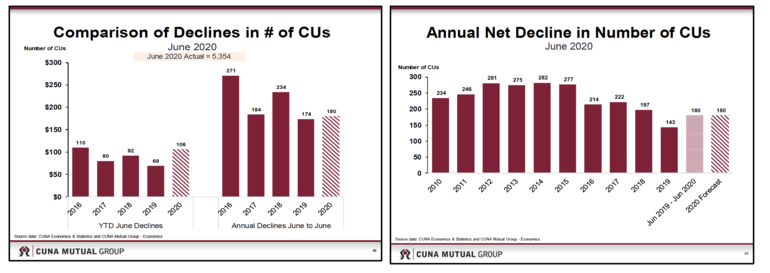
As of June 2020, CUNA estimates 5,354 credit unions were in operation, 15 fewer than May and 180 fewer than June 2019. During the first half of 2020, approximately 106 credit unions ceased to exist because of mergers, purchase and assumptions or liquidation, according to the Trends Report.
“During a typical year, 46% of the total decline in the number of credit unions takes place in the first half of the year, which means that we can estimate the 2020 full year decline in the number of credit unions to be 230, above the 143 reported in 2019,” CUNA Mutual said in its analysis. “However, my official forecast is for a decline of 180 credit unions in 2020. The average asset size of a credit union now stands at $312.4 million, up 11.7% from a year ago, while the median asset size is $37.5 million, up 7.4% over the last year, indicating larger credit unions growing faster than their smaller counterparts.”
Credit Union Membership
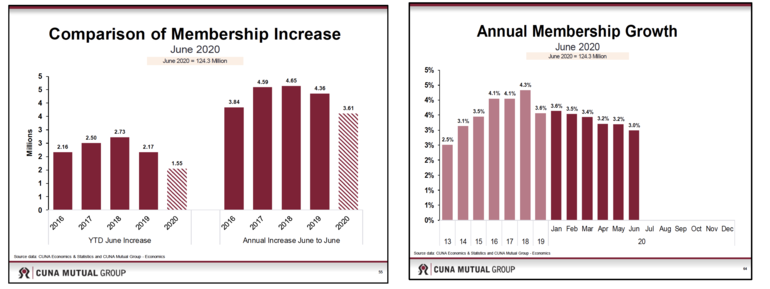
Credit union memberships grew 242,000 in June (0.2%) which is below the 471,000 new members (0.39%) added in June 2019, according to the Trends Report.
Total credit union memberships have now reached 124.3 million – 37.6% of the total U.S. population of 331 million.
“Last June, 36.6% of the U.S. population belonged to a credit union. The membership gain was driven by demand for credit by the American consumer and the 4.8 million jobs added to the U.S. economy in June, according to the Bureau of Labor Statistics,” CUNA Mutual stated. “Year-to-date, credit unions added 1.66 million new members, slower than the 2.17 million members added in the similar period in 2019.”
The Trends Report further noted year-over-year memberships have increased at a 3% pace, faster than the 0.8% population growth.
“We expect the economy to slowly reopen this fall and therefore bring back millions of jobs in 2020 and 2021, contributing to a credit union membership growth rate of 2% in 2020 and 2.5% in 2021,” the Trends Report forecast.