

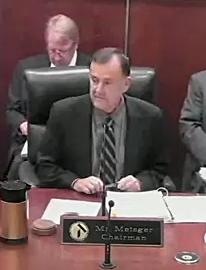
Rick Metsger
ALEXANDRIA, Va.–You’re not reading this article in a physical newspaper, and that’s all you need to know about why credit unions need updated field of membership rules, according to NCUA Chairman Rick Metsger.
Prior to voting in favor—along with Board Member Mark McWatters—of updated new field of membership rules for credit unions, Metsger said it’s important to put the board’s actions into “historical context.”
As he has in remarks before other audiences this year, Metsger noted the Federal Credit Union Act was passed in 1934 during the Great Depression to enable credit unions to be a “source of credit for provident and productive purposes, especially for people of modest means.”
“The common bond requirement is not an end in itself, but a means to an end, providing safe access to our system of cooperative credit,” continued Metsger, who has championed updated FOM rules as a personal cause since he joined the board.
Metsger noted that unlike 1934 most Americans today have 30-year mortgages that cover 80% or more of their homes’ values, and that many of the technologies used today, such as ATMs and smartphones, were unimaginable more than 80 years ago.
(Despite that, the board did not include in its new FOM rules a provision that would have allowed online communities to qualify as a basis for a field of membership.)
But beyond just technological changes, Metsger said there has been a significant change in employments in the U.S. since the 1930s.
“Lots of companies have pulled out of communities and job growth has been increasingly driven by small businesses,” he said, citing Christmas Valley in his home state of Oregon as a place in which people must drive more than 100 miles roundtrip now to access financial services. “The Federal Credit Union Act had not kept up with these workplace changes. (The Credit Union Membership Access Act) explicitly allowed credit unions to have multiple common bonds, including those businesses too small to form their own credit unions and serve their employees. Congress also authorized three types of community charters, and gave the NCUA broad authority to define the meaning of those terms…It’s important that Congress called this the Credit Union Membership Access Act. This demonstrates congressional intent. Its purpose was to facilitate access to a national system of not-for-profit cooperative credit.”
While the board nixed provisions that would have allowed online communities to qualify as a basis for FOM, Metsger seemed to indicate it’s an issue the agency may revisit in the future. He noted that today people visit branches just once every four months on average, down from an average of visiting twice per month.
“Consumers in 2016 are more likely to use mobile banking than visit a branch,” he said. “That’s a huge change.”
NCUA received more than 11,000 comment letters on the FOM proposal, including many from bankers critical of any expansion. But Metsger said Congress has given NCUA a “mandate” to act, and said that of the letters it did receive from both political parties and both chambers of Congress, all were supportive of the agency’s role.
“None of the changes proposed pose a risk to the safety and soundness of credit unions,” said Metsger. “No credit union has ever failed because its FOM was too large. But some have failed because their FOM was too small. It’s often said that states are the petri dishes of federal policy. Many of these changes have been successfully implemented years or even decades ago without adverse consequences at the state level. These are not risky actions.”