MADISON, Wis.–Credit unions added a whopping 463,000 memberships in January, significantly above the 209,000 gain recorded in January 2017, while a forecast is projecting that already strong loan growth will only continue this year.
Meanwhile, credit union borrowings grew $15.3 billion in January, the biggest one-month gain in credit union history, in order to take advantage of a recent riskless arbitrage profit opportunity, according to the CUNA Mutual Trends Report for January of 2018.
Here’s a look at credit union performance by category.
Total Credit Union Lending
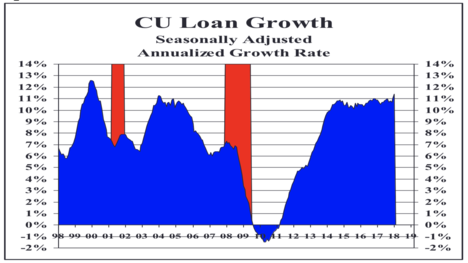
Credit union loan balances rose 0.7% in January, better than the 0.6% pace reported in January 2017, and 10.9% during the last 12 months. Credit union seasonally-adjusted annualized loan growth reached 11.4% in January 2018, the fastest pace since January 2004, CUNA Mutual said.
“This latest credit cycle boom has not yet reached its apex and looks capable of moving into its fifth year of double-digit loan growth,” the Trends Report states in its analysis. “Why is this credit boom so sustainable? Three words: faster membership growth. Credit union membership growth during the last four years has exceeded 3%, compared to only 1% annual membership growth in 2004-2005, the last time loan growth exceeded 10%.”
Credit Union Consumer Installment Credit (CUCIC)
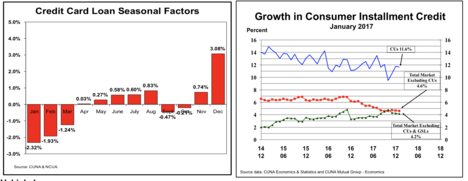
Credit union consumer installment credit balances (auto, credit card and other unsecured loans) rose 1% in January, similar to the 1.1% pace set in January 2017, due to strong auto lending offsetting falling credit card balances. January’s credit card loan seasonal factors are typically the most negative of the year at 2.32%, according to the Trends Report. Credit union consumer installment credit grew 11.6% during the last year, bucking the downward trend of the total market excluding credit unions, which grew only 4.6%. Credit unions now make up 11.2% of the consumer loan market, up from 10.5% a year ago.
Vehicle Loans
Credit union used auto loan balances rose 1.2% in January, faster than the 0.9% pace set in January 2017, and rose 12.4% during the last 12 months. But on a seasonally-adjusted annualized basis, used auto loan balances rose at a very robust 14.7% in January, the Trends Report notes, a rapid acceleration from just six months ago and the fastest pace since January 1997.
Real Estate Secured Lending – First Mortgages and Other Real Estate
Credit union first mortgage originations slowed to $141.5 billion in 2017, a 2.4% decrease under the record $145 billion in originations in 2016, according to CUNA Mutual. Credit unions proceeded to sell off 35.2% of those originations into the secondary market, a lower percentage than the 39.5% in 2016. The stage is set for another strong year of credit union first mortgage growth as rising purchase activity offsets slower refinance business, the Trends Report said.
Surplus Funds (Cash + Investments)
Credit union borrowings grew $15.3 billion in January, the biggest one-month gain in credit union history, in order to take advantage of a recent riskless arbitrage profit opportunity. In December 2017, the Federal Reserve increased the interest rate paid on excess reserves to 1.5%. This created an arbitrage opportunity whereby financial institutions can borrow funds in the short-term interbank credit markets at a lower interest rate, say 1.35%, and deposit the funds into their regional Federal Reserve Bank account earning 1.5%, the Trends Report stated. The principal limiting factor on the amount of credit union borrowings is their quarter-end capital-to-asset ratios.
Borrowings as a percent of assets reached 4.5% in January, up from 3.4% in December 2017. This is close to the record-high borrowing ratio set in January 2009 during the height of the financial crisis, when credit union borrowings made up 4.9% of their balance sheets, according to CUNA Mutual. It further forecast, “With loan growth expected to outpace savings growth in 2018 and liquidity positions already tight, expect credit unions to depend more on borrowings to meet rising loan demand.”
Savings and Assets
Credit union savings balances fell 0.9% in January, below the 0.6% decline reported in January 2017, due to a surge in post-holiday consumer spending. January savings balances have historically declined 0.2% due to recurring seasonal factors.

Credit union savings growth slowed over the last year due to rising stock prices and rising consumer confidence, the Trends Report notes.
“The distribution of credit union savings tilted toward regular shares and share drafts in 2017 as credit union members awaited an increase in the fed funds interest rate, and, soon thereafter, credit union share certificate interest rates."
Meanwhile, as has been the case, credit union asset growth rates vary significantly by asset size. Billion-dollar credit unions reported asset growth of 8.5% in 2017, around seven times faster than the smallest credit unions’ growth rate of 1.2%, the Trends Report points out.
Net Income, ROA and More
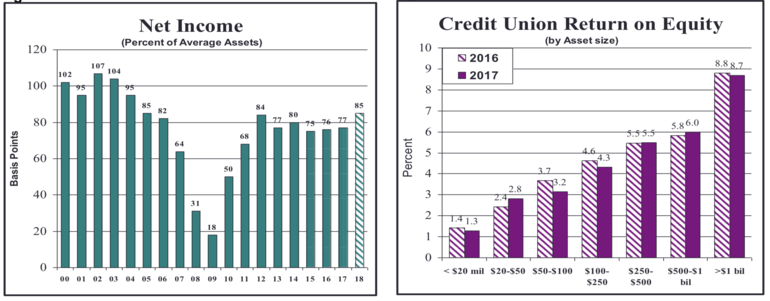
The credit union industry’s net income to average asset ratio, return on assets, rose to 0.77% in 2017, up from 0.76% in 2016.
“A nine-basis-point increase in net interest margins, combined with a three basis point decrease in operating expense ratios, was more than enough to offset a seven-basis-point increase in loan loss provision expense and a four basis point decline in non-interest income,” CUNA Mutual said. “Credit unions with greater than $1 billion in assets increased their loan loss provisions by eight basis points, moving from 0.43% of average assets in 2016 to 0.51% in 2017.”
Return on equity, ROE, ratios fell slightly for most credit unions in 2017 due to slightly higher capital-to-asset ratios in 2017 versus 2016, the report stated.
Credit Unions and Members
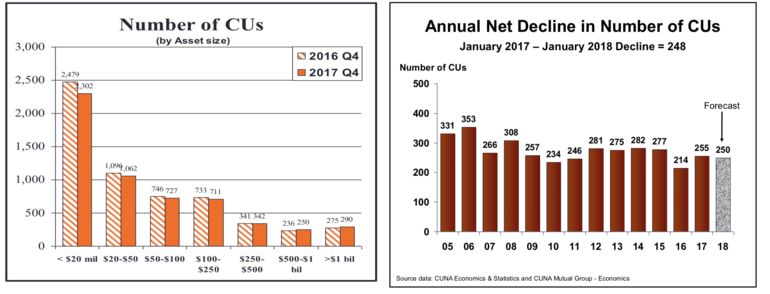
According to the Trends Report, as of January 2018, CUNA estimates 5,758 credit unions are in operation, down 248 from January 2017. Year-end 2017 NCUA call report data shows 290 credit unions with assets in excess of $1 billion.

“They held 63% of the credit union system assets and 65.2% of the loans, while making up only 5.1% of all credit unions,” according to the report. “This is up from 275 billion-dollar credit unions in 2016 holding 61% of assets and 63.1% of loans. The median asset size of a U.S. credit union rose to $31.2 million in 2017, a 7.2% increase from the $29.1 million set in 2016.:
CUNA Mutual is forecasting another 250 credit unions will disappear in 2018.
Meanwhile, credit unions added a whopping 463,000 memberships in January, significantly above the 209,000 gain recorded in January 2017, due to strong credit demand and robust job growth, CUNA Mutual said.
Total credit union memberships reached 114.5 million in January 2018. In percentage terms, credit union memberships rose 0.41% in January and 5.1% during the last 12 months.
“With the economy expected to add another 2.2 million jobs in 2018, credit unions should expect membership growth to exceed 3.5%,” the Trends Report stated.